Natural Selection and Adaptations
Explore the concepts of natural selection and adaptations with this Grade 6 science worksheet. Learn how organisms evolve to survive in their environment.
Includes
Standards
Topics
Natural Selection and Adaptations
Name:
Date:
Score:
Read each question carefully and answer to the best of your ability. Good luck!
1. Which of the following best describes natural selection?
All organisms in a population survive and reproduce equally.
Organisms that are best adapted to their environment tend to survive and reproduce more successfully.
Organisms intentionally choose to change their traits to better suit their environment.
The strongest organisms always survive, regardless of their environment.
2. An adaptation is a trait that helps an organism:
Change its behavior suddenly.
Survive and reproduce in its specific environment.
Look exactly like every other organism in its species.
Migrate to a completely different habitat.
3. The process by which organisms that are better adapted to their environment tend to survive and produce more offspring is called .
4. A physical or behavioral characteristic that helps an organism survive in its environment is called an .
5. All adaptations are developed by an individual organism during its lifetime.
True
False
6. A chameleon changing its skin color to match its surroundings is an example of an adaptation.
True
False
7. Imagine a population of rabbits in a snowy environment. Some rabbits are white, and some are brown. Explain how natural selection might affect the rabbit population over time.
8. Look at the image of the finch beaks below. Different beak shapes are adaptations for different food sources. Match each beak type to the food it is best suited for by writing the correct letter in the blank.
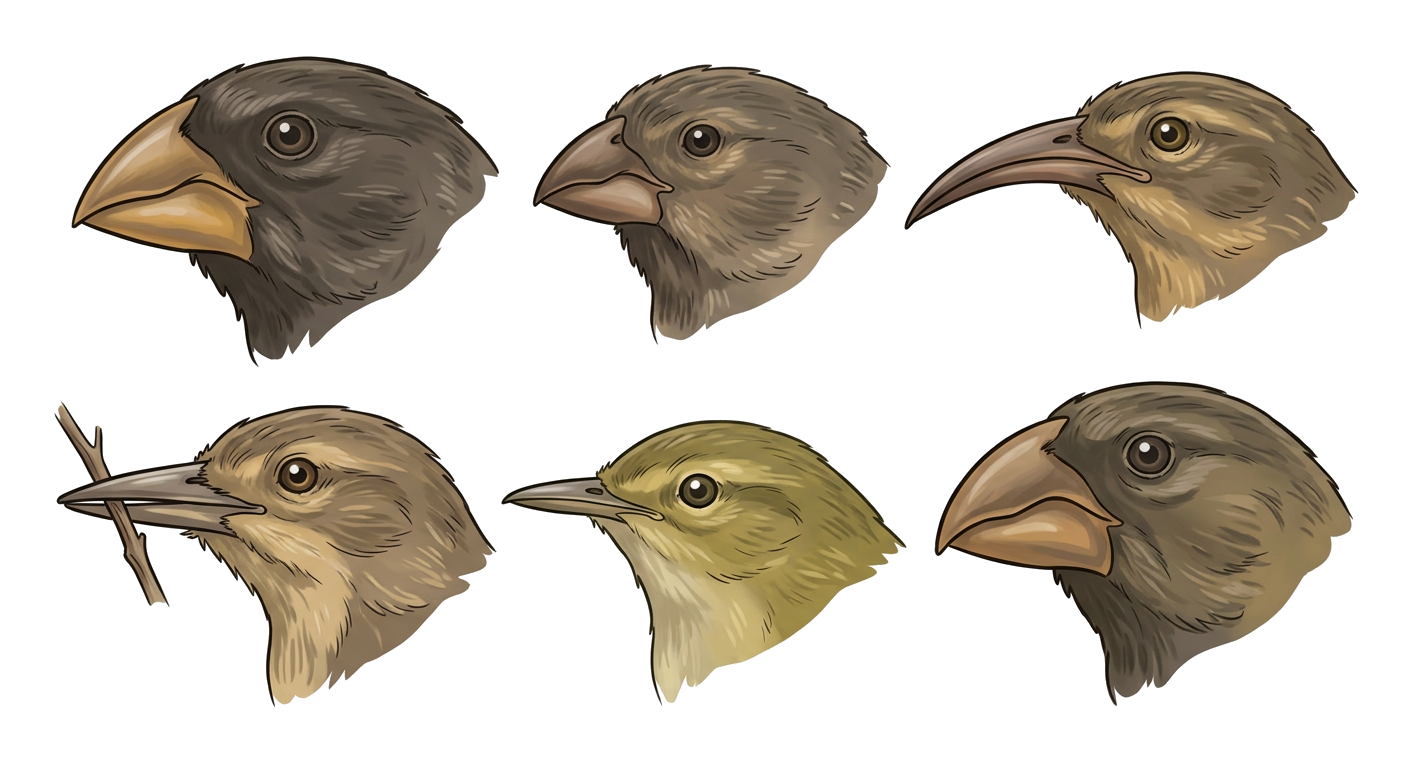
A. Large Ground Finch Beak
i. Eating small, soft seeds
B. Cactus Finch Beak
ii. Cracking large, hard seeds
C. Warbler Finch Beak
iii. Probing for nectar in cactus flowers