Particle Model of Matter
Explore the particle model of matter, understanding the arrangement and movement of particles in solids, liquids, and gases.
Includes
Standards
Topics
Particle Model of Matter
Name:
Date:
Score:
Read each question carefully and answer to the best of your ability. This worksheet will test your understanding of the particle model of matter.
1. In which state of matter are particles tightly packed and vibrate in fixed positions?
Liquid
Solid
Gas
Plasma
2. Which state of matter has particles that are far apart and move randomly?
Liquid
Solid
Gas
All of the above
Observe the image below showing the particle arrangement in different states of matter.
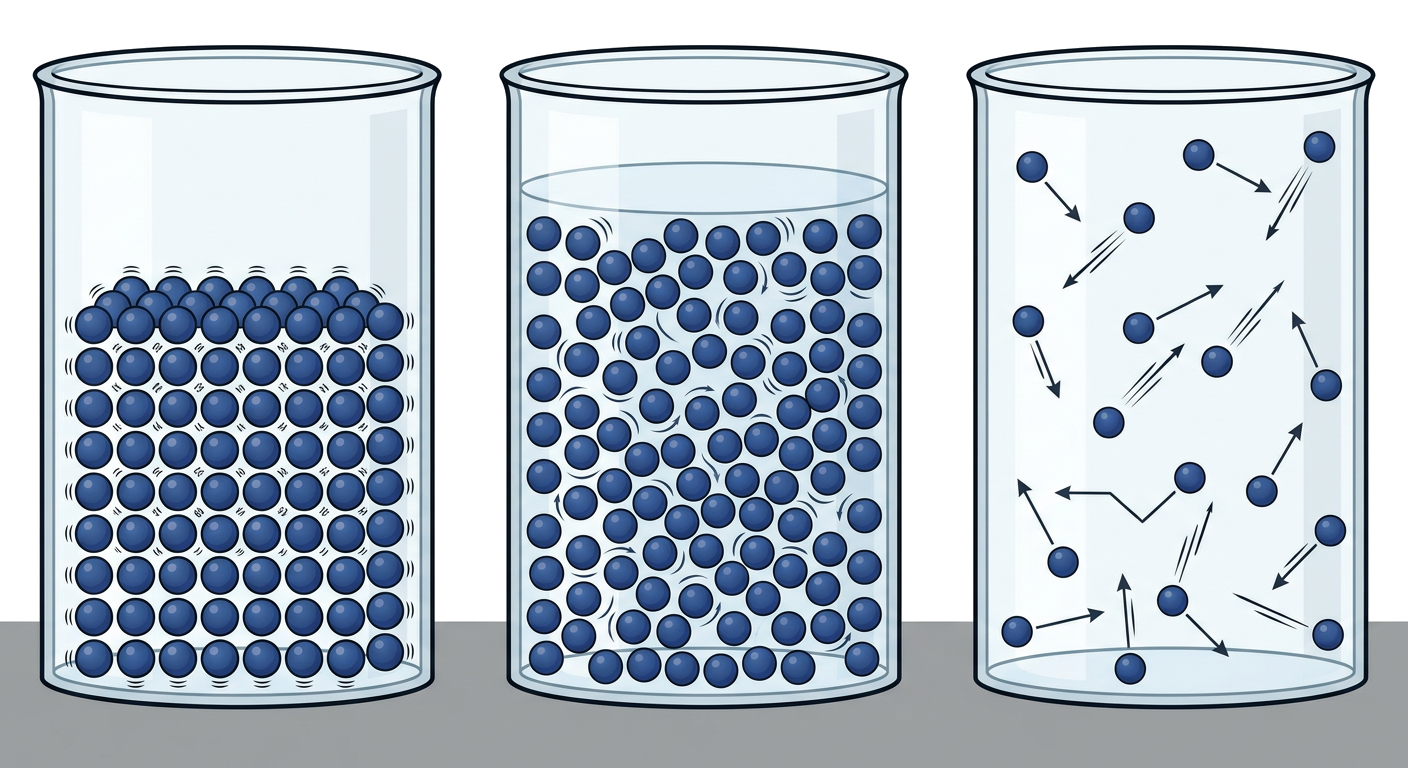
1. In a solid, particles have a fixed and vibrate in place.
2. Liquids take the shape of their container because their particles can past each other.
3. Gases have no fixed shape or because their particles are far apart and move freely.
1. When a substance melts, its particles gain energy and move closer together.
True
False
2. Evaporation is the process where a liquid turns into a gas.
True
False
1. Describe the main differences in particle arrangement and movement between a liquid and a gas.
2. Explain what happens to the particles of a substance when it condenses.
Related Worksheets
Understanding Wave Action
A Grade 6 science worksheet covering the basics of wave action, including types of waves, their properties, and how they interact with their environment.
Thermal Energy Worksheet
Explore thermal energy, heat transfer, and states of matter with this Grade 6 science worksheet.
Grade 6 Science: Graphing Basics
A worksheet for 6th-grade students to practice interpreting and creating various types of graphs, aligning with NGSS standards.
Electricity Basics Worksheet
Explore the fundamental concepts of electricity, circuits, and conductors with this Grade 6 science worksheet.
Understanding Waves Worksheet
Explore the basics of waves, including their types, properties, and how they transfer energy, suitable for Grade 6 science students.
Understanding Light Refraction
Explore the bending of light as it passes through different mediums with this engaging Grade 6 science worksheet on refraction.
Net Force and Acceleration
Explore the concepts of net force and acceleration with this Grade 6 science worksheet, featuring questions on balanced and unbalanced forces, and their effect on motion.
Light Energy Exploration
Explore the fascinating world of light energy with this comprehensive worksheet for Grade 6 science students. Learn about reflection, refraction, and the properties of light.