Movement at Joints Worksheet
Explore the different types of joints in the human body and their functions with this comprehensive Grade 7 science worksheet.
Includes
Standards
Topics
Movement at Joints
Name:
Date:
Score:
Read each question carefully and answer to the best of your ability. Refer to the diagram of the human skeleton to help you answer some questions.
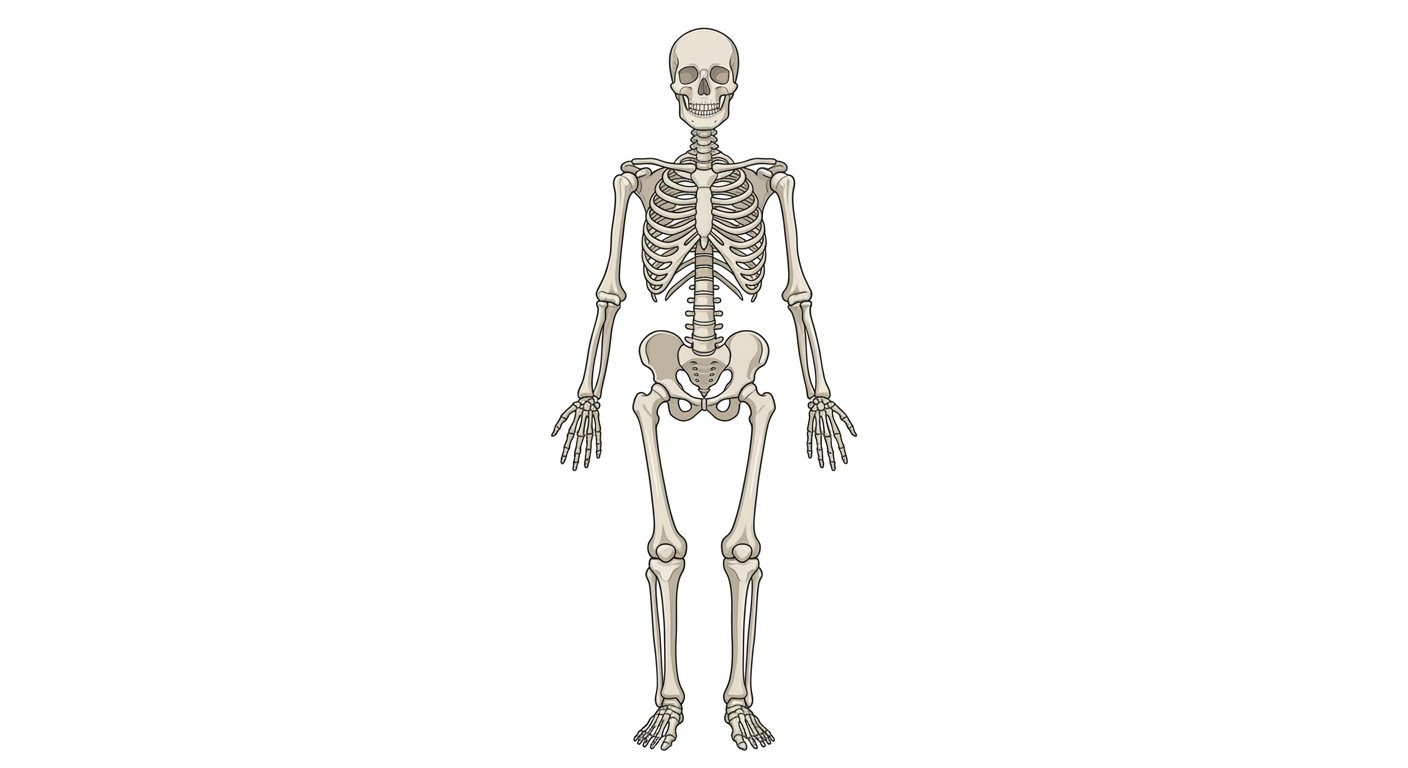
1. Which type of joint allows for the widest range of motion, like in the shoulder and hip?
Hinge joint
Ball-and-socket joint
Pivot joint
Fixed joint
2. The knee and elbow are examples of which type of joint?
Ball-and-socket joint
Gliding joint
Hinge joint
Saddle joint
3. The bones in your skull are connected by joints, which allow no movement.
4. The joint in your neck that allows you to turn your head from side to side is a joint.
5. is the connective tissue that covers the ends of bones at a joint, reducing friction.
6. Ligaments connect bones to muscles.
True
False
7. Synovial fluid helps to lubricate joints and reduce friction.
True
False
8. Describe the main function of a joint in the human body.
9. Provide an example of a gliding joint and explain how it allows movement.
Use the words below to complete the sentences.
10. connect muscles to bones.
11. acts as a shock absorber between bones.
12. are strong bands of tissue that hold bones together at a joint.
Related Worksheets
Muscles of the Leg Worksheet
A Grade 7 science worksheet focusing on the major muscles of the human leg, their functions, and identification.
Six Kingdoms of Life Worksheet
Explore the characteristics and classification of the six kingdoms of life with this engaging worksheet for Grade 7 science students.
Six Kingdoms of Life Worksheet
Explore the characteristics and classification of the six kingdoms of life with this engaging worksheet for Grade 7 science students.
Human Decomposition: The Science of Decay
Explore the stages of human decomposition, the factors that influence it, and the roles of scavengers and microorganisms in this Grade 7 Science worksheet.
Feedback Loops in Science
Explore the concepts of positive and negative feedback loops in biological and environmental systems.
Humerus Bone Worksheet
Explore the anatomy and function of the humerus bone with this Grade 7 science worksheet.
Invertebrate Animals Worksheet
Explore the fascinating world of invertebrate animals with this worksheet, covering their characteristics, classifications, and examples.
Frog Dissection Worksheet
A worksheet covering the external and internal anatomy of a frog for grade 7 science students.