Flame Test Worksheet
Explore the principles of flame tests and how different metal ions produce characteristic colors when heated in a flame.
Includes
Standards
Topics
Flame Test Worksheet
Name:
Date:
Score:
Read each question carefully and answer to the best of your ability. For multiple-choice questions, circle the correct option. For fill-in-the-blank questions, write your answer on the line provided. For short-answer questions, use the lines provided to explain your answers.
1. What causes the different colors observed in a flame test?
The temperature of the flame.
The type of fuel used in the burner.
Electrons moving between energy levels in metal ions.
The presence of oxygen in the air.
2. Which metal ion typically produces a bright red color in a flame test?
Sodium
Lithium
Potassium
Copper
3. The flame test is used to identify the presence of specific in a sample.
4. When a metal ion is heated in a flame, its electrons jump to a higher level.
5. As the electrons fall back to their original energy levels, they emit , which we see as colored light.
6. Describe the general procedure for conducting a flame test. What safety precautions should be taken?
7. Explain why different metal ions produce different colors in a flame test, even when heated in the same flame.
8. All metals produce a characteristic color in a flame test.
True
False
9. The flame test is a qualitative test, meaning it tells us what is present, not how much.
True
False
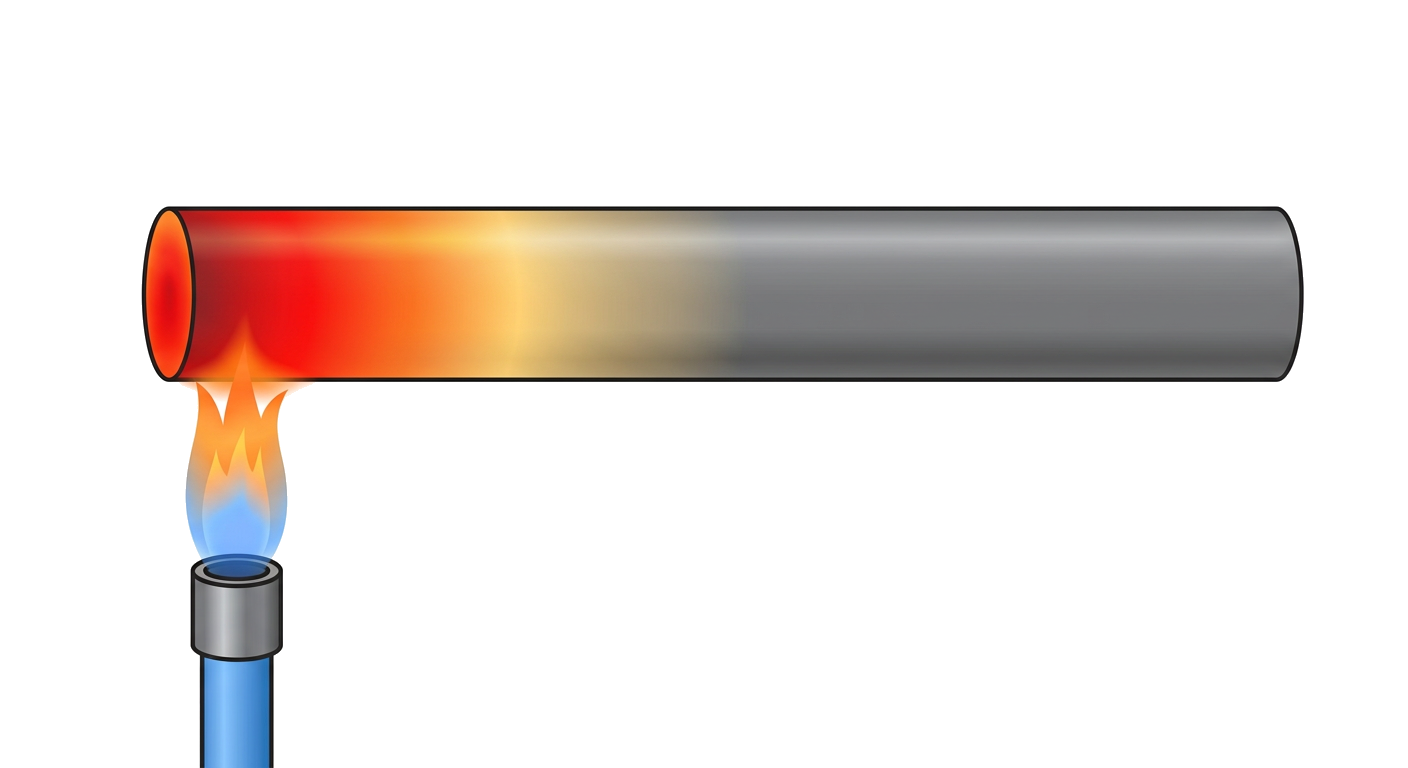
10. Observe the image below of a metal rod being heated in a flame. What is happening to the metal at a molecular level that leads to the observation of color?