Ionic Compounds Worksheet
Explore the fundamentals of ionic compounds, including their formation, properties, and naming conventions, suitable for Grade 7 Science students.
Includes
Standards
Topics
Ionic Compounds Worksheet
Name:
Date:
Score:
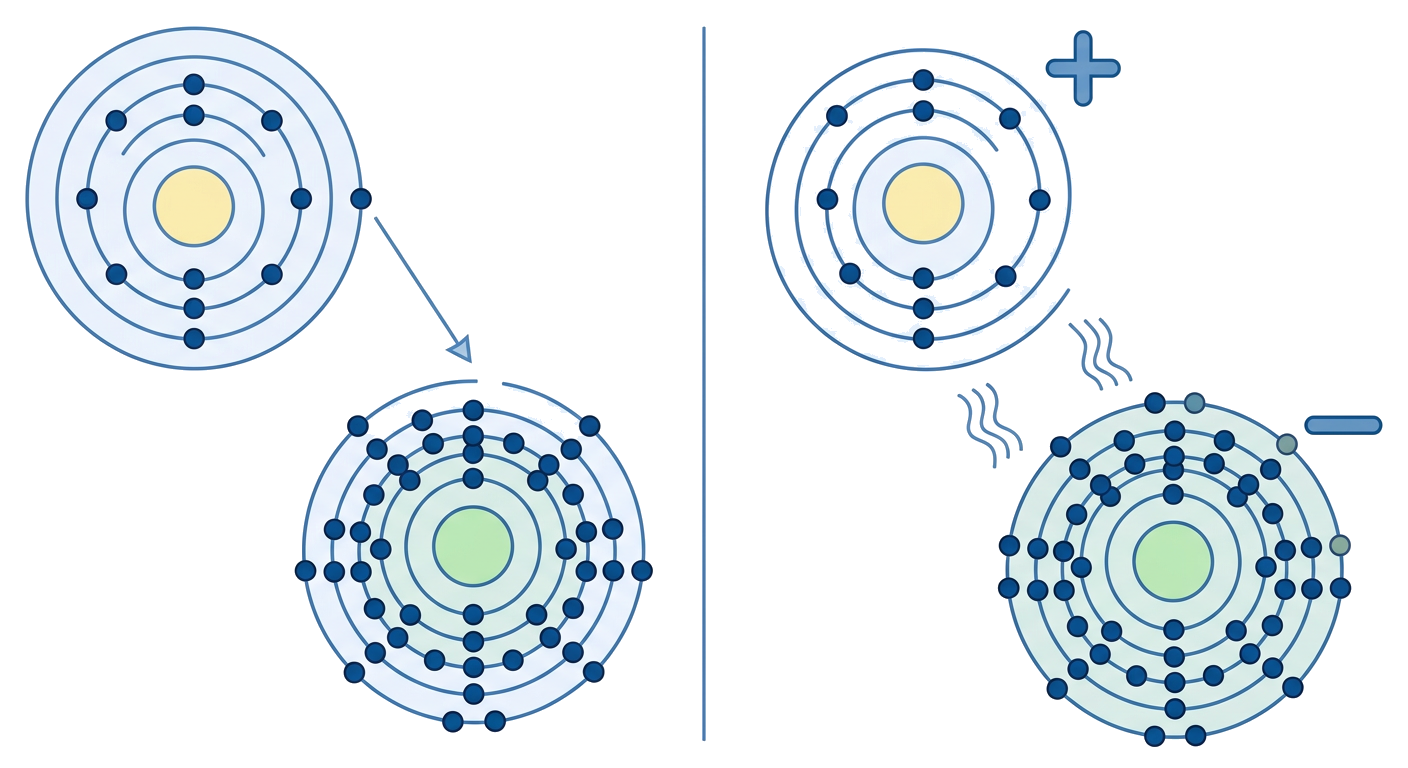
Read each question carefully and answer to the best of your ability. Use the provided illustration to help you understand ionic bond formation.
Observe the illustration below showing the formation of an ionic bond.
1. What type of elements typically form an ionic bond?
Two nonmetals
Two metals
A metal and a nonmetal
A noble gas and a metal
2. What happens to electrons during the formation of an ionic bond?
They are shared
They are transferred
They are destroyed
They remain unchanged
3. An atom that loses electrons becomes a positively charged ion called a .
4. An atom that gains electrons becomes a negatively charged ion called an .
5. Ionic compounds are typically formed between a and a .
6. Ionic compounds usually have low melting and boiling points.
True
False
7. Ionic compounds conduct electricity when dissolved in water or melted.
True
False
8. Describe how a positive ion (cation) and a negative ion (anion) are attracted to each other in an ionic compound.
9. Give two examples of common ionic compounds you might find in your home.
Use the words below to complete the sentences.
10. The force of attraction between oppositely charged ions is called an force.
11. In an ionic bond, electrons are from one atom to another.