Properties of Water Worksheet
Explore the unique properties of water, including its molecular structure, cohesion, adhesion, and density, for 7th-grade science.
Includes
Standards
Properties of Water
Name:
Date:
Score:
Read each question carefully and answer to the best of your ability. Diagrams are provided for some questions to help you visualize the concepts.
1. What property of water allows insects to walk on its surface?
Adhesion
Cohesion
High specific heat
Density
2. Why is water considered a 'universal solvent'?
It has a low boiling point.
It can dissolve many substances.
It is found everywhere on Earth.
It has strong hydrogen bonds.
3. The attraction between water molecules and other substances is called .
4. Water molecules are made up of two atoms and one atom.
5. The property of water that allows it to absorb a lot of heat without a significant change in temperature is called its .
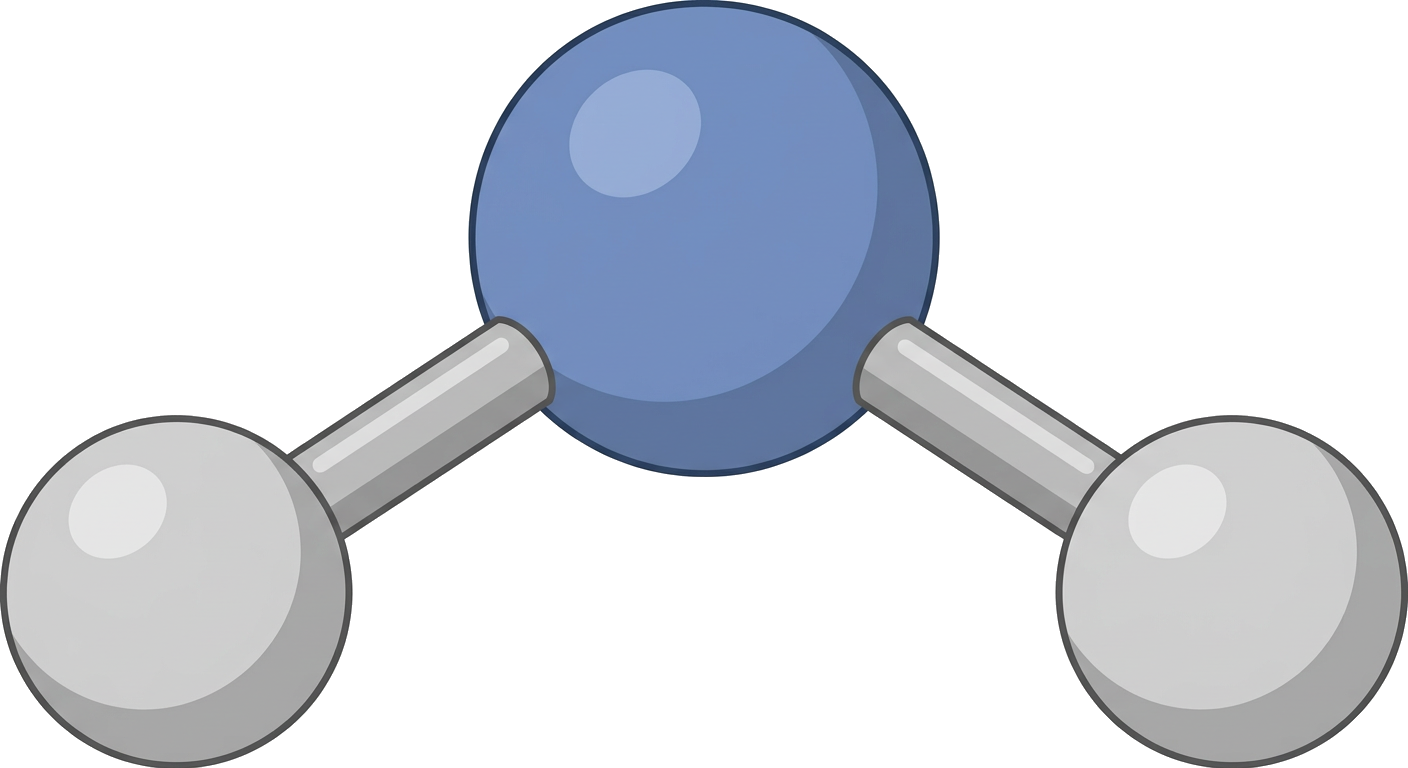
6. Observe the diagram of a water molecule below. Explain why water is considered a polar molecule.
7. Describe two ways the high specific heat of water is beneficial to living organisms.
8. Ice is less dense than liquid water.
True
False
9. Capillary action is a result of both cohesion and adhesion.
True
False
Use the words below to complete the sentences.
10. Water's ability to stick to itself is called .
11. The 'skin' on the surface of water is due to .
12. Because it has a slightly positive and slightly negative end, a water molecule is considered .