Grade 7 Science: Separation Techniques
A worksheet for 7th-grade science students to practice identifying and understanding various separation techniques used in chemistry.
Includes
Standards
Topics
Separation Techniques Worksheet
Name:
Date:
Score:
Read each question carefully and answer to the best of your ability. This worksheet covers various separation techniques used in chemistry.
1. Which separation technique is best for separating insoluble solids from liquids?
Distillation
Filtration
Evaporation
Chromatography
2. Which of the following is used to separate liquids with different boiling points?
Magnetism
Decantation
Distillation
Sieving
1. In chromatography, substances are separated based on their different affinities for the stationary and phases.
2. Filtration uses a to separate solid particles from a liquid.
3. Evaporation is a method used to separate a solid from a liquid solvent.
1. Sieving can be used to separate a mixture of sugar and salt.
True
False
2. Distillation involves heating a liquid to form a vapor and then cooling the vapor to condense it back into a liquid.
True
False
1. Explain how filtration is used to purify water.
2. Describe a real-world application where distillation is used.
Observe the diagram of the distillation apparatus below and answer the questions.
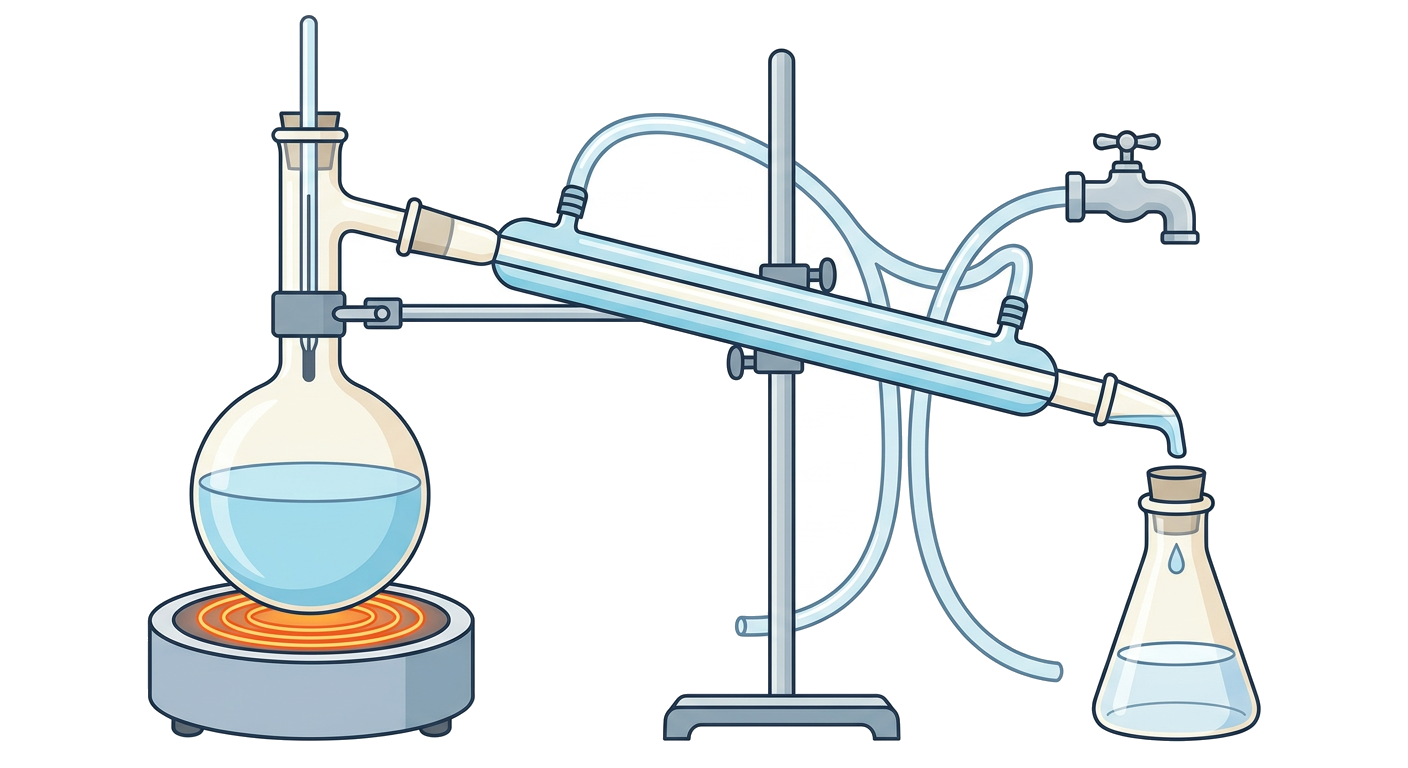
a. What is happening in the flask on the left?
b. What is the purpose of the condenser?
Use the words below to complete the sentences.
1. Separating iron filings from sand can be done using .
2. is a technique that separates components of a mixture by spinning them at high speeds.
3. When a mixture of immiscible liquids is allowed to stand, the denser liquid settles at the bottom, and the top layer can be poured off using .