Grade 7 Science: Parallel Circuits
Explore the fundamentals of parallel circuits, including current, voltage, and resistance, with this engaging worksheet for Grade 7 science students.
Includes
Standards
Topics
Parallel Circuits Worksheet
Name:
Date:
Score:
Read each question carefully and answer to the best of your ability. Show your work where applicable.
What is a Parallel Circuit?
In a parallel circuit, components are connected across the same two points, creating multiple paths for the current to flow. This means that if one component fails, the others can continue to operate.
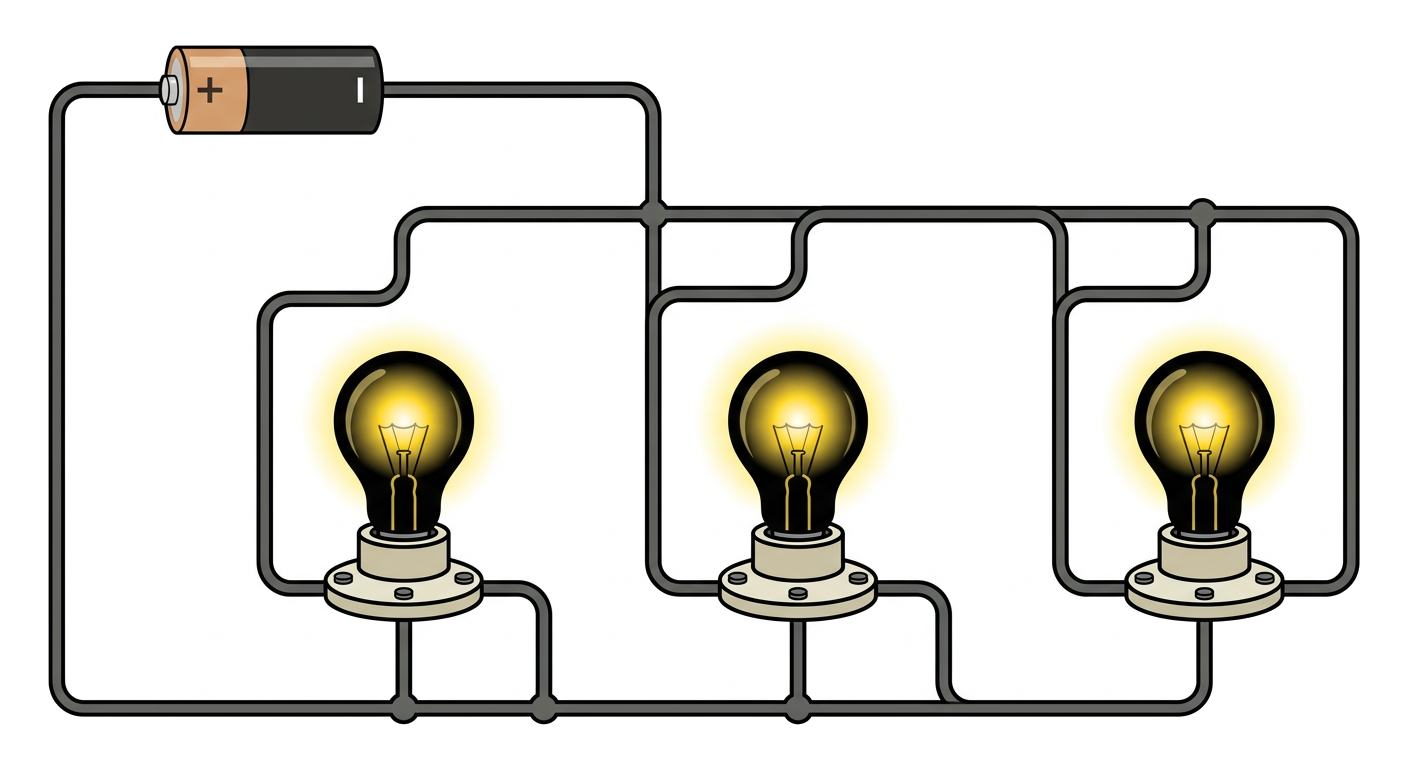
1. Which of the following best describes a parallel circuit?
Components are connected in a single loop.
Current has multiple paths to flow through.
Voltage is divided among components.
The circuit breaks if one component fails.
2. In a parallel circuit, how does the voltage across each component compare?
It is the same across all components.
It is divided equally among components.
It varies depending on the resistance of each component.
It is higher across components with lower resistance.
3. In a parallel circuit, if one bulb burns out, the other bulbs will .
4. The total current in a parallel circuit is the of the currents through each branch.
5. Adding more resistors in parallel the total resistance of the circuit.
6. All components in a parallel circuit share the same voltage.
True
False
7. The current is the same through each branch of a parallel circuit.
True
False
8. Explain why a parallel circuit is often preferred over a series circuit for household wiring.
9. If you have three light bulbs connected in parallel to a battery, and you remove one bulb, what happens to the other two bulbs? Why?