Weather & Seasons: Grade 7 Science
A comprehensive worksheet for 7th-grade science students focusing on weather phenomena, atmospheric conditions, and the causes of seasons.
Includes
Standards
Topics
Weather & Seasons
Name:
Date:
Score:
Read each question carefully and answer to the best of your ability. For multiple-choice questions, circle the letter next to the correct answer. For fill-in-the-blank questions, complete the sentence with the appropriate term. For short answer questions, write your response in the space provided.
1. Which of the following describes the difference between weather and climate?
Weather is long-term atmospheric conditions, while climate is short-term.
Weather refers to daily atmospheric conditions, and climate is the average weather over a long period.
Weather and climate are interchangeable terms.
Climate is caused by human activities, while weather is natural.
2. What causes the Earth's seasons?
The Earth's distance from the sun.
The Earth's rotation on its axis.
The tilt of the Earth's axis as it orbits the sun.
Changes in the sun's temperature.
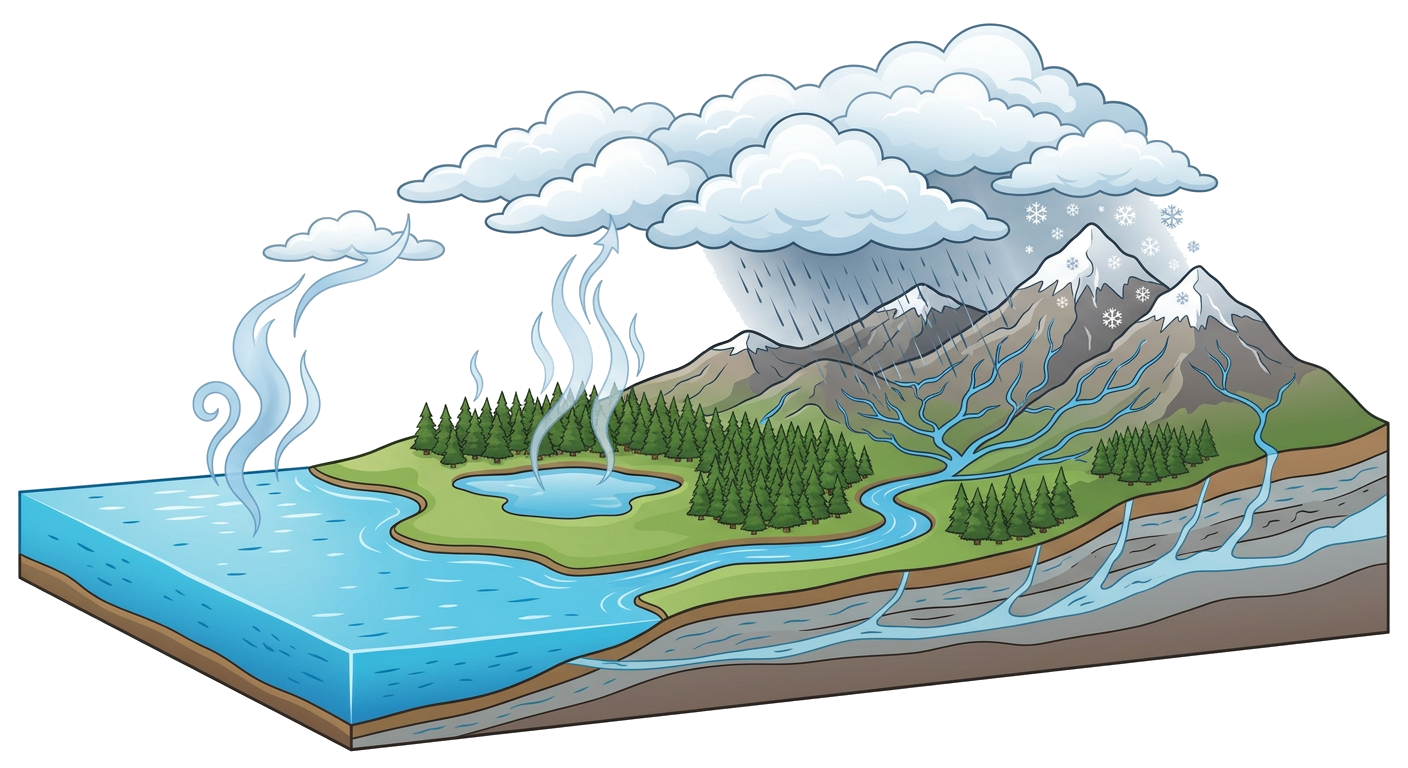
3. The continuous movement of water on, above, and below the surface of the Earth is called the .
4. Air pressure is measured using a .
5. A large body of air that has similar temperature, humidity, and air pressure throughout is known as an .
6. Explain how the water cycle contributes to weather patterns.
7. The greenhouse effect is a process where certain gases in the Earth's atmosphere trap heat, warming the planet.
True
False
8. El Niño is a climate pattern that describes the unusual warming of surface waters in the eastern tropical Pacific Ocean.
True
False
Match each weather phenomenon with its description.
9. Hurricane
a. A violent rotating column of air extending from a thunderstorm to the ground.
10. Tornado
b. A severe tropical storm with strong winds and heavy rainfall.
11. Blizzard
c. A severe snowstorm with high winds and low visibility.
Use the words below to complete the sentences.
12. Heat transfer through direct contact is called .
13. The lowest layer of Earth's atmosphere, where most weather occurs, is the .