Balance in Nature: Ecosystems and Interactions
Explore the intricate balance within natural ecosystems, including food webs, population dynamics, and the impact of human activities.
Includes
Standards
Topics
Balance in Nature: Ecosystems and Interactions
Name:
Date:
Score:
Read each question carefully and answer to the best of your ability. Use complete sentences for short answer questions.
1. Which of the following best describes an ecosystem?
A group of animals living in the same area.
All the living organisms in an area interacting with their non-living environment.
The study of environmental problems.
A collection of different habitats.
2. What is the role of a decomposer in an ecosystem?
To produce their own food.
To consume other organisms.
To break down dead organic matter.
To regulate population sizes.
1. Organisms that produce their own food are called .
2. A shows the feeding relationships between different organisms in an ecosystem.
3. If a population of predators increases, the population of its prey will likely .
1. Explain the difference between a food chain and a food web.
2. Describe one way human activity can disrupt the balance in an ecosystem.
1. All ecosystems contain producers, consumers, and decomposers.
True
False
2. Introduced species always benefit the native species in an ecosystem.
True
False
Examine the food web below and answer the questions that follow.
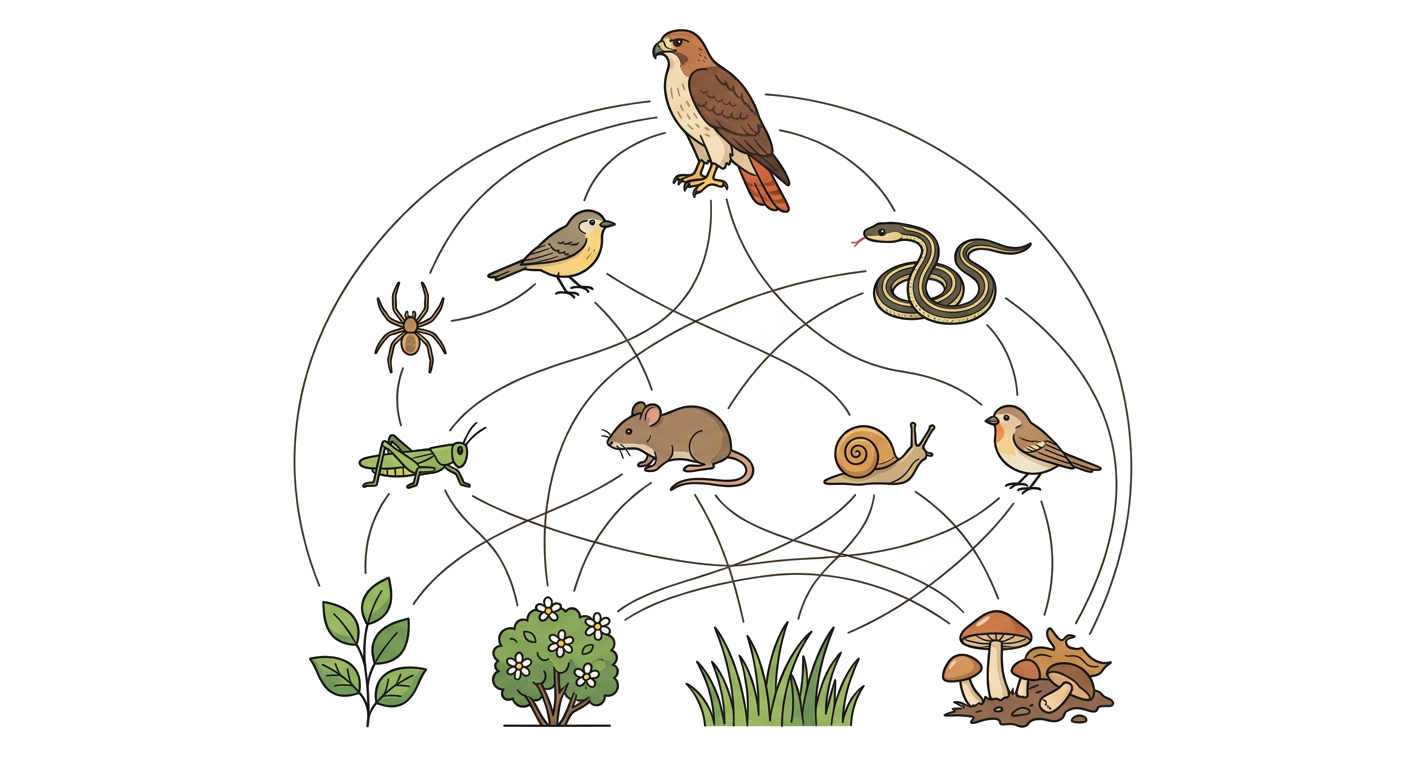
1. Identify two producers in this food web.
2. Name one organism that is both a primary and secondary consumer.
3. What would happen to the hawk population if the snake population significantly decreased? Explain your reasoning.
Related Worksheets
The Human Reproductive System
Explore the structures and functions of the male and female reproductive systems, including key hormones and processes.
Grade 8 Fungi Worksheet
Explore the fascinating world of fungi with this Grade 8 science worksheet covering their characteristics, reproduction, and ecological roles.
Interactions in an Ecosystem
Explore the complex relationships and interactions within ecosystems, including food webs, energy flow, and symbiotic relationships, for Grade 8 Science.
Immune System Basics
An introductory worksheet on the human immune system for 8th-grade science students.
Grade 8 Science: The Human Eye
Explore the anatomy and function of the human eye, including its parts, how vision works, and common eye conditions.
Ecological Relationships Worksheet
Explore ecological relationships including predation, competition, mutualism, commensalism, and parasitism with this Grade 8 Science worksheet.
Grade 8 Taxonomy Worksheet
Explore the principles of biological classification with this Grade 8 Science worksheet on Taxonomy, covering hierarchical ranks, binomial nomenclature, and the characteristics of different kingdoms.
Energy Flow in Ecosystems
Explore the concepts of energy flow, food chains, food webs, and ecological pyramids in ecosystems.