Dichotomous Key Practice
This worksheet helps 8th-grade students practice using dichotomous keys to identify organisms based on their characteristics.
Includes
Standards
Topics
Dichotomous Key Practice
Name:
Date:
Score:
Read each question carefully and use the provided dichotomous key to identify the organisms or answer the questions. A dichotomous key is a tool that allows the user to determine the identity of items in the natural world, such as trees, wildflowers, mammals, reptiles, rocks, and fish.
Dichotomous Key for Imaginary Creatures:
1a. Creature has wings .............................................................. go to 2 1b. Creature does not have wings .......................................... go to 3 2a. Creature has feathers ..................................................... Flier 2b. Creature has leathery wings .......................................... Glider 3a. Creature has more than 4 legs ....................................... Crawler 3b. Creature has 4 legs or less ............................................ go to 4 4a. Creature has fur ............................................................ Prowler 4b. Creature has scales ..................................................... Slider
1. According to the key, a creature with leathery wings would be identified as a:
Flier
Glider
Crawler
Prowler
2. Which characteristic would lead you to identify a creature as a 'Crawler'?
Has feathers
Has fur
Has more than 4 legs
Does not have wings
3. A creature that has wings and feathers would be classified as a .
4. If a creature does not have wings and has scales, you would identify it as a .
5. Describe the purpose of a dichotomous key in scientific classification.
6. Each step in a dichotomous key typically offers three choices.
True
False
Use the image below and the following key to identify the type of leaf shown.
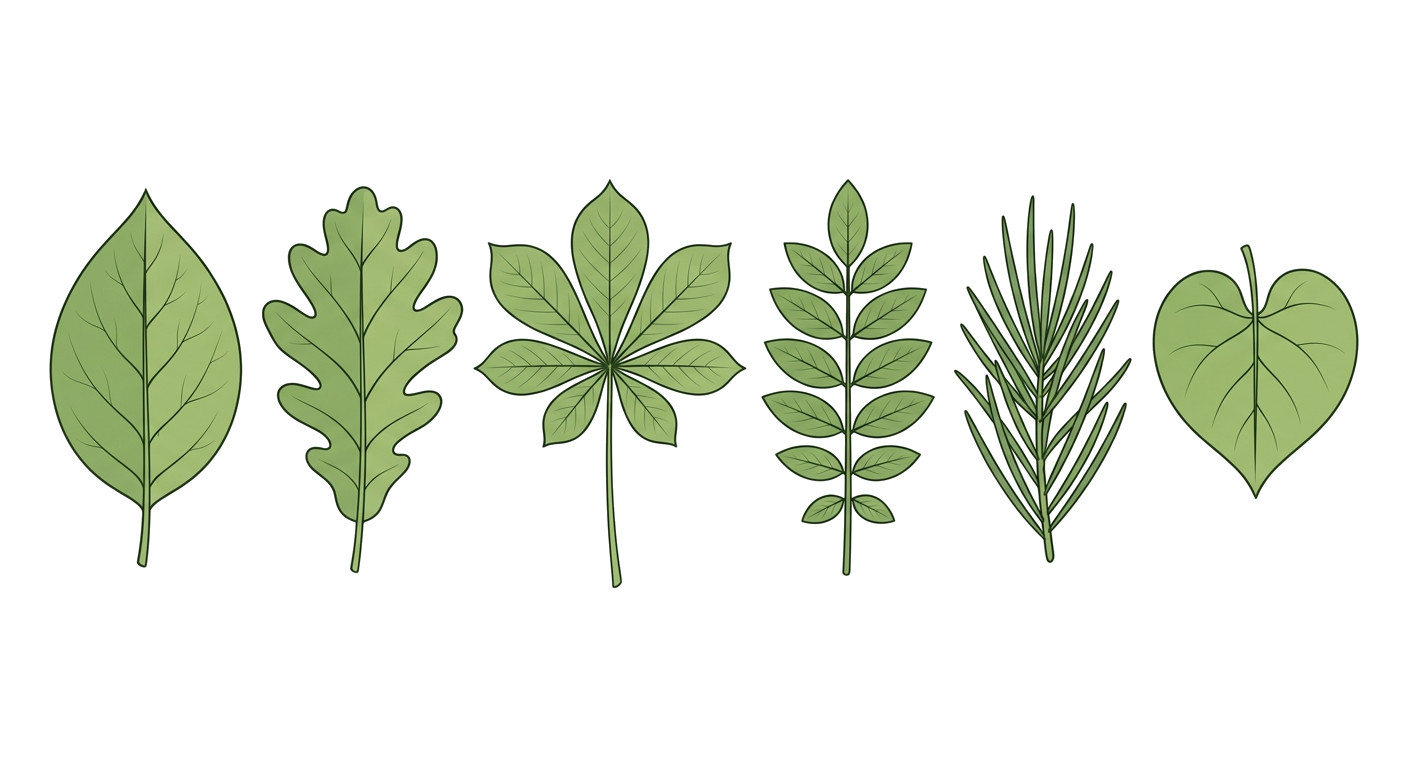
Dichotomous Key for Leaf Identification: 1a. Leaf is simple (one blade per petiole) .............................. go to 2 1b. Leaf is compound (multiple leaflets per petiole) ............ go to 4 2a. Leaf margin is smooth ................................................ Entire 2b. Leaf margin is toothed or lobed ................................... go to 3 3a. Leaf margin is toothed ............................................... Serrated 3b. Leaf margin is deeply lobed ........................................ Lobed 4a. Leaflets are arranged along a central stem .................... Pinnately Compound 4b. Leaflets radiate from a single point .............................. Palmately Compound
7. Based on the key and the image, what type of leaf is the maple leaf shown?
Related Worksheets
The Human Reproductive System
Explore the structures and functions of the male and female reproductive systems, including key hormones and processes.
Grade 8 Fungi Worksheet
Explore the fascinating world of fungi with this Grade 8 science worksheet covering their characteristics, reproduction, and ecological roles.
Interactions in an Ecosystem
Explore the complex relationships and interactions within ecosystems, including food webs, energy flow, and symbiotic relationships, for Grade 8 Science.
Immune System Basics
An introductory worksheet on the human immune system for 8th-grade science students.
Grade 8 Science: The Human Eye
Explore the anatomy and function of the human eye, including its parts, how vision works, and common eye conditions.
Ecological Relationships Worksheet
Explore ecological relationships including predation, competition, mutualism, commensalism, and parasitism with this Grade 8 Science worksheet.
Grade 8 Taxonomy Worksheet
Explore the principles of biological classification with this Grade 8 Science worksheet on Taxonomy, covering hierarchical ranks, binomial nomenclature, and the characteristics of different kingdoms.
Energy Flow in Ecosystems
Explore the concepts of energy flow, food chains, food webs, and ecological pyramids in ecosystems.