Factors Affecting Photosynthesis
Explore the key environmental factors that influence the rate of photosynthesis in plants, including light intensity, carbon dioxide concentration, and temperature.
Includes
Standards
Topics
Factors Affecting Photosynthesis
Name:
Date:
Score:
Read each question carefully and answer to the best of your ability. For multiple-choice questions, circle the letter of the correct answer. For fill-in-the-blanks, write your answer in the space provided.
1. Which of the following is NOT a primary factor affecting the rate of photosynthesis?
Light intensity
Carbon dioxide concentration
Oxygen concentration
Temperature
2. What happens to the rate of photosynthesis if light intensity is too low?
It increases rapidly.
It decreases.
It stays the same.
It stops completely.
3. The pigment inside plant cells that absorbs light energy for photosynthesis is called .
4. Plants take in gas from the atmosphere for photosynthesis.
5. The ideal temperature range for most plants to perform photosynthesis efficiently is between and degrees Celsius.
6. Increasing the carbon dioxide concentration indefinitely will always increase the rate of photosynthesis.
True
False
7. Photosynthesis can occur in the absence of light, as long as other factors are optimal.
True
False
8. Explain how extreme temperatures can affect the rate of photosynthesis. Refer to enzymes in your answer.
9. Describe the relationship between light intensity and the rate of photosynthesis. What is a 'limiting factor' in this context?
10. Observe the diagram below, which illustrates the process of photosynthesis. Identify the inputs and outputs of this process.
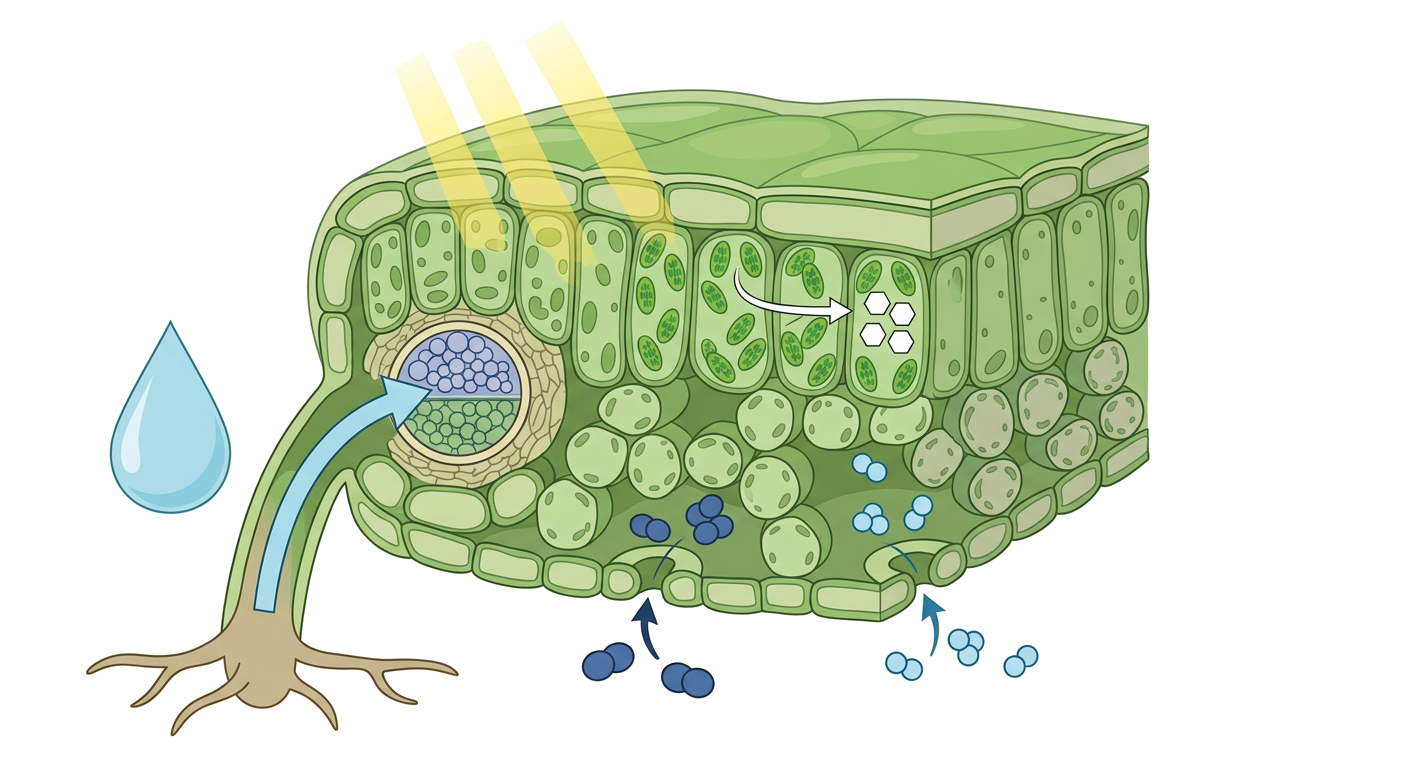
Inputs:
Outputs:
Related Worksheets
The Human Reproductive System
Explore the structures and functions of the male and female reproductive systems, including key hormones and processes.
Grade 8 Fungi Worksheet
Explore the fascinating world of fungi with this Grade 8 science worksheet covering their characteristics, reproduction, and ecological roles.
Interactions in an Ecosystem
Explore the complex relationships and interactions within ecosystems, including food webs, energy flow, and symbiotic relationships, for Grade 8 Science.
Immune System Basics
An introductory worksheet on the human immune system for 8th-grade science students.
Grade 8 Science: The Human Eye
Explore the anatomy and function of the human eye, including its parts, how vision works, and common eye conditions.
Ecological Relationships Worksheet
Explore ecological relationships including predation, competition, mutualism, commensalism, and parasitism with this Grade 8 Science worksheet.
Grade 8 Taxonomy Worksheet
Explore the principles of biological classification with this Grade 8 Science worksheet on Taxonomy, covering hierarchical ranks, binomial nomenclature, and the characteristics of different kingdoms.
Energy Flow in Ecosystems
Explore the concepts of energy flow, food chains, food webs, and ecological pyramids in ecosystems.