Fossil Fundamentals
Explore the world of fossils, learn about their formation, different types, and how they provide clues about Earth's ancient life and environments.
Includes
Standards
Topics
Fossil Fundamentals
Name:
Date:
Score:
Read each question carefully and answer to the best of your ability. Use complete sentences for short answer questions.
1. What is the process by which organic material in a dead organism is replaced by minerals, forming a fossil?
Erosion
Petrification
Decomposition
Sedimentation
2. Which type of rock is most likely to contain fossils?
Igneous rock
Metamorphic rock
Sedimentary rock
All of the above
3. A fossil that is an impression of an organism, like a footprint, is called a fossil.
4. The preserved remains or traces of organisms that lived in the past are called .
5. Fossils can only be formed from the hard parts of an organism, such as bones or shells.
True
False
6. The fossil record provides evidence for the evolution of life on Earth.
True
False
7. Describe the conditions necessary for an organism to become fossilized. Why are fossils relatively rare?
Match the type of fossil with its description.
8. Mold fossil
a. An exact replica of the organism's shape, formed when minerals fill a mold.
9. Cast fossil
b. An impression of the outside of an organism, like a hollow shape in rock.
10. Trace fossil
c. Evidence of an organism's activity, such as footprints or burrows.
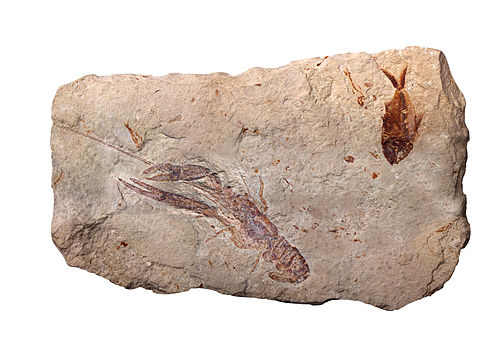
Observe the image below showing different types of fossils. Identify and label at least two different types of fossils you can distinguish.