Genetics: Dominant and Recessive Traits
Explore key genetics vocabulary including dominant, recessive, genotype, and phenotype, and apply these concepts to inheritance patterns.
Includes
Standards
Topics
Genetics: Dominant and Recessive Traits
Name:
Date:
Score:
Read each question carefully and provide your best answer. This worksheet will test your understanding of dominant and recessive traits in genetics.
1. Which term describes an allele that always expresses its trait when present?
Recessive
Dominant
Homozygous
Heterozygous
2. For a recessive trait to be expressed, an individual must inherit:
One dominant allele
One recessive allele
Two dominant alleles
Two recessive alleles
3. The passing of traits from parents to offspring is called .
4. An organism's observable characteristics or traits are its .
5. The genetic makeup of an organism, consisting of the alleles it carries, is called its .
6. A heterozygous individual has two identical alleles for a particular gene.
True
False
7. Dominant alleles are always more common in a population than recessive alleles.
True
False
8. Explain the difference between a dominant allele and a recessive allele. Use an example to illustrate your explanation.
Use the words below to complete the sentences.
9. Different forms of a gene are called .
10. An individual with two different alleles for a trait is described as .
11. Observe the image below of a DNA double helix. DNA carries the genetic information that determines an organism's traits.
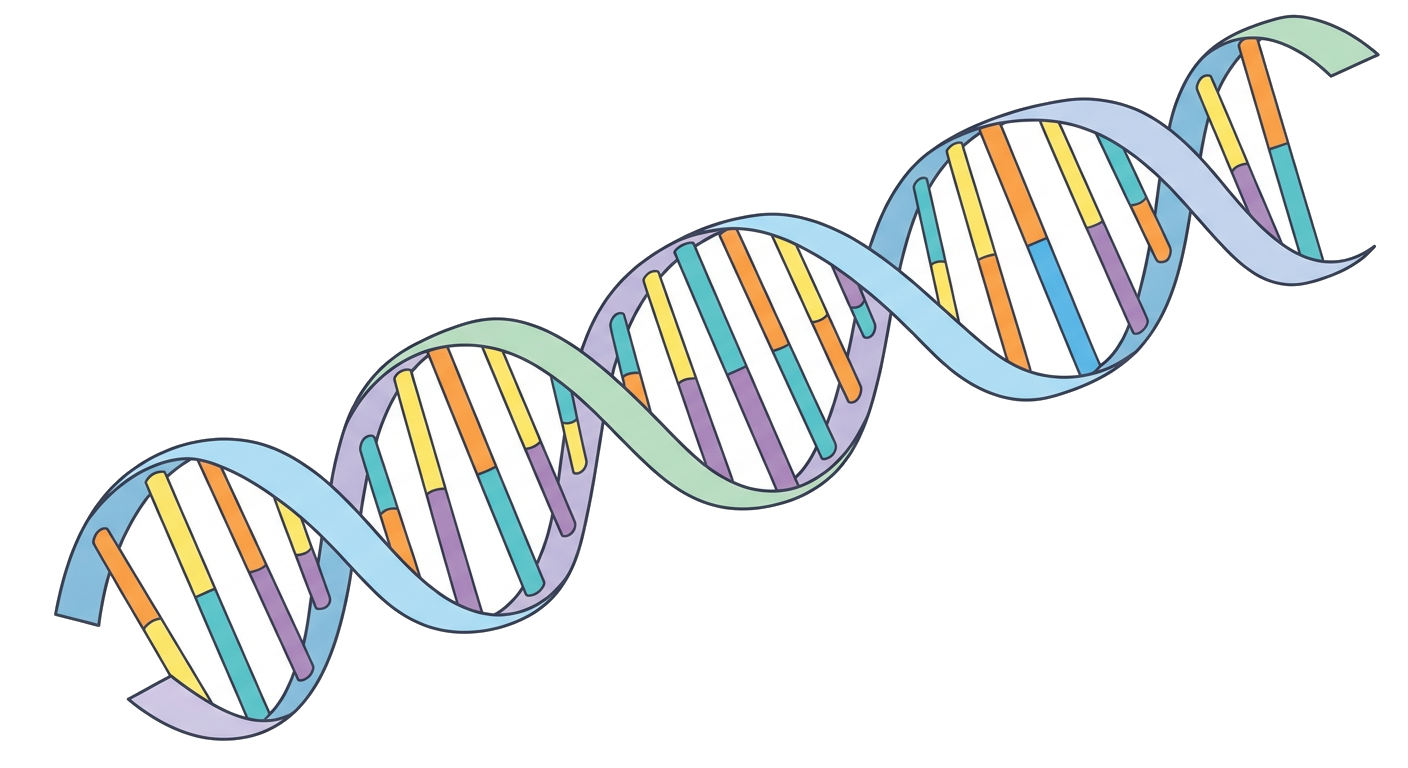
How do dominant and recessive alleles relate to the information stored in this structure?
Related Worksheets
The Human Reproductive System
Explore the structures and functions of the male and female reproductive systems, including key hormones and processes.
Grade 8 Fungi Worksheet
Explore the fascinating world of fungi with this Grade 8 science worksheet covering their characteristics, reproduction, and ecological roles.
Interactions in an Ecosystem
Explore the complex relationships and interactions within ecosystems, including food webs, energy flow, and symbiotic relationships, for Grade 8 Science.
Immune System Basics
An introductory worksheet on the human immune system for 8th-grade science students.
Grade 8 Science: The Human Eye
Explore the anatomy and function of the human eye, including its parts, how vision works, and common eye conditions.
Ecological Relationships Worksheet
Explore ecological relationships including predation, competition, mutualism, commensalism, and parasitism with this Grade 8 Science worksheet.
Grade 8 Taxonomy Worksheet
Explore the principles of biological classification with this Grade 8 Science worksheet on Taxonomy, covering hierarchical ranks, binomial nomenclature, and the characteristics of different kingdoms.
Energy Flow in Ecosystems
Explore the concepts of energy flow, food chains, food webs, and ecological pyramids in ecosystems.