Movement at Joints
Explore the different types of joints in the human body and their functions, including hinge, ball-and-socket, pivot, and gliding joints.
Includes
Standards
Topics
Movement at Joints
Name:
Date:
Score:
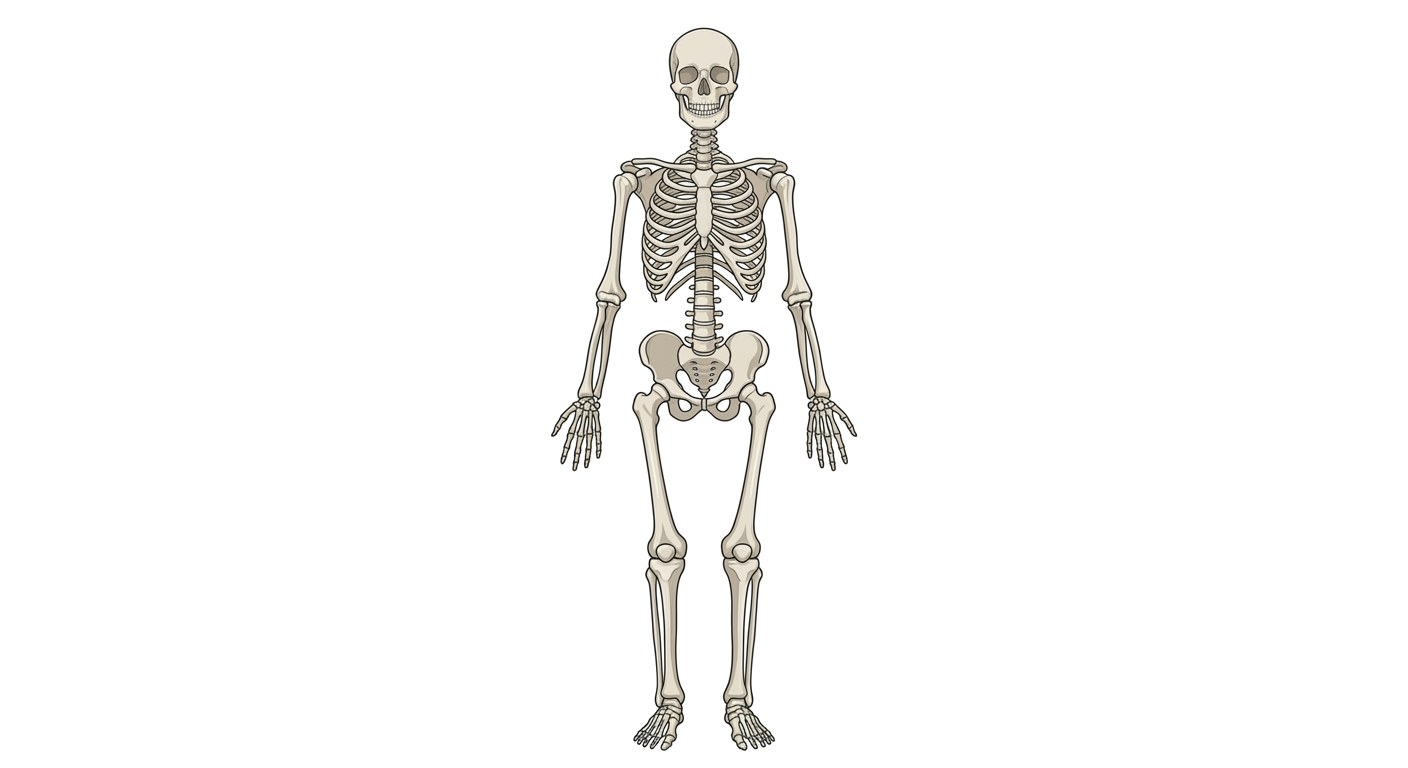
Read each question carefully and answer to the best of your ability. Refer to the diagram of the human skeleton as needed.
Human Skeleton
1. Which type of joint allows for movement in many directions, like the shoulder and hip?
Hinge joint
Ball-and-socket joint
Pivot joint
Gliding joint
2. The knee and elbow are examples of which type of joint?
Ball-and-socket joint
Pivot joint
Hinge joint
Fixed joint
1. Joints are the points where two or more meet.
2. The joint in your neck that allows you to turn your head side to side is a joint.
3. joints allow bones to slide past each other, like in your wrist and ankle.
1. All joints in the human body are designed for extensive movement.
True
False
2. Cartilage is a tough, flexible tissue that covers the ends of bones at a joint, reducing friction.
True
False
1. Describe the main function of ligaments in a joint.
2. Provide an example of a fixed (immovable) joint in the human body and explain why it is important.
Match each joint type with its description or example.
1. Hinge joint
a. Allows bones to slide past each other
2. Ball-and-socket joint
b. Found in the knee and elbow
3. Pivot joint
c. Allows rotational movement
4. Gliding joint
d. Offers the widest range of motion
Related Worksheets
The Human Reproductive System
Explore the structures and functions of the male and female reproductive systems, including key hormones and processes.
Grade 8 Fungi Worksheet
Explore the fascinating world of fungi with this Grade 8 science worksheet covering their characteristics, reproduction, and ecological roles.
Interactions in an Ecosystem
Explore the complex relationships and interactions within ecosystems, including food webs, energy flow, and symbiotic relationships, for Grade 8 Science.
Immune System Basics
An introductory worksheet on the human immune system for 8th-grade science students.
Grade 8 Science: The Human Eye
Explore the anatomy and function of the human eye, including its parts, how vision works, and common eye conditions.
Ecological Relationships Worksheet
Explore ecological relationships including predation, competition, mutualism, commensalism, and parasitism with this Grade 8 Science worksheet.
Grade 8 Taxonomy Worksheet
Explore the principles of biological classification with this Grade 8 Science worksheet on Taxonomy, covering hierarchical ranks, binomial nomenclature, and the characteristics of different kingdoms.
Energy Flow in Ecosystems
Explore the concepts of energy flow, food chains, food webs, and ecological pyramids in ecosystems.