Ionic Compounds Worksheet
Explore the fundamentals of ionic compounds, including their formation, properties, and naming conventions, suitable for Grade 8 science students.
Includes
Standards
Topics
Ionic Compounds: Formation and Properties
Name:
Date:
Score:
Read each question carefully and answer to the best of your ability. Show your work where applicable.
1. Which type of bond involves the transfer of electrons between atoms?
Covalent bond
Ionic bond
Metallic bond
Hydrogen bond
2. What kind of elements typically form ionic bonds?
Two nonmetals
Two metals
A metal and a nonmetal
A metalloid and a nonmetal
3. An atom that gains electrons becomes a ion, while an atom that loses electrons becomes a ion.
4. Ionic compounds are generally at room temperature and have melting points.
5. Explain how an ionic bond forms between sodium (Na) and chlorine (Cl) atoms.
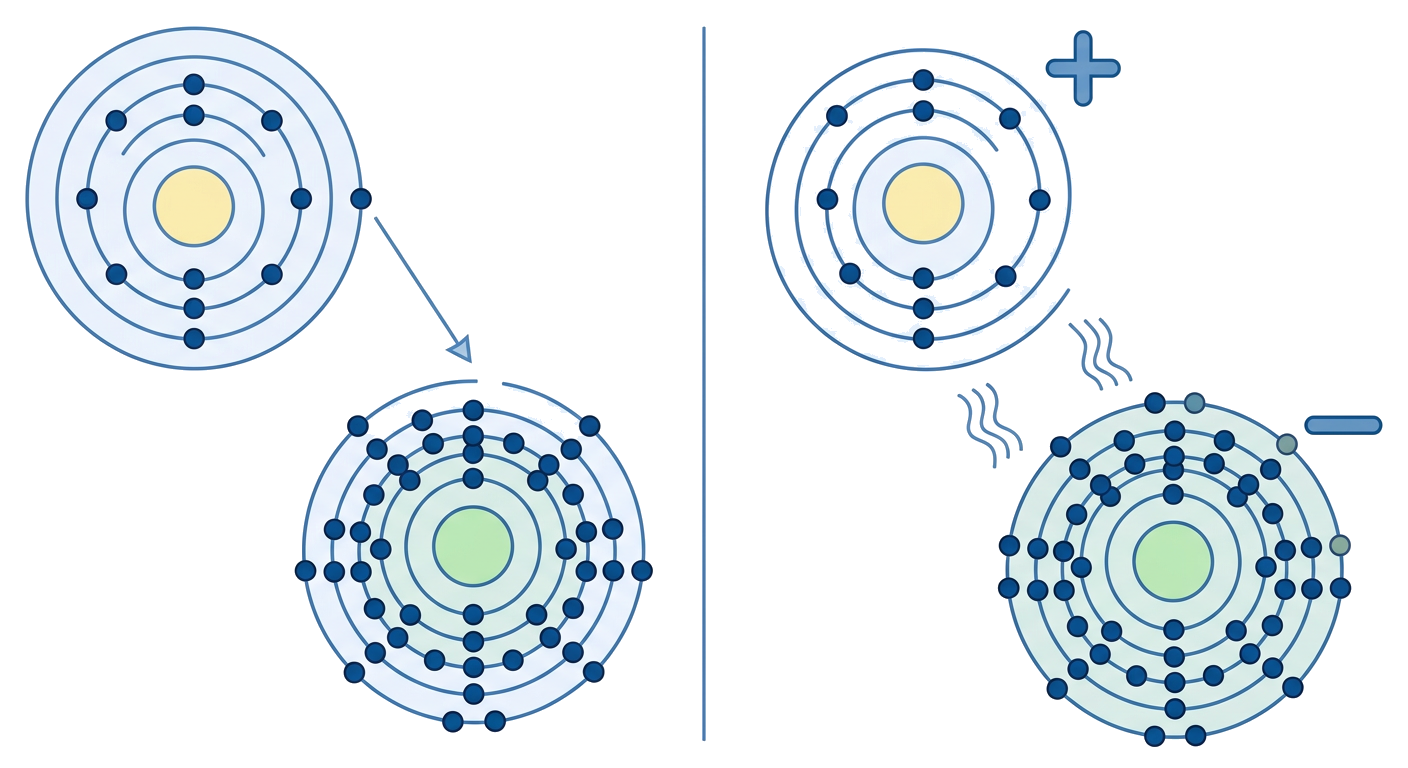
6. Based on the illustration, describe what happens to the electrons during the formation of an ionic bond.
7. Ionic compounds conduct electricity when dissolved in water.
True
False
8. Ionic bonds are formed between atoms with similar electronegativity values.
True
False
Use the words below to complete the sentences.
9. Positively charged ions are called , while negatively charged ions are called .
10. The strong electrostatic forces between ions in an ionic compound form a repeating pattern called a .