Combination Circuits Worksheet
Explore the principles of combination circuits, including series and parallel components, and learn to calculate total resistance, current, and voltage.
Includes
Standards
Topics
Combination Circuits Worksheet
Name:
Date:
Score:
Read each question carefully and provide your best answer. Show all your work for calculation problems.
1. A combination circuit contains both and components.
2. In a series circuit, the total resistance is the of individual resistances.
3. In a parallel circuit, the voltage across each branch is .
1. Which of the following is true for current in a series circuit?
It is different in each component.
It is the same throughout the circuit.
It is inversely proportional to resistance.
It increases with voltage.
2. If one bulb burns out in a parallel circuit, what happens to the other bulbs?
All other bulbs go out.
The other bulbs remain lit.
The other bulbs become brighter.
The other bulbs become dimmer.
1. Explain the main difference between a series circuit and a parallel circuit.
Analyze the circuit diagram below and answer the questions.
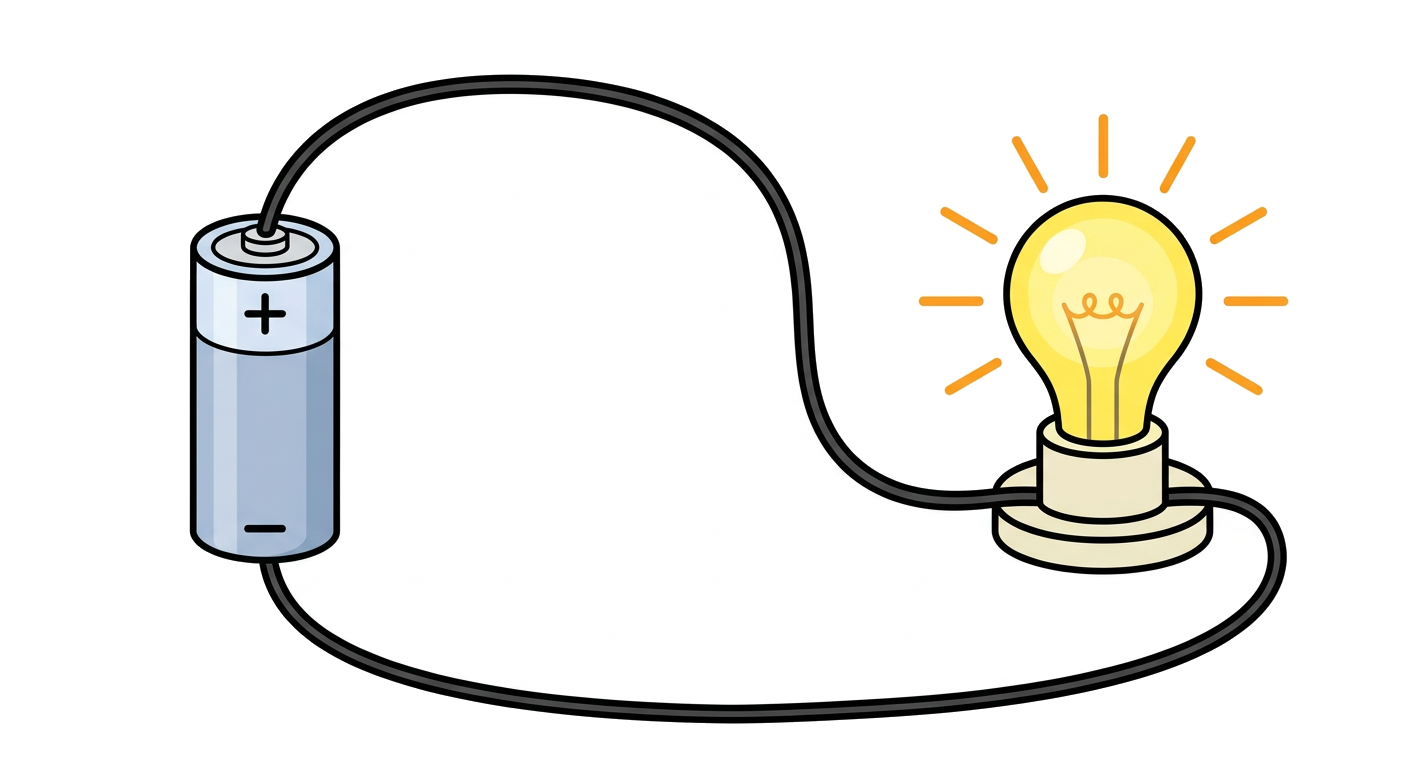
1. Identify the components that are in series.
2. Identify the components that are in parallel.
1. Adding more resistors in series decreases the total resistance of the circuit.
True
False
2. The total current in a parallel circuit is the sum of the currents in each branch.
True
False
1. A circuit has two resistors, R1 = 10 Ω and R2 = 20 Ω, connected in series to a 9V battery. Calculate the total resistance and the total current flowing through the circuit.
Related Worksheets
Grade 8 Particle Model Worksheet
Explore the states of matter and the particle model with this Grade 8 Science worksheet, covering solids, liquids, and gases.
Work and Energy in Physics
Explore the fundamental concepts of work, energy, and power in physics with this engaging Grade 8 science worksheet.
Grade 8 Science: Understanding Fluids
This worksheet covers fundamental concepts of fluids, including states of matter, density, pressure, and buoyancy, suitable for Grade 8 science students.
Grade 8 Science: Energy Conversion
This worksheet covers various forms of energy, the law of conservation of energy, and examples of energy conversion in different scenarios.
Heat Flow Fundamentals
Explore the principles of heat transfer, including conduction, convection, and radiation, with this Grade 8 science worksheet.
Spring Potential Energy & Hooke's Law Worksheet
Explore spring potential energy and Hooke's Law with this comprehensive worksheet for Grade 8 science students.
Understanding Friction
This worksheet explores the concept of friction, its types, and its effects on motion, suitable for grade 8 science students.
Properties of Light Worksheet
Explore the properties of light, including reflection, refraction, and the electromagnetic spectrum, with this engaging Grade 8 science worksheet.