Evidence of Evolution Worksheet
Explore the various lines of evidence supporting the theory of evolution, including fossils, homologous structures, embryology, and biochemical similarities.
Includes
Standards
Topics
Evidence of Evolution
Name:
Date:
Score:
Read each question carefully and answer to the best of your ability. This worksheet will test your understanding of the different types of evidence that support the theory of evolution.
1. Which type of evidence involves comparing the skeletal structures of different organisms to find similarities?
Fossil evidence
Embryological evidence
Anatomical evidence (Homologous Structures)
Biochemical evidence
2. The presence of gill slits and tails in early human embryos suggests a common ancestry with which group of animals?
Insects
Fish
Birds
Reptiles
3. The preserved remains or traces of organisms from the past are called .
4. Structures that have a similar evolutionary origin but different functions, like the wing of a bat and the arm of a human, are known as structures.
5. Vestigial structures, such as the human appendix, have no known function and provide evidence of evolution.
True
False
6. DNA and protein similarities among different species provide strong biochemical evidence for evolution.
True
False
7. Observe the image below showing homologous structures.
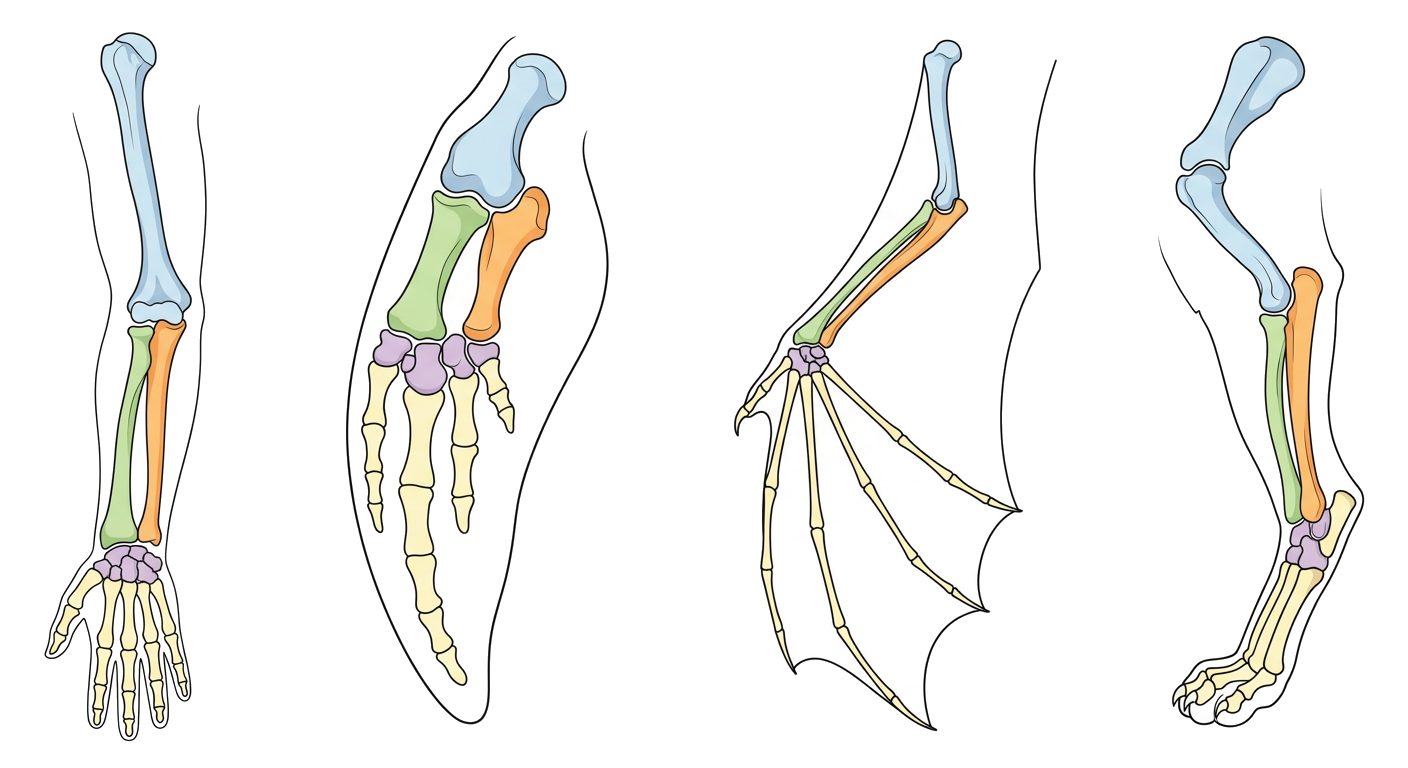
Explain how homologous structures provide evidence for common ancestry among different species. Give an example from the image.
8. Describe how the fossil record supports the theory of evolution. What can we learn from fossils about past life forms?
Use the words below to complete the sentences.
9. The study of the development of embryos provides evidence of shared developmental patterns, which is known as .
10. The more similar the sequences are between two species, the more closely related they are considered to be.
Related Worksheets
The Human Reproductive System
Explore the structures and functions of the male and female reproductive systems, including key hormones and processes.
Grade 8 Fungi Worksheet
Explore the fascinating world of fungi with this Grade 8 science worksheet covering their characteristics, reproduction, and ecological roles.
Interactions in an Ecosystem
Explore the complex relationships and interactions within ecosystems, including food webs, energy flow, and symbiotic relationships, for Grade 8 Science.
Immune System Basics
An introductory worksheet on the human immune system for 8th-grade science students.
Grade 8 Science: The Human Eye
Explore the anatomy and function of the human eye, including its parts, how vision works, and common eye conditions.
Ecological Relationships Worksheet
Explore ecological relationships including predation, competition, mutualism, commensalism, and parasitism with this Grade 8 Science worksheet.
Grade 8 Taxonomy Worksheet
Explore the principles of biological classification with this Grade 8 Science worksheet on Taxonomy, covering hierarchical ranks, binomial nomenclature, and the characteristics of different kingdoms.
Energy Flow in Ecosystems
Explore the concepts of energy flow, food chains, food webs, and ecological pyramids in ecosystems.