Bacteria and Archaea Worksheet
Explore the fascinating world of bacteria and archaea, understanding their structures, classifications, and roles in various environments.
Includes
Standards
Topics
Bacteria and Archaea
Name:
Date:
Score:
Read each question carefully and provide your answer in the space provided. Some questions may require you to select from given options.
1. Which of the following is a key difference between bacteria and archaea?
Bacteria have a nucleus, while archaea do not.
Archaea have peptidoglycan in their cell walls, while bacteria do not.
The cell membranes of archaea contain unique lipids not found in bacteria.
Bacteria are prokaryotic, while archaea are eukaryotic.
2. Which of the following describes a common shape of bacteria?
Spherical (cocci)
Rod-shaped (bacilli)
Spiral (spirilla)
All of the above
3. Bacteria and archaea are both organisms, meaning they lack a membrane-bound nucleus.
4. Many archaea are known as because they live in extreme environments such as hot springs or highly saline waters.
5. Observe the diagram of a bacterial cell below. Identify and label any three structures.
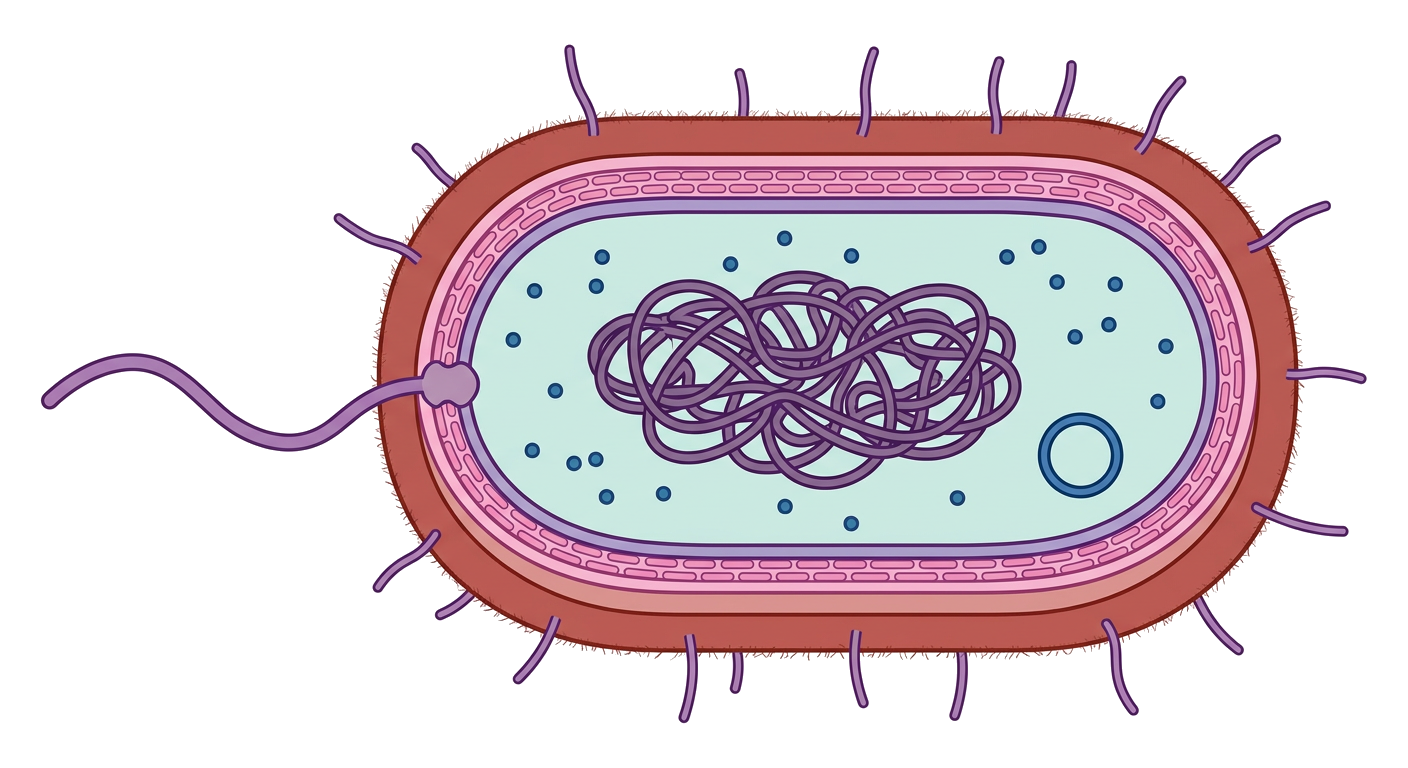
a.
b.
c.
6. Describe two ways in which bacteria are beneficial to humans or the environment.
7. All bacteria are harmful and cause disease.
True
False
8. Archaea are more closely related to eukaryotes than to bacteria.
True
False
Match the term on the left with its correct definition on the right.
9. Plasmid
a. Region containing the main genetic material in a prokaryotic cell
10. Nucleoid
b. Small, circular DNA molecule separate from the bacterial chromosome
11. Flagellum
c. Long, whip-like appendage used for movement