Blood Groups: Understanding Compatibility
This worksheet covers the basics of human blood groups, including ABO and Rh systems, antigens, antibodies, and transfusion compatibility for Grade 9 Science students.
Includes
Standards
Topics
Blood Groups: Understanding Compatibility
Name:
Date:
Score:
Read each question carefully and answer to the best of your ability. Use the provided space for your answers.
1. Which component of blood determines its ABO blood group?
Plasma
White blood cells
Red blood cell antigens
Platelets
2. A person with O-negative blood is considered a universal donor because:
They have both A and B antigens.
They have no A or B antigens and no Rh factor.
They have anti-A and anti-B antibodies.
Their blood clots easily.
3. The presence or absence of the antigen on red blood cells determines if a person is Rh-positive or Rh-negative.
4. Blood group AB is known as the universal because individuals with this blood type can receive blood from all other ABO groups.
5. A person with B blood group has A antigens and anti-B antibodies.
True
False
6. Agglutination occurs when incompatible blood types are mixed, leading to clumping of red blood cells.
True
False
7. Briefly explain the difference between an antigen and an antibody in the context of blood groups.
8. Why is it crucial to match blood types before a blood transfusion?
Refer to the blood type transfusion chart below to answer the following question.
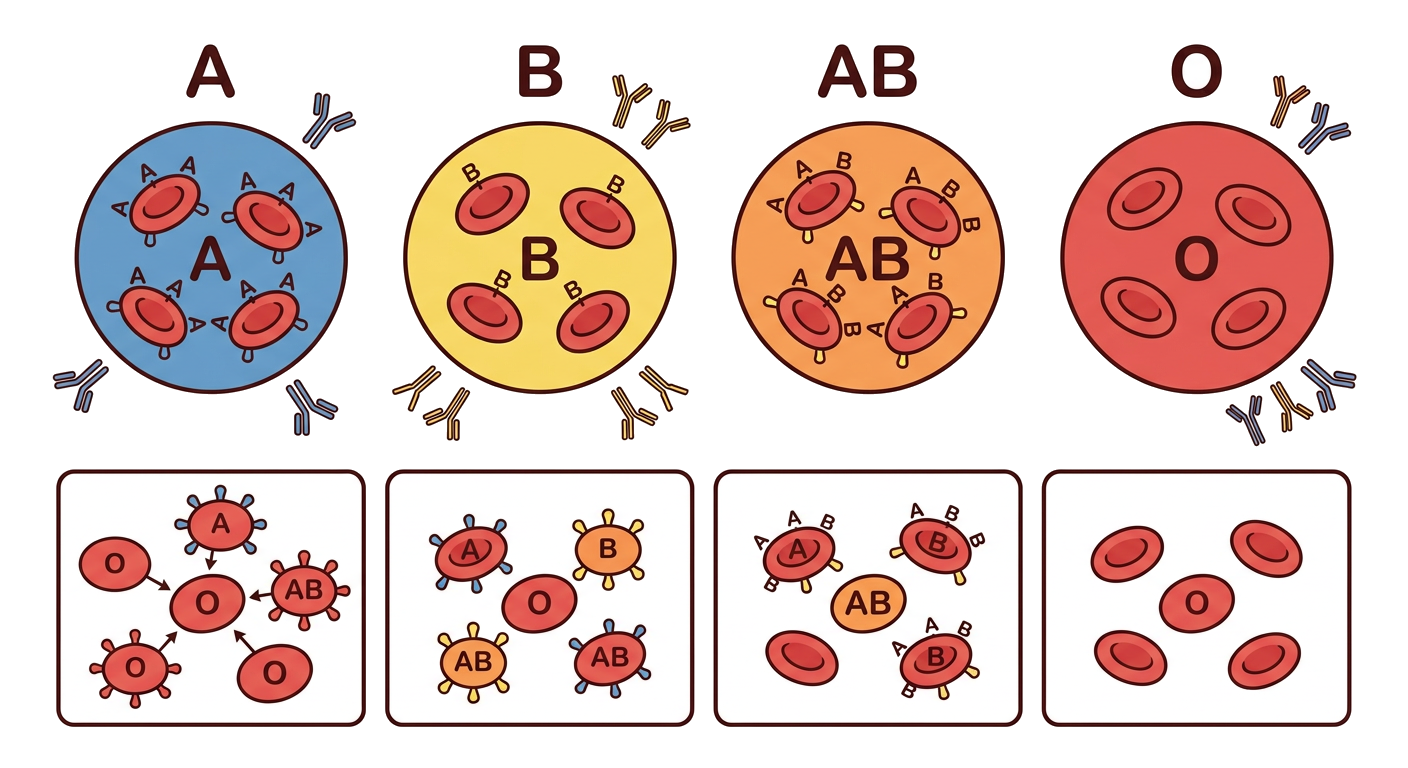
9. According to the chart, which blood types can a person with B+ blood safely receive?