Gene Mapping Worksheet
Explore the principles of gene mapping, including linkage, recombination frequency, and map units, with this engaging Grade 9 science worksheet.
Includes
Standards
Topics
Gene Mapping Worksheet
Name:
Date:
Score:
Read each question carefully and answer to the best of your ability. Show all your work for calculation problems.
Gene mapping is a process used to determine the location of genes on a chromosome and the distance between them. This is crucial for understanding genetic diseases and inheritance patterns.
1. What is the primary purpose of gene mapping?
To determine the sequence of DNA.
To locate genes on a chromosome and their relative distances.
To identify all proteins produced by an organism.
To clone genes for genetic engineering.
2. What is the relationship between recombination frequency and gene distance?
They are inversely proportional.
They are directly proportional.
They are unrelated.
They are proportional only for genes on different chromosomes.
1. Genes located on the same chromosome are said to be .
2. The exchange of genetic material between homologous chromosomes is called .
3. One map unit (centimorgan) is equivalent to a recombination frequency.
1. Explain how crossing over contributes to genetic variation and is utilized in gene mapping.
1. The maximum recombination frequency between two genes is 50%.
True
False
Observe the image below representing DNA structure.
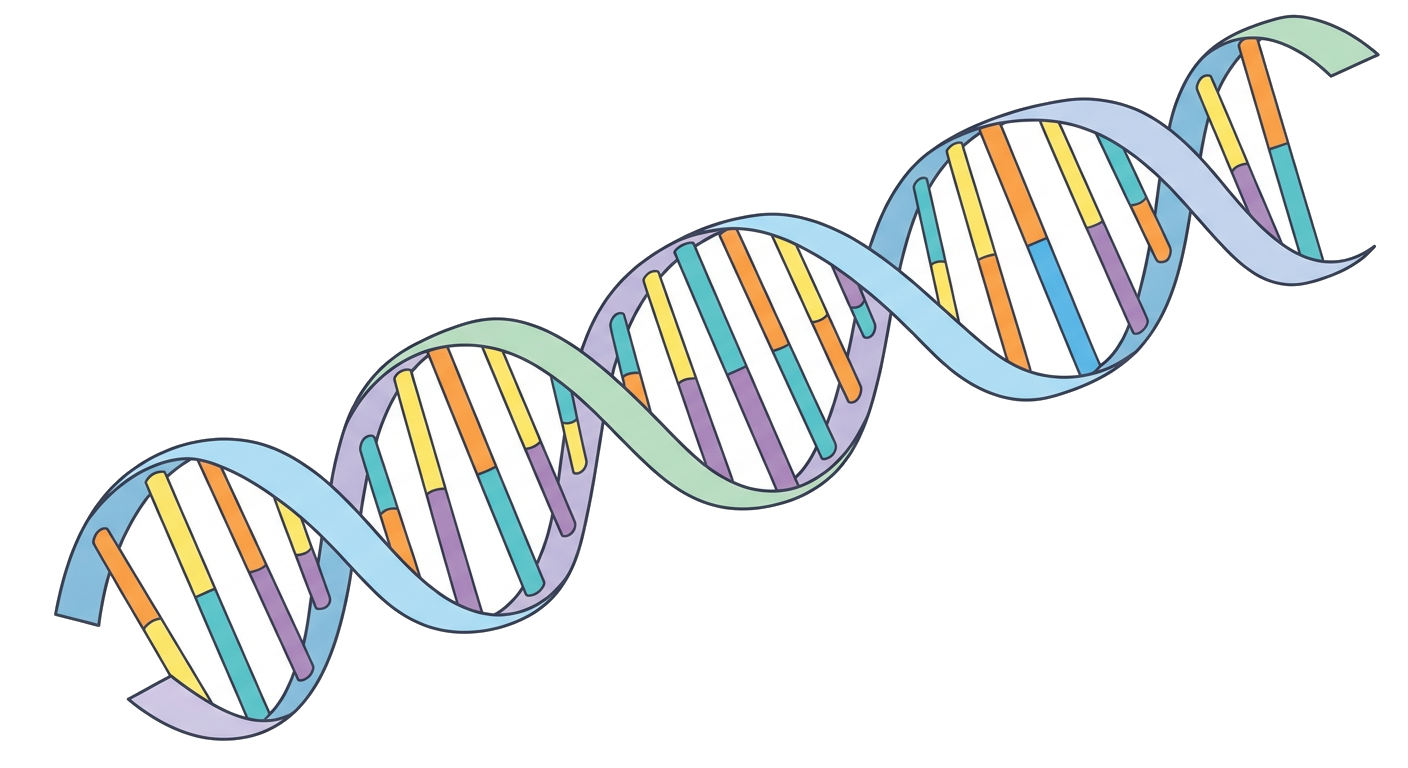
How does the structure of DNA relate to the concept of genes and their arrangement on chromosomes?
In a genetic cross, two linked genes (A and B) show a recombination frequency of 15%. What is the distance between these two genes in map units?