Homologous Structures Worksheet
Explore the concept of homologous structures in biology, examining similarities in different species that suggest common ancestry.
Includes
Standards
Topics
Homologous Structures Worksheet
Name:
Date:
Score:
Read each question carefully and answer to the best of your ability. Refer to the provided diagrams and your knowledge of biology.
Homologous structures are anatomical resemblances between different species that are inherited from a common ancestor. These structures may have different functions, but their underlying anatomy is similar, indicating a shared evolutionary past.
1. Define homologous structures in your own words. Provide an example not discussed in this worksheet.
2. Which of the following best describes the relationship between a human arm, a bat wing, and a whale flipper?
They are analogous structures, as they all perform the same function.
They are homologous structures, sharing a common ancestor but adapted for different functions.
They are vestigial structures, serving no current purpose.
They are examples of convergent evolution, developing similar features independently.
Observe the diagram below showing the forelimbs of different animals:
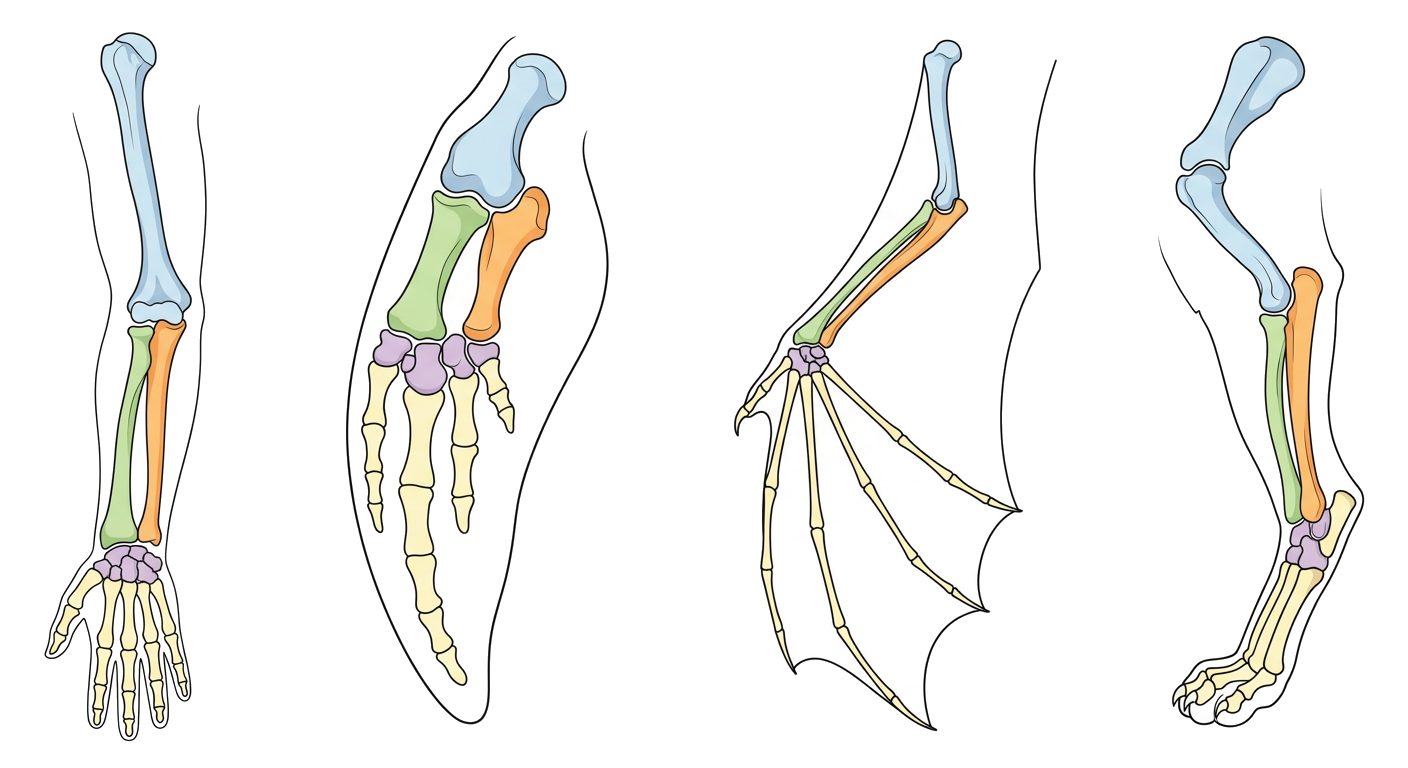
3. The bones in the forelimbs of humans, cats, whales, and bats are structurally similar. This similarity suggests that these species share a . Despite their different functions (e.g., grasping, walking, swimming, flying), the underlying skeletal arrangement is evidence of .
4. Homologous structures always have the same function in different species.
True
False
5. Explain how homologous structures provide strong evidence for the theory of evolution.