Cell Membrane Structure & Function
Explore the structure and function of the cell membrane, including its components, transport mechanisms, and role in maintaining cellular homeostasis.
Includes
Standards
Topics
Cell Membrane Structure & Function
Name:
Date:
Score:
Read each question carefully and answer to the best of your ability. Refer to the provided diagram where necessary.
Observe the diagram of the cell membrane below and fill in the blanks regarding its components.
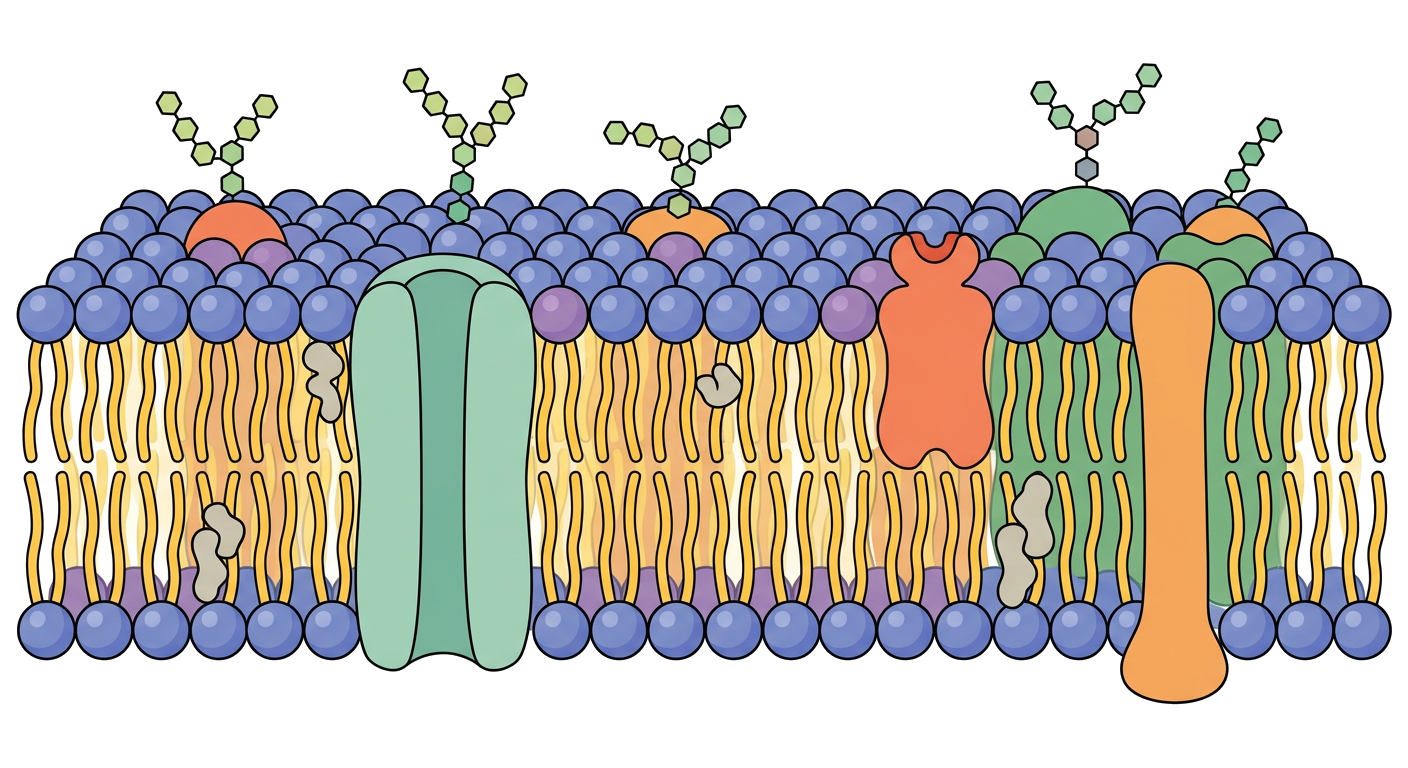
1. The primary component of the cell membrane is the bilayer.
2. Proteins embedded within or associated with the membrane are called proteins.
3. Carbohydrate chains attached to lipids form , while those attached to proteins form .
4. is a lipid found in animal cell membranes that helps maintain fluidity.
5. Which of the following best describes the cell membrane's structure?
A rigid, impermeable protein layer.
A fluid mosaic of lipids and proteins.
A solid carbohydrate wall.
A single layer of phospholipids.
6. Which type of transport requires energy to move substances across the membrane against their concentration gradient?
Facilitated diffusion
Osmosis
Active transport
Simple diffusion
7. The cell membrane is selectively permeable, meaning it allows all substances to pass through freely.
True
False
8. Passive transport mechanisms move substances from an area of low concentration to an area of high concentration.
True
False
9. Explain the role of the phospholipid bilayer in the cell membrane.
10. Describe the difference between diffusion and osmosis.
Match the term on the left with its correct definition on the right.
11. Endocytosis
a. Movement of water across a selectively permeable membrane.
12. Exocytosis
b. Process of taking substances into the cell by engulfing them.
13. Osmosis
c. Process of releasing substances from the cell.