Phases of Meiosis Worksheet
Explore the stages of meiosis, a crucial process for sexual reproduction, with this comprehensive worksheet for Grade 9 science students.
Includes
Standards
Topics
Phases of Meiosis
Name:
Date:
Score:
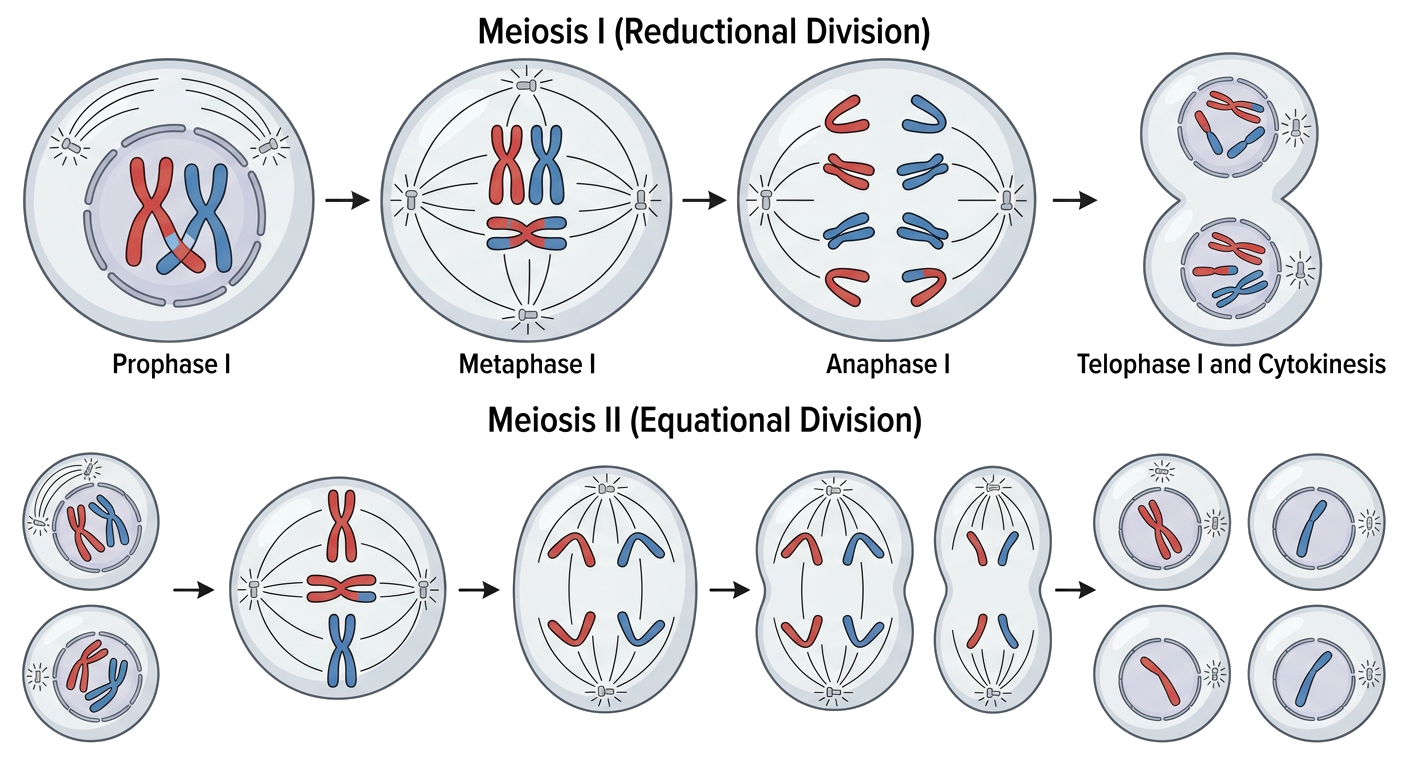
Read each question carefully and answer to the best of your ability. Refer to the provided diagram of meiosis stages for assistance.
Observe the diagram below showing the different stages of meiosis:
1. Meiosis is a type of cell division that reduces the number of chromosomes in the parent cell by half and produces four cells.
2. During Prophase I, homologous chromosomes pair up to form a .
3. The process of occurs in Prophase I, leading to genetic variation.
4. In Anaphase I, chromosomes separate and move to opposite poles of the cell.
5. Meiosis II is similar to , as sister chromatids separate.
1. Which of the following best describes the outcome of meiosis?
Two diploid cells
Four diploid cells
Two haploid cells
Four haploid cells
2. At which stage of meiosis do sister chromatids separate?
Anaphase I
Metaphase I
Anaphase II
Telophase II
1. Meiosis produces genetically identical daughter cells.
True
False
2. Crossing over occurs during Prophase II of meiosis.
True
False
Match each phase of meiosis with its description.
1. Prophase I
a. Sister chromatids separate.
2. Metaphase I
b. Homologous chromosomes align at the metaphase plate.
3. Anaphase I
c. Homologous chromosomes separate.
4. Prophase II
d. Chromosomes condense, nuclear envelope breaks down. Crossing over occurs.
5. Anaphase II
e. New spindle fibers form around the chromosomes.
1. Explain the main difference between Meiosis I and Meiosis II.
2. Why is genetic variation important for a species, and how does meiosis contribute to it?