Sliding Filament Theory Worksheet
Explore the mechanisms of muscle contraction through the sliding filament theory with this comprehensive worksheet for Grade 9 science students.
Includes
Standards
Topics
Sliding Filament Theory Worksheet
Name:
Date:
Score:
Read each question carefully and provide your best answer based on your understanding of the sliding filament theory.
1. The basic contractile unit of a muscle fiber is called a .
2. During muscle contraction, the filaments slide past the filaments.
3. The protein responsible for binding to calcium ions and initiating muscle contraction is .
4. ATP provides the energy for the heads to detach from .
5. Which of the following statements best describes the role of calcium ions in muscle contraction?
They directly bind to actin.
They cause myosin heads to pivot.
They bind to troponin, exposing myosin-binding sites.
They release acetylcholine at the neuromuscular junction.
6. Which protein forms the thick filaments in a sarcomere?
Actin
Myosin
Troponin
Tropomyosin
7. Briefly explain the 'power stroke' in muscle contraction.
8. The Z-discs move closer together during muscle contraction.
True
False
9. Myosin heads bind to tropomyosin during relaxation.
True
False
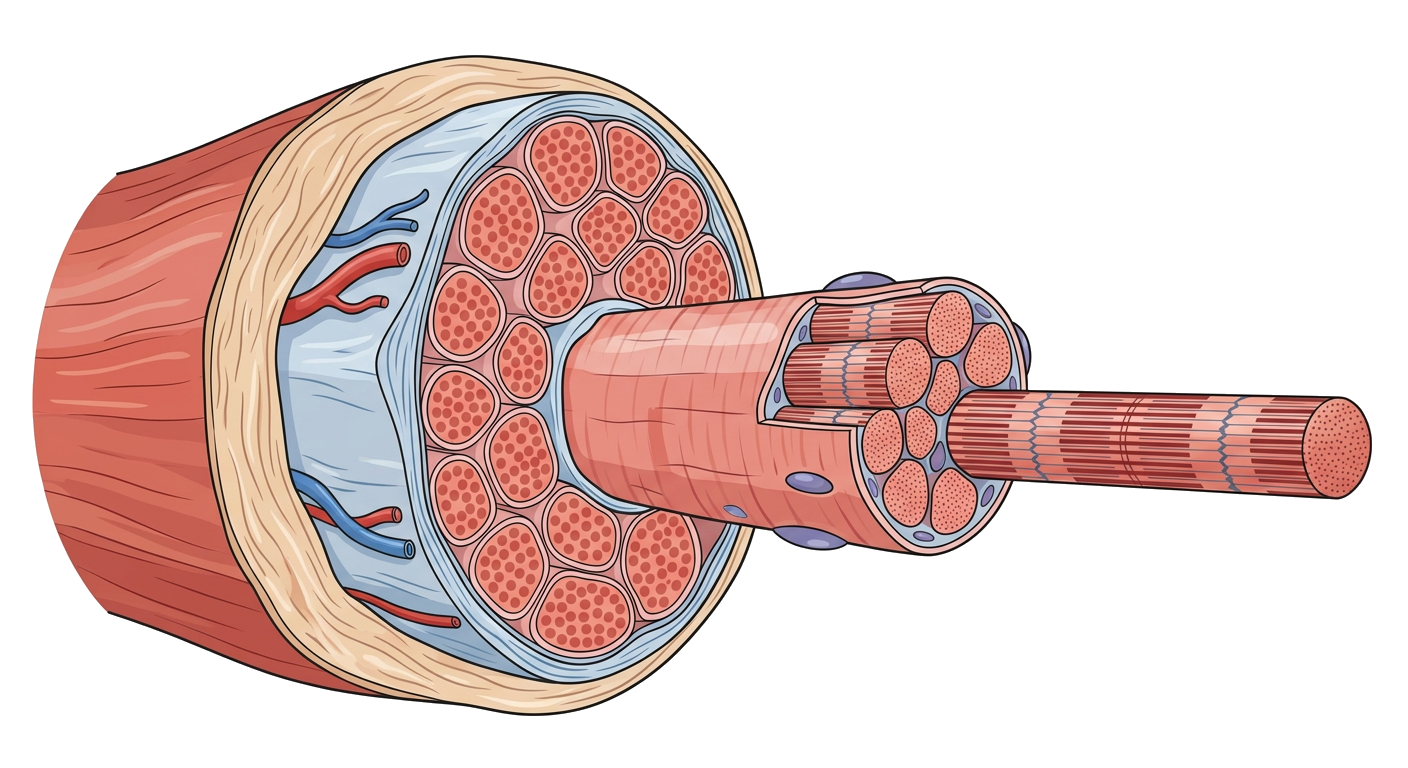
10. Observe the diagram of a muscle fiber cross-section. Label the thick and thin filaments.
11. Number the following events of muscle contraction in the correct order (1-5):
Myosin heads bind to actin, forming cross-bridges.
Calcium ions bind to troponin, causing tropomyosin to move.
Myosin heads pivot, pulling actin filaments towards the M-line.
ATP binds to myosin heads, causing them to detach from actin.
A nerve impulse arrives at the neuromuscular junction.