Burette Reading Practice
A Grade 9 science worksheet focused on understanding and accurately reading a burette in chemistry experiments.
Includes
Standards
Topics
Burette Reading Practice
Name:
Date:
Score:
Carefully read each question and follow the instructions. Pay close attention to the meniscus when reading burette volumes. All readings should be recorded to two decimal places.
A burette is a laboratory instrument used to dispense variable, measured amounts of a chemical solution. It is commonly used in titrations to determine the concentration of an unknown solution. Accurate reading of a burette is crucial for precise experimental results.
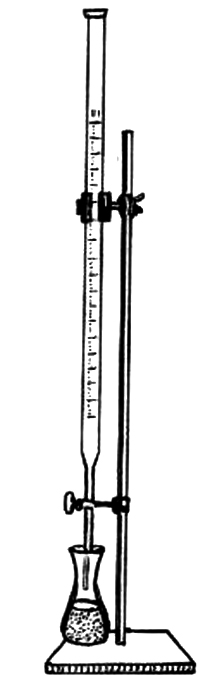
1. When reading a burette, you should always read the bottom of the .
2. The volume is read from at the top to at the bottom.
3. A burette is typically graduated in 0.1 mL increments, allowing readings to be estimated to mL.
4. Which of the following is the correct way to read the volume of liquid in a burette?
At eye level with the top of the meniscus.
At eye level with the bottom of the meniscus.
From above, looking down at the meniscus.
From below, looking up at the meniscus.
5. Imagine a burette where the liquid level is between 15.6 mL and 15.7 mL. The lowest point of the meniscus is exactly halfway between the 15.6 mL mark and the 15.7 mL mark. What is the correct reading?
6. Explain why it is important to read the burette at eye level.
7. Air bubbles in the burette tip will lead to an overestimation of the volume delivered.
True
False