Calorimetry Principles
This worksheet covers the basic principles of calorimetry, including energy transfer, specific heat capacity, and calculations related to heat exchange in a calorimeter. Suitable for Grade 9 science students.
Includes
Standards
Topics
Calorimetry Principles Worksheet
Name:
Date:
Score:
Read each question carefully and provide your best answer. Show all your work for calculations.
1. What is the primary purpose of a calorimeter?
To measure mass
To measure temperature changes
To measure heat absorbed or released
To measure volume
2. Which of the following is an essential component of a simple calorimeter?
A heating plate
An insulated container
A magnifying glass
A spectroscope
3. The principle behind calorimetry is the conservation of .
4. The specific heat capacity (c) of a substance is the amount of required to raise the temperature of 1 gram of the substance by 1 degree Celsius.
5. Describe the basic function of a calorimeter.
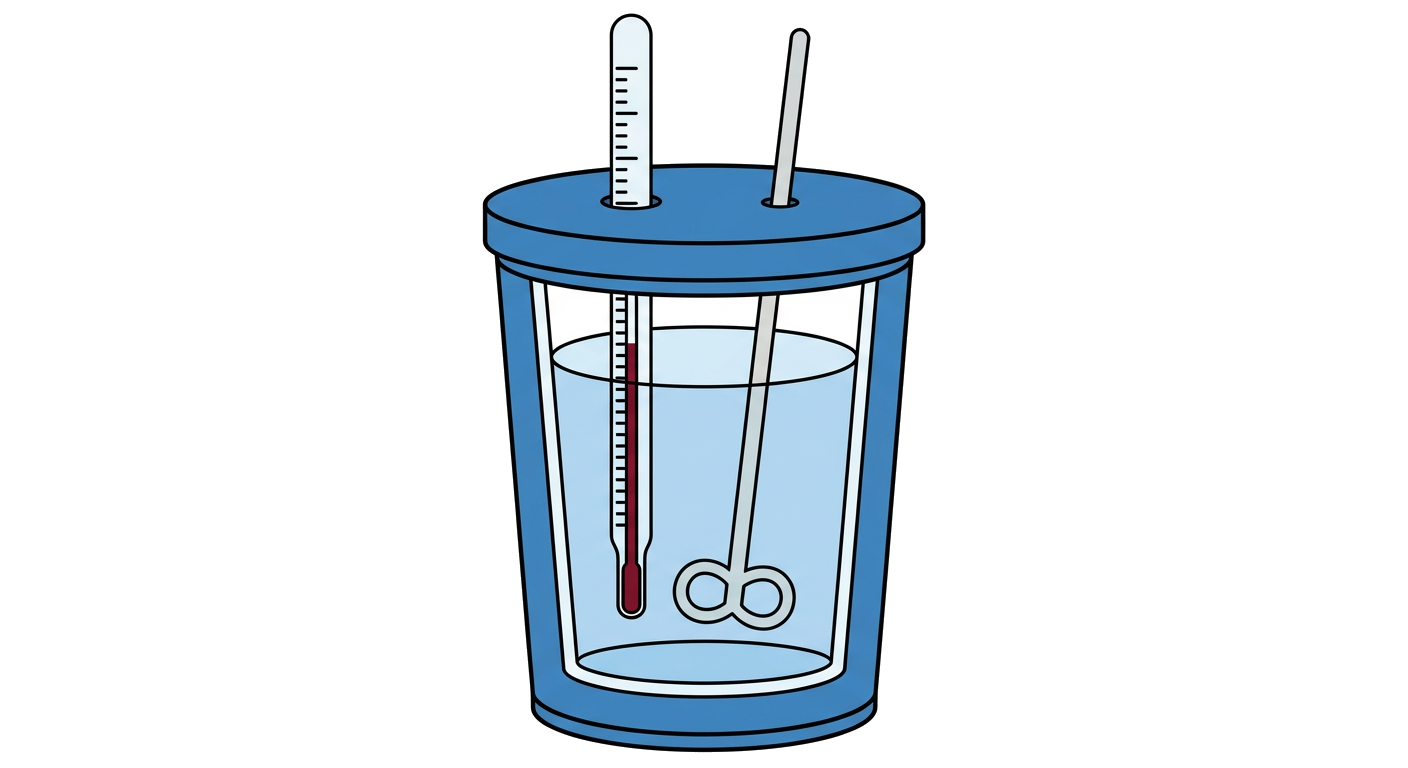
6. Explain why insulation is crucial for a calorimeter to work effectively.
7. In an ideal calorimeter, there is no heat exchange with the surroundings.
True
False
8. A substance with a high specific heat capacity will heat up and cool down quickly.
True
False
9. A 50.0 g sample of metal at 100.0 °C is placed in a calorimeter containing 100.0 g of water at 25.0 °C. The final temperature of the water and metal is 28.5 °C. If the specific heat capacity of water is 4.18 J/g°C, calculate the specific heat capacity of the metal. Assume no heat loss to the surroundings.
Related Worksheets
Hydrocarbons Worksheet
A Grade 9 science worksheet covering the basics of hydrocarbons, including their definition, types, and properties.
Grade 9 Chemistry: Word Equations Worksheet
This worksheet focuses on writing and interpreting word equations for chemical reactions, covering reactants, products, and states of matter for Grade 9 Science students.