Conservation of Matter Worksheet
This worksheet covers the fundamental principle of conservation of matter, including its definition, application in chemical reactions, and related concepts for Grade 9 science students.
Includes
Standards
Topics
Conservation of Matter
Name:
Date:
Score:
Read each question carefully and answer to the best of your ability. Show all your work for calculations.
1. Which of the following statements best describes the Law of Conservation of Matter?
Matter can be created and destroyed, but only in nuclear reactions.
The total mass of reactants is always less than the total mass of products.
Matter cannot be created or destroyed, but it can change forms.
Energy is always conserved, but matter is not.
2. If 10.0 grams of hydrogen react completely with 80.0 grams of oxygen to form water, what is the total mass of water produced?
70.0 grams
80.0 grams
90.0 grams
100.0 grams
3. The Law of Conservation of Matter applies to both physical and chemical changes.
True
False
4. In a closed system, the total mass of the system remains constant, even if chemical reactions occur.
True
False
5. The Law of Conservation of Matter states that matter cannot be created or .
6. In a chemical reaction, the total mass of the must equal the total mass of the .
7. When ice melts into water, it undergoes a change, and the total mass remains .
8. Explain why balancing chemical equations is important in demonstrating the Law of Conservation of Matter.
9. Describe an everyday example of the Law of Conservation of Matter in action.
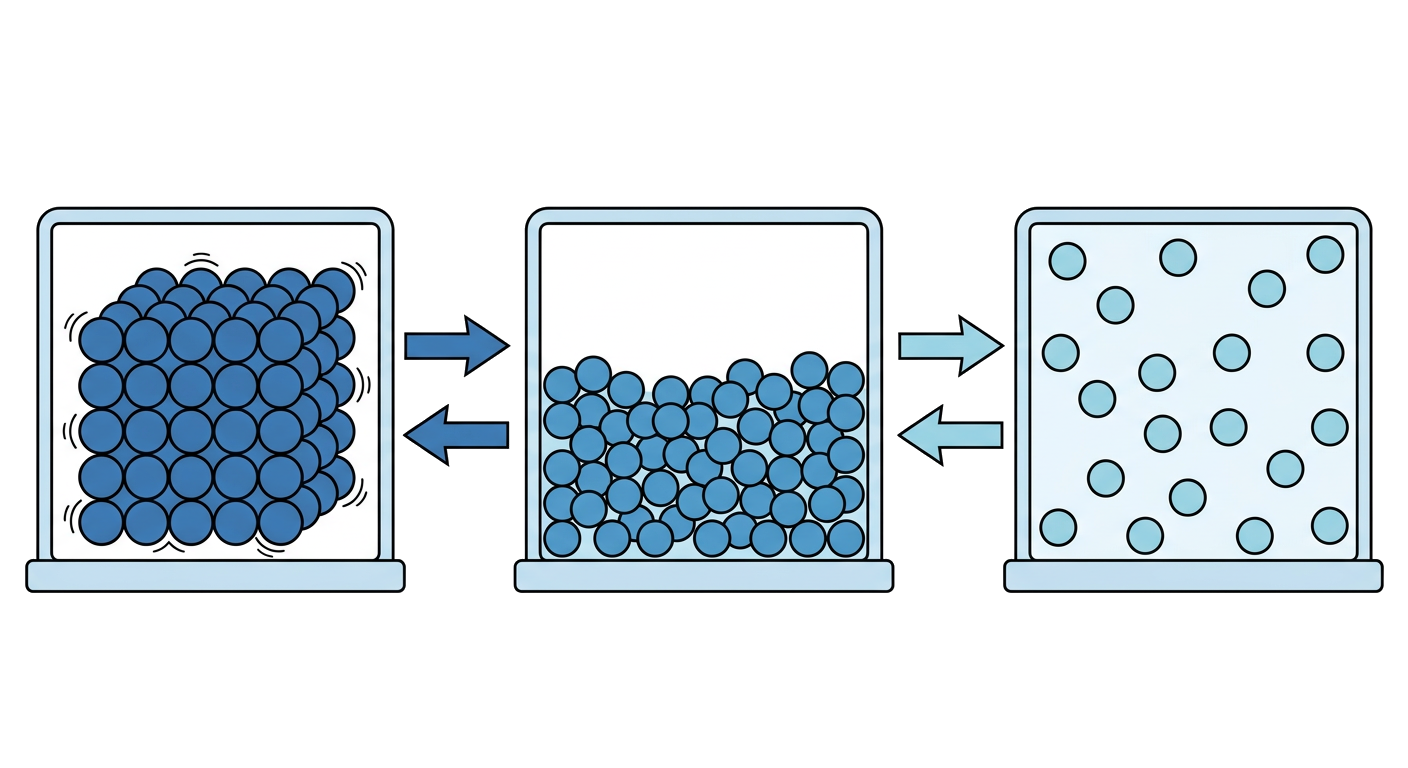
10. Observe the image below showing states of matter transitions. If 100 grams of water freezes into ice, what will be the mass of the ice? Explain your answer in relation to the Law of Conservation of Matter.
Related Worksheets
Hydrocarbons Worksheet
A Grade 9 science worksheet covering the basics of hydrocarbons, including their definition, types, and properties.
Grade 9 Chemistry: Word Equations Worksheet
This worksheet focuses on writing and interpreting word equations for chemical reactions, covering reactants, products, and states of matter for Grade 9 Science students.