Grade 9 Science: Ionic Formulas
Worksheet for Grade 9 Science students covering the fundamentals of ionic bonding, formula writing, and nomenclature.
Includes
Standards
Topics
Ionic Formulas Worksheet
Name:
Date:
Score:
Read each question carefully and answer to the best of your ability. Show all your work for calculations.
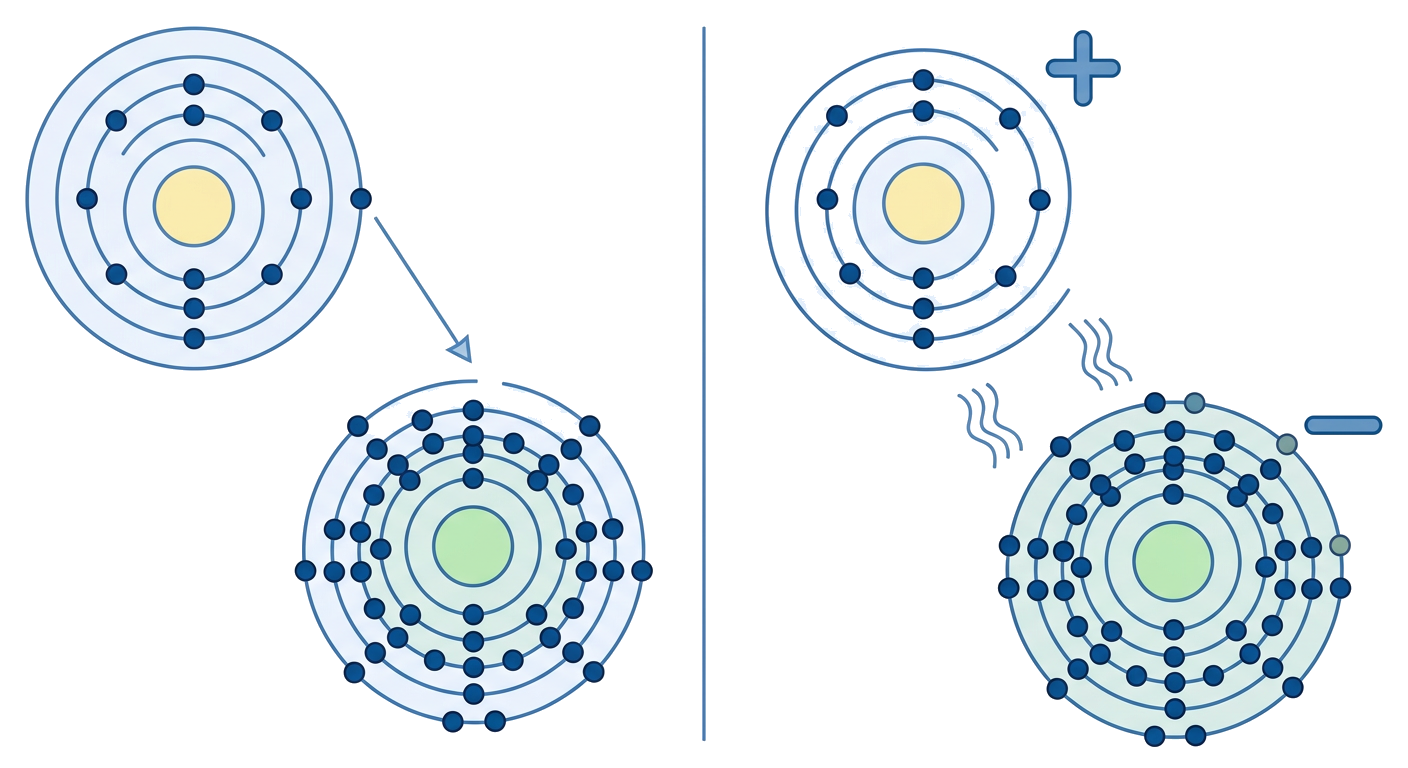
Ionic bonds are formed between a metal and a nonmetal through the transfer of electrons. This results in the formation of charged particles called ions, which are held together by electrostatic forces. Cations are positively charged ions (formed by metals losing electrons), and anions are negatively charged ions (formed by nonmetals gaining electrons).
1. An ionic bond typically forms between a and a .
2. Atoms gain or lose electrons to achieve a stable electron configuration similar to that of a gas.
3. A positively charged ion is called a(n) , while a negatively charged ion is called a(n) .
1. Which of the following elements is most likely to form a cation?
Oxygen
Chlorine
Sodium
Neon
2. What is the charge of an ion formed from an element in Group 17 (halogens)?
+1
-1
+2
-2
Write the chemical formula for the ionic compound formed from each pair of elements:
1. Sodium and Chlorine
2. Magnesium and Oxygen
3. Aluminum and Fluorine
4. Calcium and Nitrogen
Name the following ionic compounds:
1. KCl
2. Fe₂O₃
3. Cu(NO₃)₂
4. NH₄Cl
1. In an ionic bond, electrons are shared between atoms.
True
False
2. The criss-cross method can be used to determine the subscripts in an ionic formula.
True
False
Related Worksheets
Hydrocarbons Worksheet
A Grade 9 science worksheet covering the basics of hydrocarbons, including their definition, types, and properties.
Grade 9 Chemistry: Word Equations Worksheet
This worksheet focuses on writing and interpreting word equations for chemical reactions, covering reactants, products, and states of matter for Grade 9 Science students.