Law of Superposition Worksheet
This worksheet covers the Law of Superposition, a fundamental principle in geology used to determine the relative ages of rock layers.
Includes
Standards
Topics
Law of Superposition Worksheet
Name:
Date:
Score:
Read each question carefully and answer to the best of your ability. Refer to the provided diagrams where applicable.
The Law of Superposition is a key principle in stratigraphy, which is the study of rock layers (strata) and their formation. This law states that in an undisturbed sequence of sedimentary rock layers, the oldest layers are at the bottom and the youngest layers are at the top.
1. What does the Law of Superposition primarily help scientists determine?
The absolute age of rocks
The relative age of rock layers
The chemical composition of rocks
The type of fossils present
2. In an undisturbed sequence of sedimentary rock, where would you find the oldest layer?
At the top
In the middle
At the bottom
Randomly distributed
3. The Law of Superposition applies to rock layers that have not been disturbed.
4. In a sequence of undisturbed rock layers, the youngest layers are found at the .
5. The study of rock layers and their formation is called .
6. Observe the image below. Label the oldest and youngest rock layers based on the Law of Superposition.
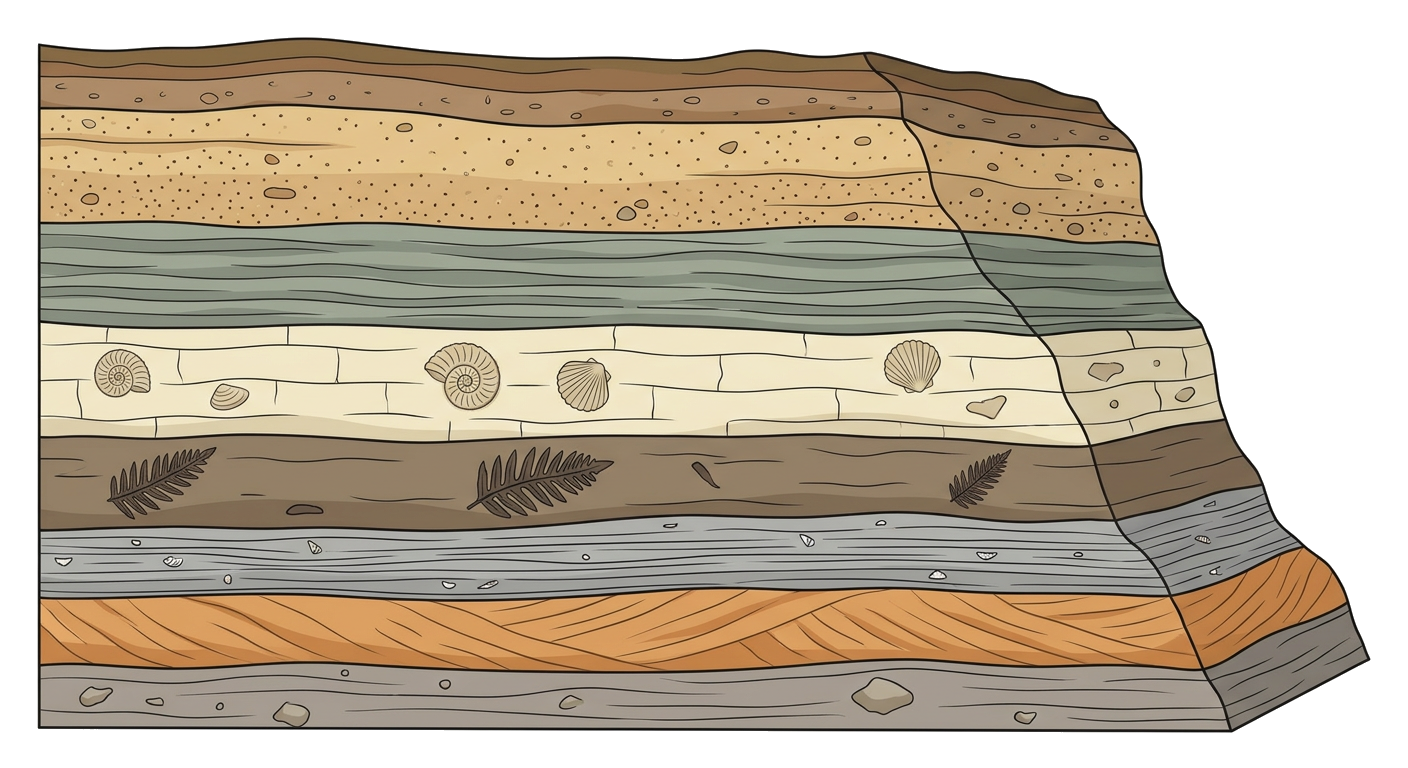
7. Explain why the Law of Superposition might not hold true in an area with significant tectonic activity.
8. The Law of Superposition can be used to determine the exact numerical age of a rock layer.
True
False
9. Igneous intrusions are always older than the sedimentary rock layers they cut through.
True
False
Match the geological term with its definition.
10. Stratigraphy
a. The process by which sediments are compacted and cemented to form sedimentary rock.
11. Relative Age
b. The study of rock layers and their formation.
12. Lithification
c. The age of a rock layer compared to other rock layers.