Locating Earthquakes
Explore how seismographs work and how seismic waves are used to locate earthquake epicenters.
Includes
Standards
Topics
Locating Earthquakes Worksheet
Name:
Date:
Score:
Read each question carefully and answer to the best of your ability. Use complete sentences for short answer questions.
1. What is the name of the instrument used to detect and record seismic waves?
Barometer
Anemometer
Seismograph
Thermometer
2. Which type of seismic wave travels fastest and arrives first at a seismograph station?
S-waves
P-waves
Surface waves
Tidal waves
1. The point on the Earth's surface directly above the focus of an earthquake is called the .
2. Scientists use data from at least seismic stations to locate an earthquake's epicenter.
3. The difference in arrival times between P-waves and S-waves helps seismologists determine the to the earthquake.
1. Explain the principle of triangulation as it applies to locating an earthquake's epicenter.
The image below shows a simplified seismogram. Study it and answer the questions.
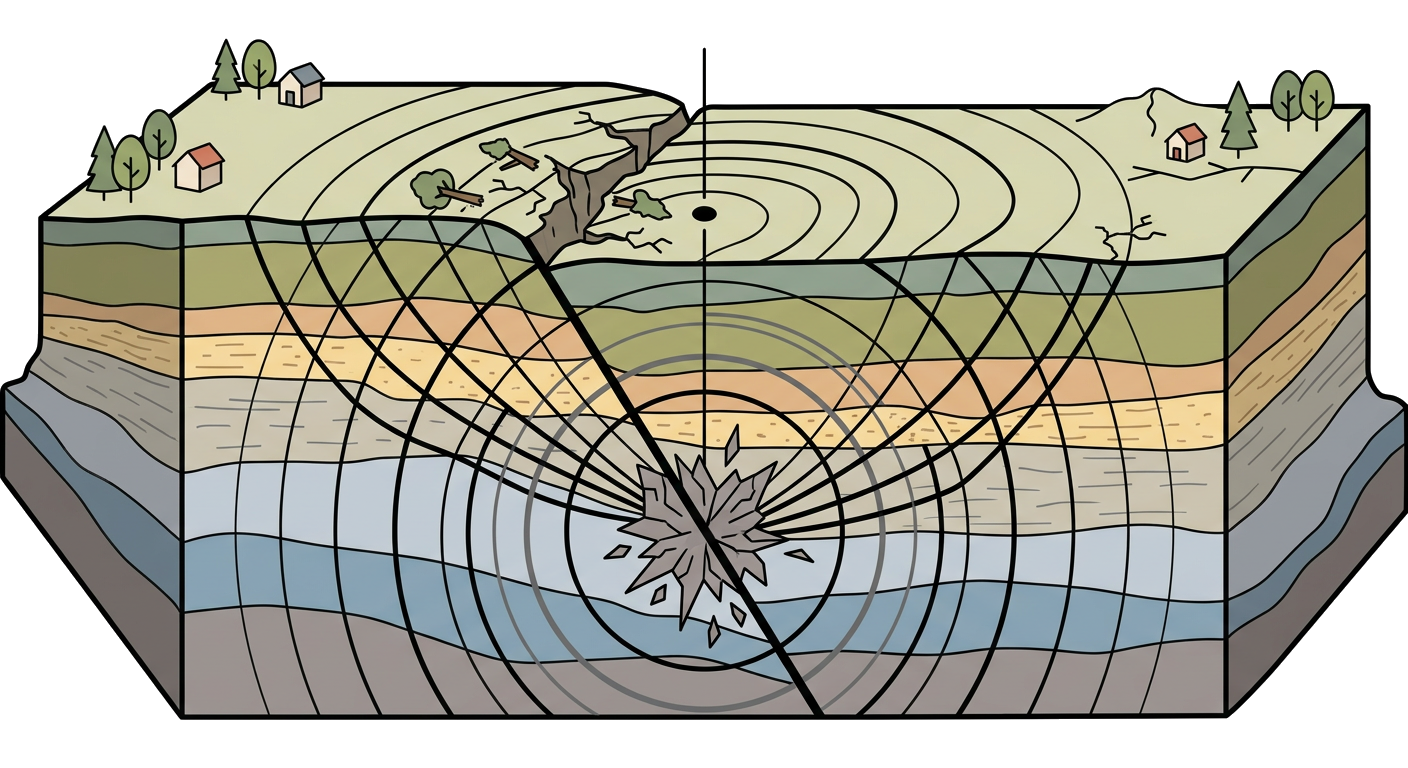
1. On the seismogram, identify and label the arrival of the P-wave and the S-wave.
2. How would the time difference between the P-wave and S-wave arrival change if the seismograph station was further from the earthquake's epicenter?
1. Surface waves cause the most damage during an earthquake.
True
False
2. The Richter scale measures the intensity of an earthquake, not its magnitude.
True
False