Autosomal Recessive Inheritance Worksheet
Explore the principles of autosomal recessive inheritance with this Grade 9 science worksheet, covering genotypes, phenotypes, and Punnett squares.
Includes
Standards
Autosomal Recessive Inheritance
Name:
Date:
Score:
Read each question carefully and provide your best answer. For multiple choice, circle the correct option. For fill-in-the-blanks, write your answer on the line provided. For short answer questions, use the space provided.
1. In autosomal recessive inheritance, an individual must inherit which of the following to express the trait?
One dominant allele and one recessive allele
Two dominant alleles
Two recessive alleles
Only one recessive allele
2. If both parents are carriers (heterozygous) for an autosomal recessive trait, what is the probability that their child will express the trait?
0%
25%
50%
75%
3. An individual with one dominant allele and one recessive allele for a trait is called a .
4. In autosomal recessive inheritance, the trait only appears when an individual is for the recessive allele.
5. Cystic fibrosis (CF) is an autosomal recessive disorder. Let 'F' represent the dominant allele for normal function and 'f' represent the recessive allele for cystic fibrosis. If a carrier mother (Ff) and a carrier father (Ff) have children, complete the Punnett square below and answer the questions.
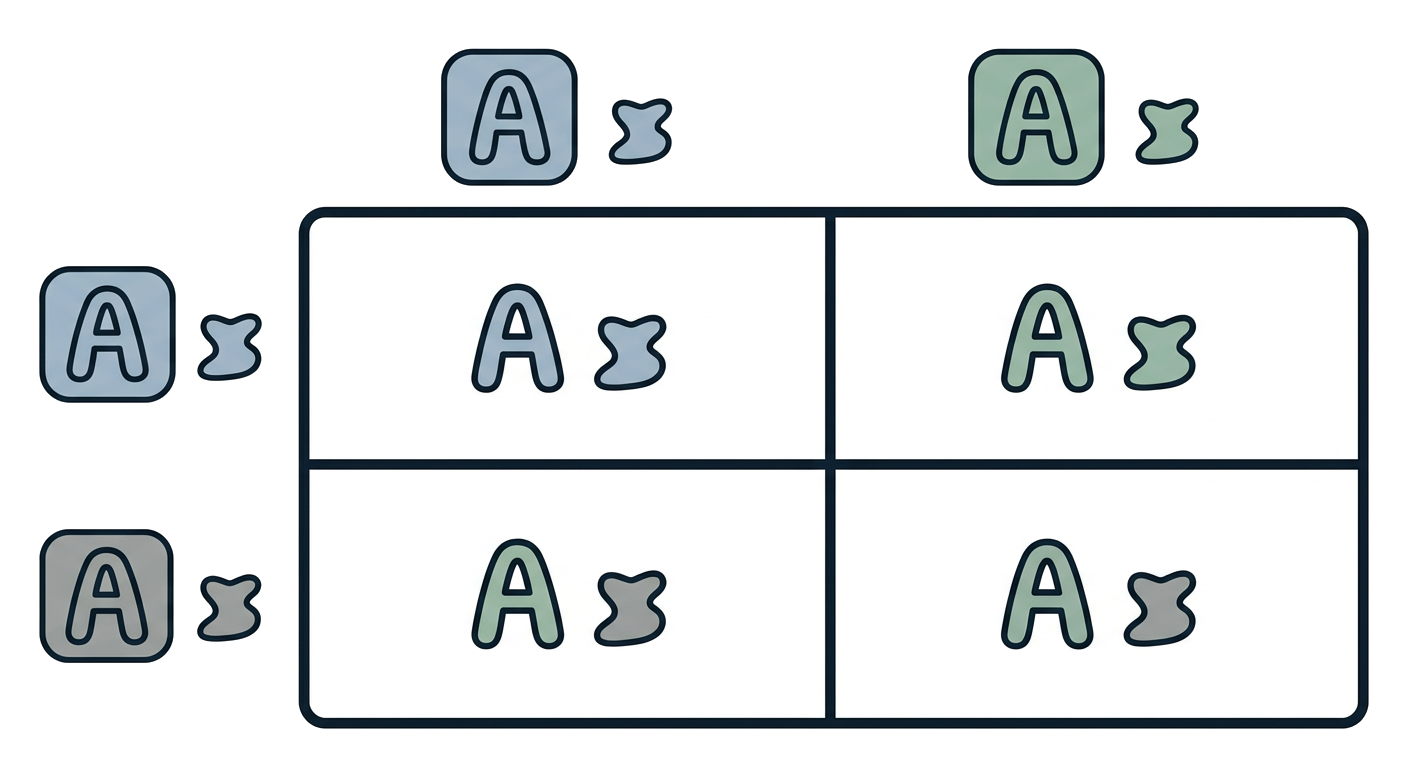
a. What is the probability that their child will have cystic fibrosis?
b. What is the probability that their child will be a carrier for cystic fibrosis?
c. What is the probability that their child will be homozygous dominant?
6. If an individual has one copy of the recessive allele for an autosomal recessive trait, they will always show symptoms of the disorder.
True
False
7. Autosomal recessive traits are equally likely to affect males and females.
True
False
8. Explain why two parents who do not express an autosomal recessive trait can still have a child who does express the trait.