Grade 9 Pedigree Analysis Worksheet
Analyze pedigree charts to understand inheritance patterns of genetic traits, including autosomal dominant, autosomal recessive, and X-linked inheritance.
Includes
Standards
Topics
Grade 9 Pedigree Analysis Worksheet
Name:
Date:
Score:
Carefully read each question and analyze the provided pedigree charts to answer accurately. Remember to consider patterns of inheritance such as autosomal dominant, autosomal recessive, and X-linked.
A pedigree chart is a diagram that shows the occurrence and appearance or phenotypes of a particular gene or organism and its ancestors from one generation to the next, most commonly in humans, dogs, and race horses. Understanding these charts is crucial for predicting genetic disorders and traits.
1. In a pedigree chart, what does a square symbol typically represent?
Female
Male
Affected individual
Carrier
2. Which pattern of inheritance typically shows affected individuals in every generation, with affected offspring having at least one affected parent?
Autosomal recessive
Autosomal dominant
X-linked recessive
Y-linked
Directions: Analyze the pedigree chart below and answer the questions that follow.
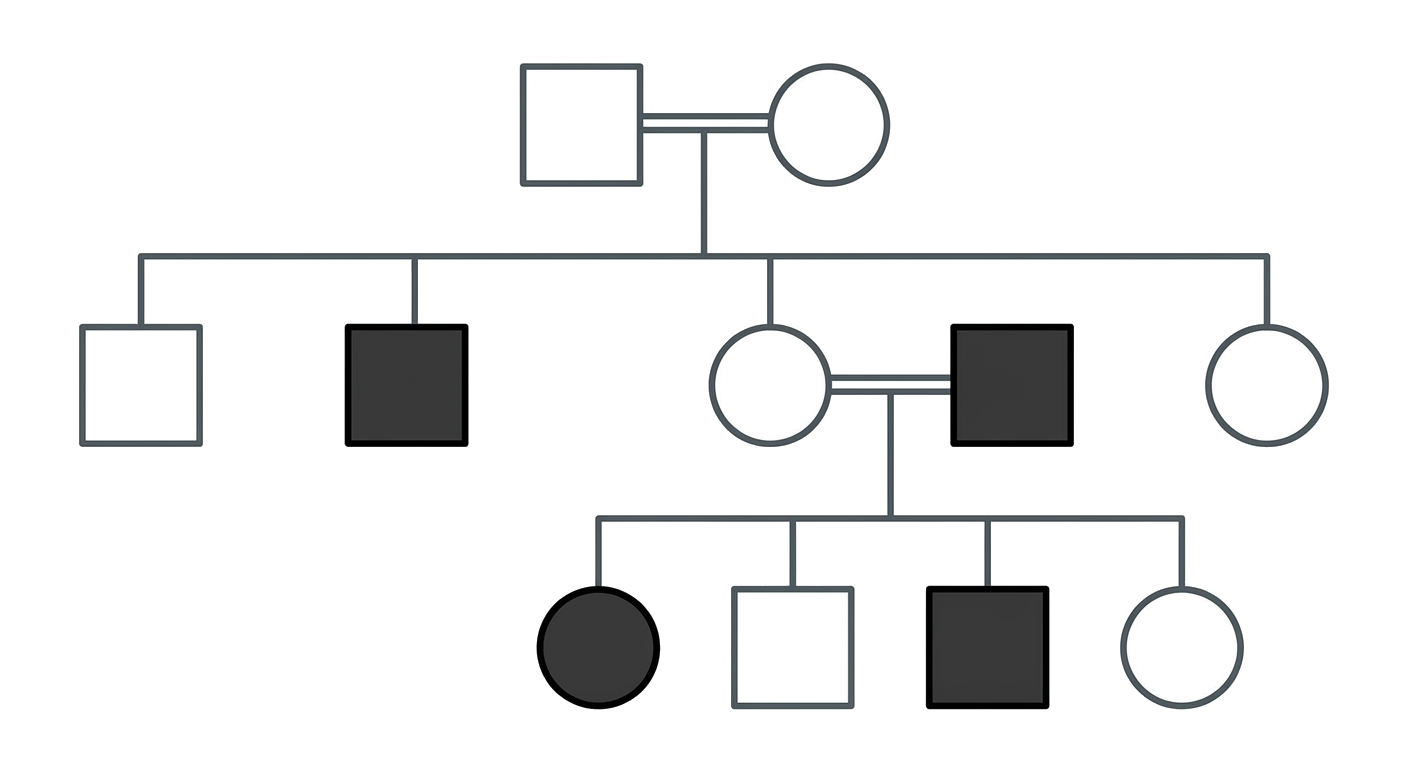
3. How many generations are shown in this pedigree chart?
4. Is the trait shown in the pedigree likely dominant or recessive? Explain your reasoning.
5. Is the trait likely autosomal or X-linked? Explain your reasoning.
6. In a pedigree, a half-filled symbol indicates a .
7. If a trait is X-linked recessive, it will be more common in .
8. Consanguineous marriages (marriages between close relatives) often increase the likelihood of offspring inheriting disorders.
9. An affected female in an X-linked recessive pedigree must have an affected father and at least a carrier mother.
True
False
10. In autosomal dominant inheritance, two unaffected parents can have an affected child.
True
False