Grade 9 Science: Sex-Linked Pedigrees
Explore the inheritance patterns of sex-linked traits through pedigree analysis in this Grade 9 science worksheet.
Includes
Standards
Topics
Sex-Linked Pedigrees: Grade 9 Science
Name:
Date:
Score:
Read each question carefully and answer to the best of your ability. Refer to the provided pedigree charts to analyze inheritance patterns.
Sex-linked traits are genetic characteristics determined by genes located on the sex chromosomes (X or Y). In humans, most sex-linked traits are X-linked, meaning the gene is on the X chromosome. Because males have only one X chromosome (XY), they are more likely to express recessive X-linked traits than females (XX). Pedigrees are diagrams that show the inheritance of a trait through several generations of a family.
1. Which of the following best describes a sex-linked trait?
A trait found only in males.
A trait whose gene is located on a sex chromosome.
A trait that skips generations.
A trait expressed equally in males and females.
2. Why are males more susceptible to X-linked recessive disorders?
They have two X chromosomes.
They only have one X chromosome.
They have a Y chromosome.
They inherit more genes from their mother.
Use the pedigree chart below to answer the following questions. Assume the shaded individuals express the recessive sex-linked trait.
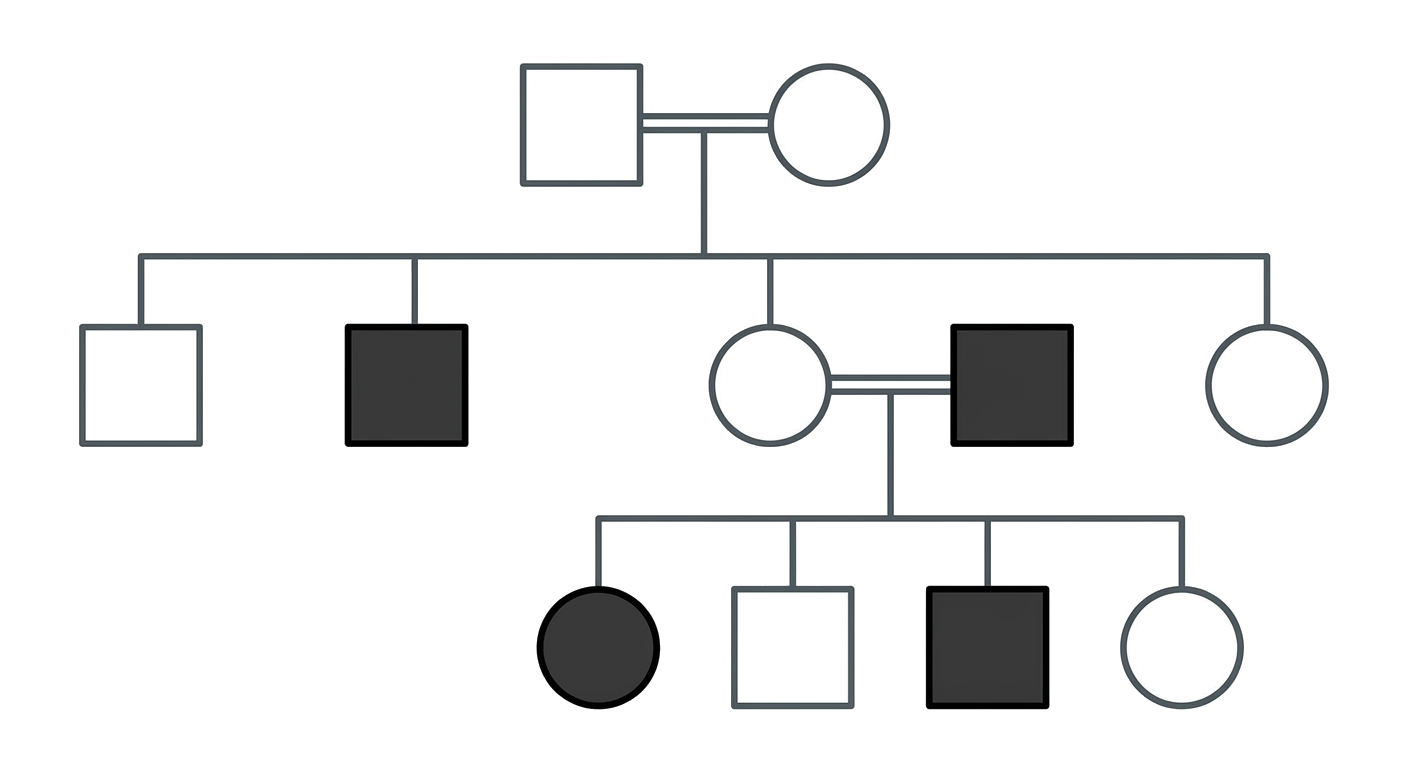
3. Based on the pedigree, is the trait dominant or recessive? Explain your reasoning.
4. Is the trait X-linked or Y-linked? Justify your answer.
5. What is the genotype of individual II-1 (the first male in the second generation)? Use 'X' and 'Y' for chromosomes and 'A'/'a' for alleles.
6. What is the probability that individual III-2 (the second female in the third generation) is a carrier for the trait?
7. A male cannot be a carrier for an X-linked recessive trait.
True
False
8. All daughters of a father with an X-linked recessive trait will be carriers.
True
False
9. In a pedigree, squares represent and circles represent .
10. An individual who carries one copy of a recessive allele for an X-linked trait but does not express the trait is called a .