Ocean Water Movements Worksheet
Explore the fascinating movements of ocean water, including currents, waves, and tides, and their impact on Earth's climate and ecosystems.
Includes
Standards
Topics
Ocean Water Movements
Name:
Date:
Score:
Read each question carefully and provide your best answer. Some questions may require you to refer to the provided illustration.
1. Which of the following is the primary driving force behind surface ocean currents?
Tidal forces from the moon
Wind
Variations in water density
Earth's magnetic field
2. The Coriolis effect deflects ocean currents to the in the Northern Hemisphere.
Left
Right
Upward
Downward
3. The rhythmic rise and fall of ocean water is known as a .
4. Deep ocean currents are primarily driven by differences in water and .
5. Waves are a significant factor in the global distribution of heat across the planet.
True
False
6. The Gulf Stream is a warm ocean current that significantly influences the climate of Western Europe.
True
False
7. Explain the difference between a wave and a current.
8. Describe how the 'Ocean Zones Cross Section' illustration below demonstrates the concept of different ocean layers.
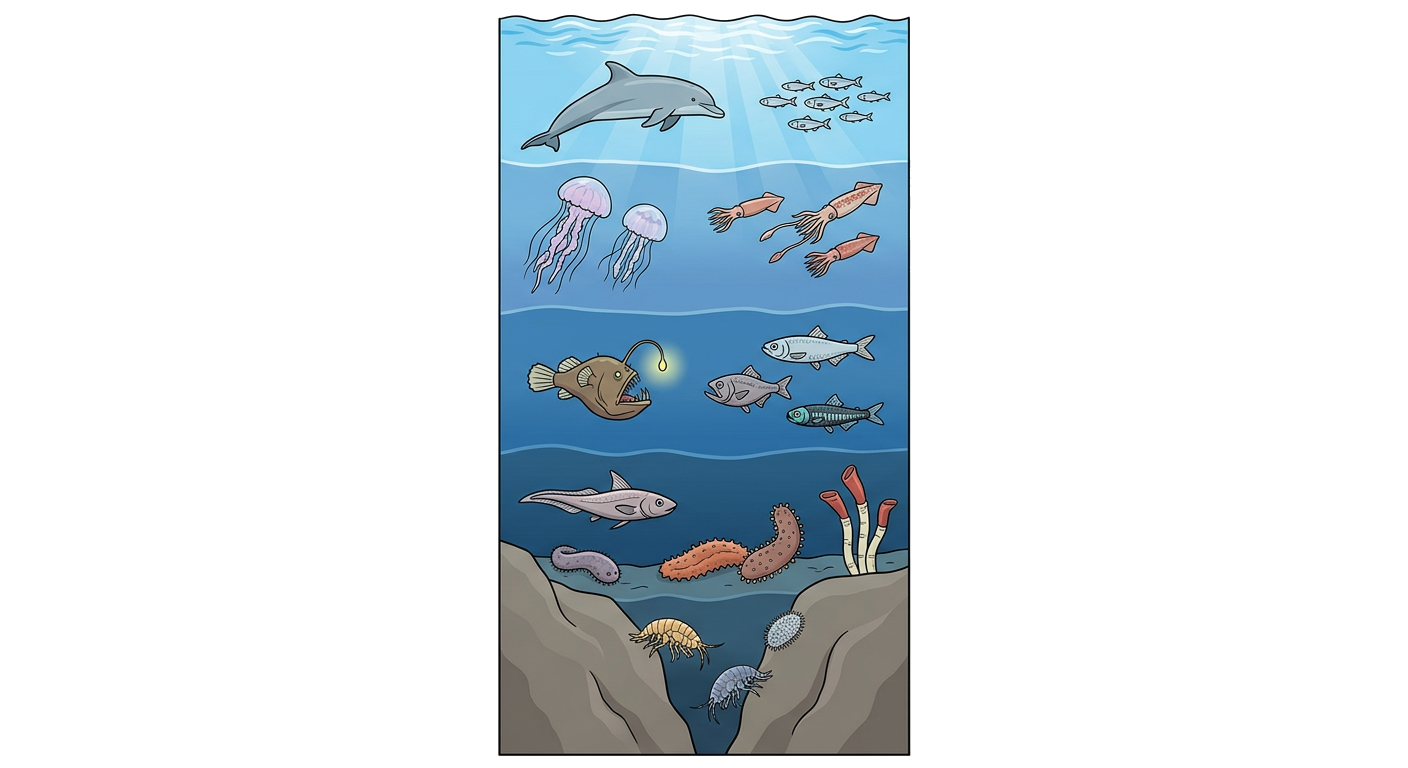
Match each term on the left with its definition on the right.
9. Tides
a. The horizontal movement of ocean water.
10. Currents
b. The rhythmic rise and fall of ocean water due to gravitational forces.
11. Waves
c. The transfer of energy through water, causing oscillations.
12. Discuss the global conveyor belt (thermohaline circulation) and its significance for Earth's climate and marine ecosystems. Include how it is driven and its general path.