Federalist Debate Worksheet
Explore the historical context, key arguments, and influential figures of the Federalist Debate in early U.S. history.
Includes
Topics
Federalist Debate: Understanding the Foundations
Name:
Date:
Score:
Read each question carefully and answer to the best of your knowledge. This worksheet will assess your understanding of the Federalist and Anti-Federalist debates during the formation of the United States Constitution.
1. Which of the following was a primary concern of the Anti-Federalists?
A strong central government that could protect individual liberties.
The absence of a Bill of Rights to protect individual freedoms.
The need for a national currency and uniform economic policies.
The potential for states to become too powerful and independent.
2. The Federalist Papers were a series of essays written to:
Argue against the ratification of the Constitution.
Support the Articles of Confederation.
Persuade states to ratify the Constitution.
Propose amendments to the Constitution.
3. The primary authors of The Federalist Papers were Alexander Hamilton, James Madison, and .
4. Anti-Federalists often argued that the new Constitution lacked a to protect citizens' rights.
5. Federalists believed in a strong central government with broad powers.
True
False
6. The Anti-Federalists were generally wealthy merchants and landowners.
True
False
7. Briefly explain the main difference in philosophy between the Federalists and Anti-Federalists regarding the power of the national government.
8. What was the purpose of the Federalist Papers, and why were they important?
Examine the image of the Federalist Papers below and answer the question that follows.
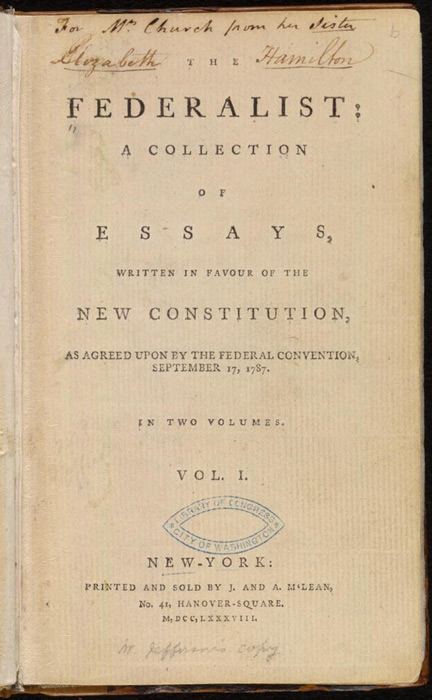
9. Based on the image, and your knowledge of the Federalist Debate, what does the publication of such a document suggest about the political climate in America during the late 1780s?
Use the words below to complete the sentences.
10. Anti-Federalists feared that a strong central government could lead to .
11. The process of officially approving the Constitution was known as .