Cellular Transport Worksheet
Grade 11 Biology worksheet focusing on active and passive cellular transport mechanisms, including diffusion, osmosis, facilitated diffusion, and active transport.
Includes
Standards
Topics
Cellular Transport: Grade 11 Biology
Name:
Date:
Score:
Read each question carefully and answer to the best of your ability. This worksheet covers various aspects of cellular transport, including passive and active mechanisms.
1. Which of the following best describes the primary function of the cell membrane?
To produce energy for the cell.
To control what enters and leaves the cell.
To store genetic material.
To synthesize proteins.
2. Which type of transport requires the cell to expend energy?
Simple diffusion
Osmosis
Facilitated diffusion
Active transport
1. The movement of water across a selectively permeable membrane is called .
2. Large molecules are transported out of the cell by a process called .
3. The is composed of a phospholipid bilayer with embedded proteins.
1. Diffusion is the movement of molecules from an area of lower concentration to an area of higher concentration.
True
False
2. Facilitated diffusion requires energy in the form of ATP.
True
False
1. Describe the main difference between passive transport and active transport.
2. Explain how a cell maintains homeostasis through selective permeability of its membrane.
Observe the diagram of a cell membrane below and answer the questions.
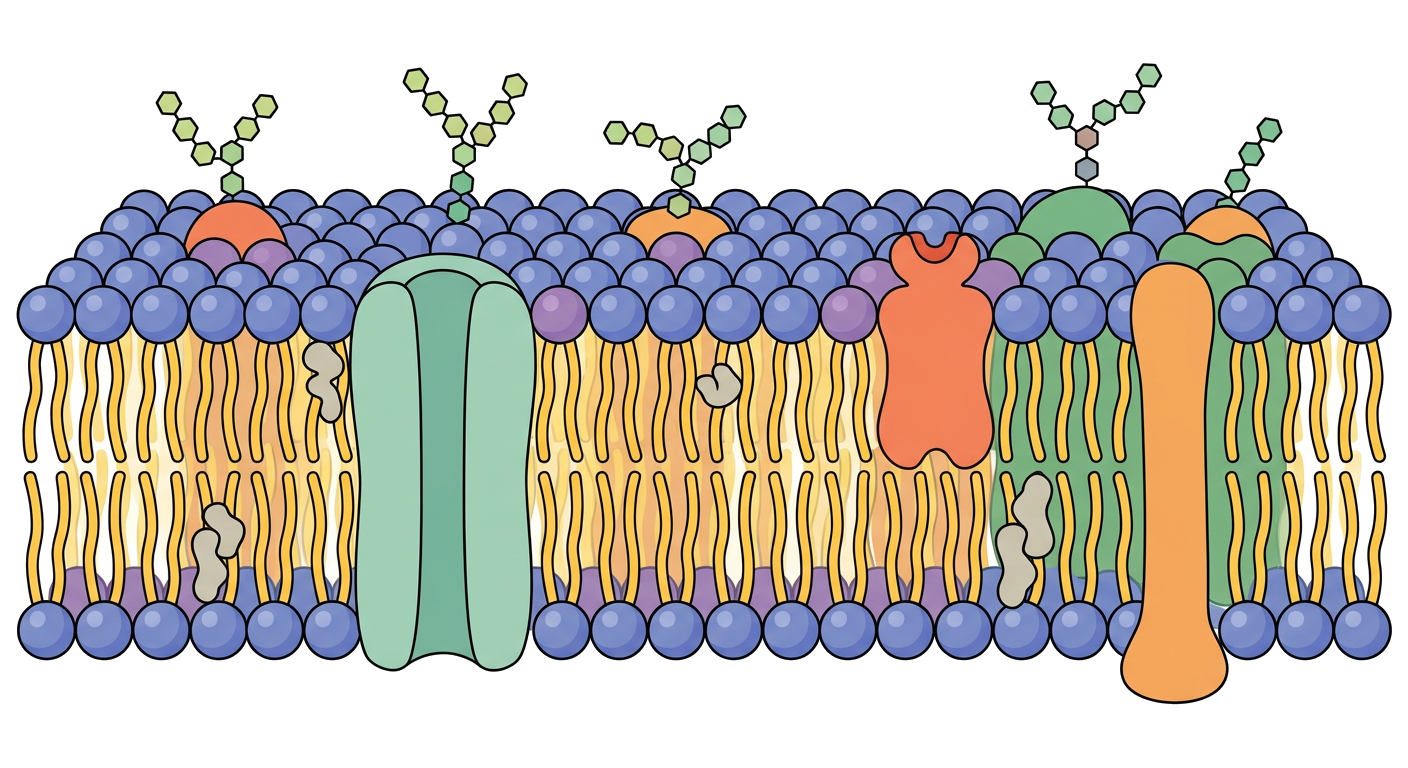
1. Identify two components labeled in the cell membrane diagram that are involved in transport.
2. Briefly explain the role of the phospholipid bilayer in regulating cellular transport.
Use the words below to complete the sentences.
1. Active transport moves substances against their .
2. are required for facilitated diffusion to transport specific molecules across the membrane.
3. The process of a cell engulfing substances by forming a vesicle is known as .
4. Energy for active transport is often provided by .
Related Worksheets
The Cell Membrane: Structure and Function
An 11th-grade science worksheet focusing on the structure, components, and functions of the cell membrane, including transport mechanisms.
Human Skull Anatomy Worksheet
Explore the complex anatomy and functions of the human skull with this Grade 11 science worksheet.