Lung Volumes and Capacities Worksheet
Explore the different lung volumes and capacities, their definitions, and their significance in respiratory physiology for Grade 11 science students.
Includes
Standards
Topics
Lung Volumes and Capacities
Name:
Date:
Score:
Read each question carefully and answer to the best of your ability. Refer to your notes and textbook if needed.
1. Which of the following represents the total amount of air that can be inspired after a normal expiration?
Tidal Volume (TV)
Inspiratory Capacity (IC)
Vital Capacity (VC)
Functional Residual Capacity (FRC)
2. The volume of air remaining in the lungs after a maximal forceful expiration is called:
Expiratory Reserve Volume (ERV)
Residual Volume (RV)
Total Lung Capacity (TLC)
Inspiratory Reserve Volume (IRV)
3. The sum of tidal volume and inspiratory reserve volume is known as the .
4. is the volume of air moved in or out of the lungs during a single, normal breath.
5. The total amount of exchangeable air, which is the sum of TV, IRV, and ERV, is called the .
6. Briefly explain the difference between a lung volume and a lung capacity.
7. Total Lung Capacity (TLC) can be measured directly using a spirometer.
True
False
8. Inspiratory Reserve Volume (IRV) is typically larger than Expiratory Reserve Volume (ERV).
True
False
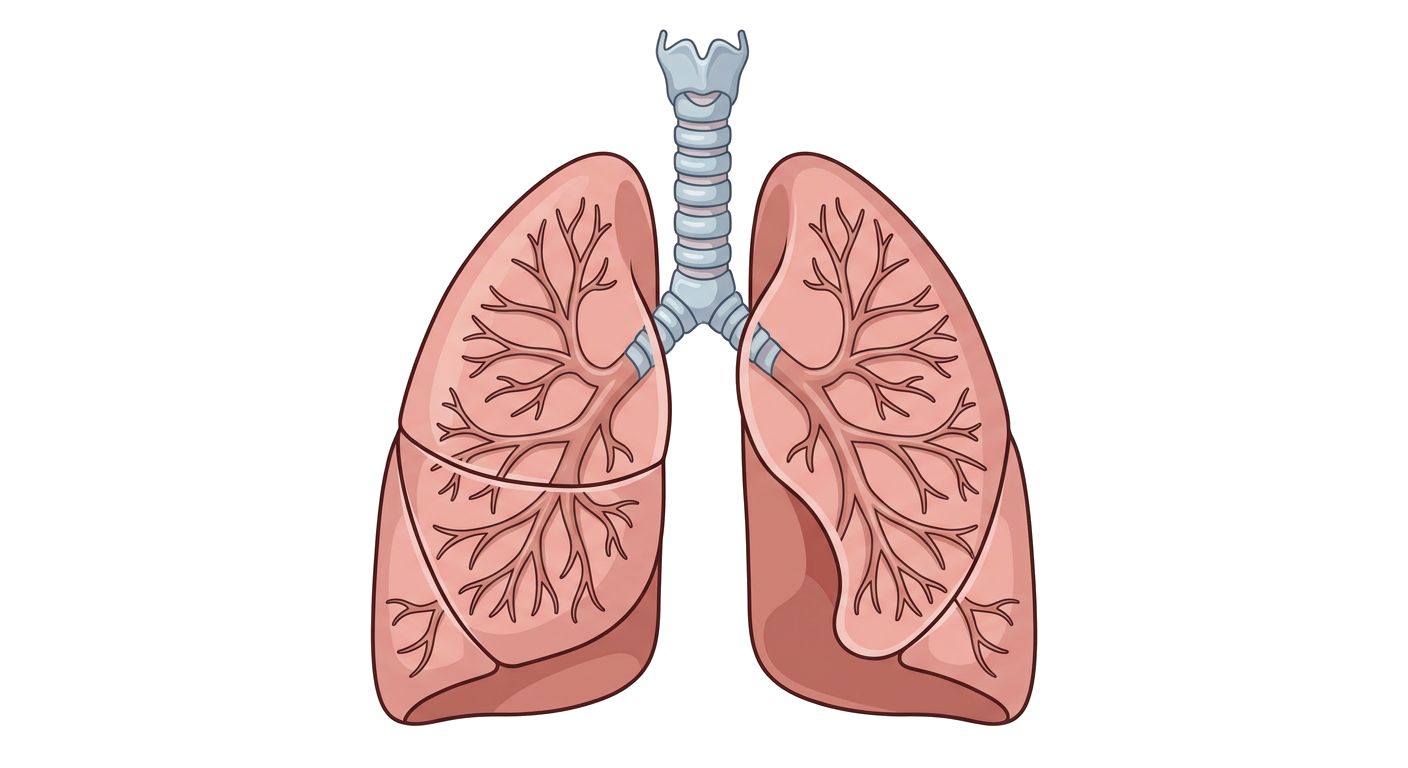
9. Label the main structures of the lungs and airways shown in the diagram.
10. In relation to the diagram, where would residual volume be primarily located?
Related Worksheets
The Cell Membrane: Structure and Function
An 11th-grade science worksheet focusing on the structure, components, and functions of the cell membrane, including transport mechanisms.
Human Skull Anatomy Worksheet
Explore the complex anatomy and functions of the human skull with this Grade 11 science worksheet.