Grade 11 Biology: Muscle Contraction Worksheet
This worksheet covers the fundamental mechanisms of muscle contraction, including the sliding filament theory and the roles of key proteins and ions.
Includes
Standards
Topics
Grade 11 Biology: Muscle Contraction
Name:
Date:
Score:
Read each question carefully and answer to the best of your ability. Show all your work for calculations and explain your reasoning where necessary.
1. The basic unit of muscle contraction is the .
2. During muscle contraction, the filaments slide past the filaments.
3. The binding of to troponin causes a conformational change that exposes the binding sites on actin.
4. ATP is required for the detachment of heads from actin and for the pumping of calcium ions back into the reticulum.
1. Which of the following is responsible for transmitting the action potential from the motor neuron to the muscle fiber?
Sarcoplasmic reticulum
Neuromuscular junction
T-tubules
Sarcolemma
2. What is the primary role of ATP in muscle contraction?
Binding to troponin to expose actin sites
Causing the power stroke of the myosin head
Detaching myosin from actin and actively transporting Ca2+
Storing calcium ions in the sarcoplasmic reticulum
1. Briefly explain the 'sliding filament theory' of muscle contraction.
2. Describe the role of calcium ions (Ca2+) in initiating muscle contraction.
1. Troponin and tropomyosin are regulatory proteins associated with thick filaments.
True
False
2. A single motor neuron can innervate multiple muscle fibers.
True
False
Examine the diagram of a muscle fiber cross-section below and answer the question that follows.
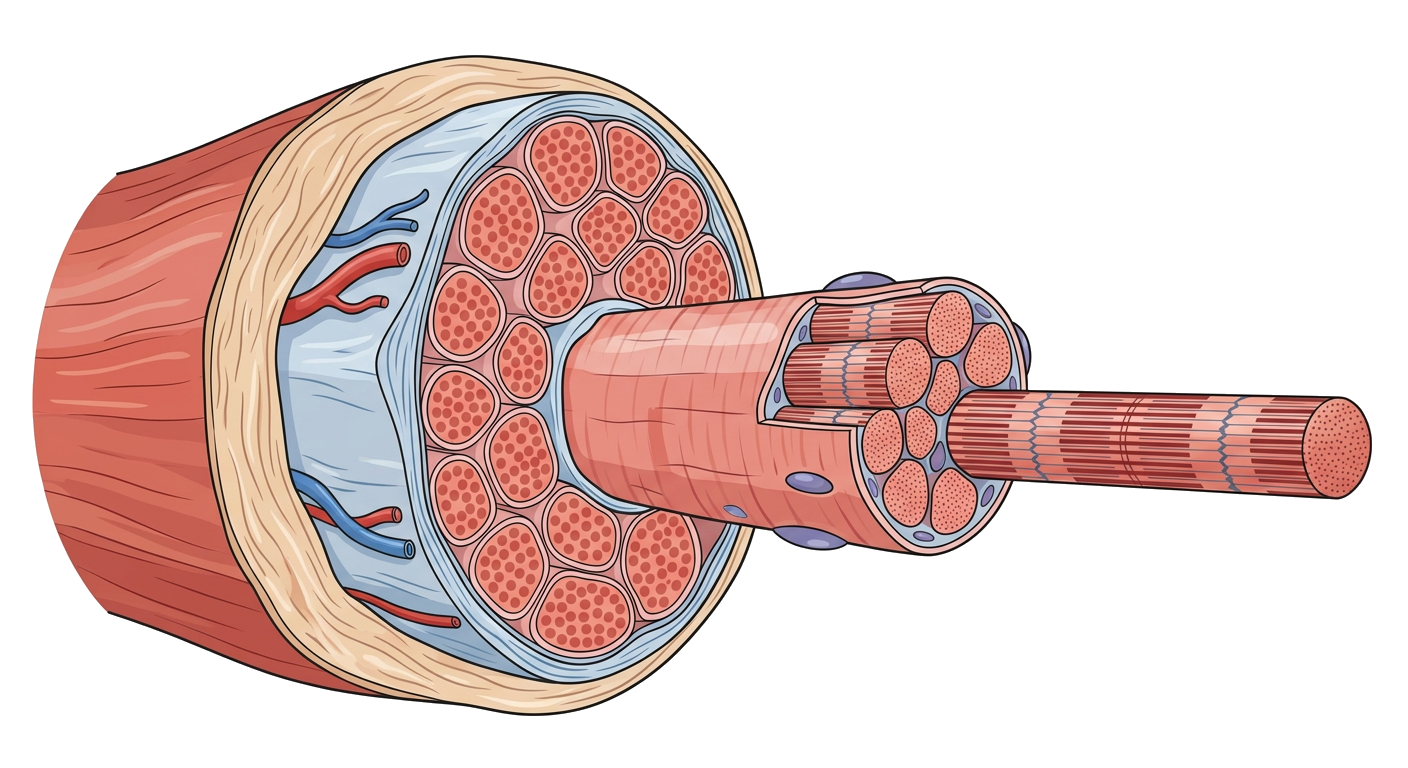
1. Identify two key structures visible in the cross-section that are directly involved in the sliding filament mechanism. Briefly describe their roles.
Related Worksheets
The Cell Membrane: Structure and Function
An 11th-grade science worksheet focusing on the structure, components, and functions of the cell membrane, including transport mechanisms.
Human Skull Anatomy Worksheet
Explore the complex anatomy and functions of the human skull with this Grade 11 science worksheet.