Passive Transport Review
A Grade 11 science worksheet covering key concepts of passive transport including diffusion, osmosis, and facilitated diffusion.
Includes
Standards
Topics
Passive Transport Review
Name:
Date:
Score:
Read each question carefully and provide your best answer. This worksheet will test your knowledge of passive transport mechanisms.
1. Which of the following best describes passive transport?
Movement of substances against their concentration gradient, requiring energy.
Movement of substances from an area of high concentration to an area of low concentration, without requiring energy.
Movement of water molecules across a selectively permeable membrane, requiring ATP.
Bulk transport of large molecules into or out of the cell.
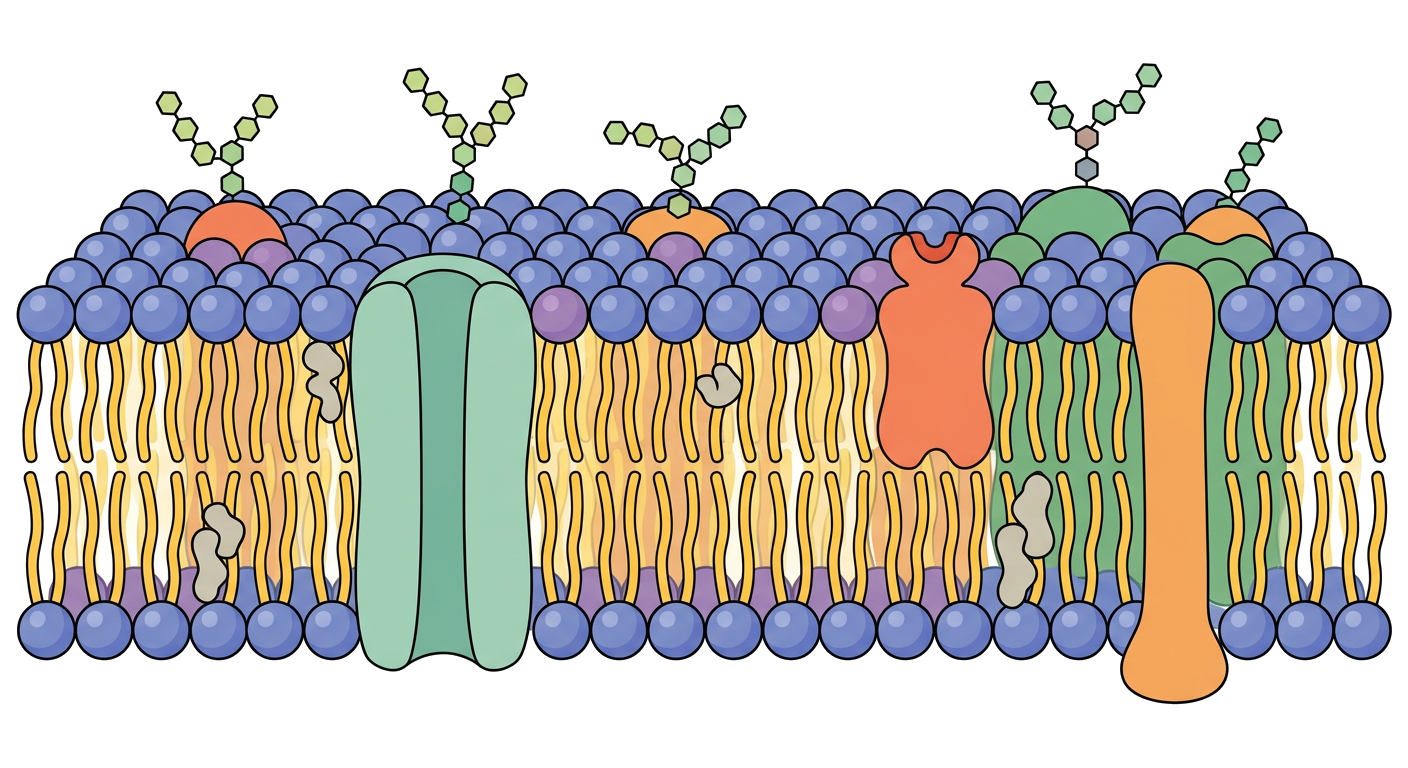
2. The illustration below shows a cell membrane. Which component is primarily responsible for facilitated diffusion?
Phospholipid bilayer
Integral proteins
Cholesterol
Glycoproteins
3. The movement of water across a selectively permeable membrane from a region of high water concentration to a region of low water concentration is called .
4. Small, nonpolar molecules like oxygen and carbon dioxide cross the cell membrane primarily through diffusion.
5. In diffusion, transport proteins assist in the movement of molecules across the membrane, but no ATP is expended.
6. Hypertonic solutions cause animal cells to swell and burst.
True
False
7. Passive transport always involves the movement of substances down their concentration gradient.
True
False
8. Differentiate between simple diffusion and facilitated diffusion. Provide an example of a substance that moves by each method.
9. Explain the concept of osmosis using the terms 'solute concentration' and 'water potential'.
Match the term on the left with its definition on the right.
10. Isotonic solution
a. Contains a lower solute concentration than the cell
11. Hypotonic solution
b. Contains a higher solute concentration than the cell
12. Hypertonic solution
c. Has the same solute concentration as the cell
Related Worksheets
The Cell Membrane: Structure and Function
An 11th-grade science worksheet focusing on the structure, components, and functions of the cell membrane, including transport mechanisms.
Human Skull Anatomy Worksheet
Explore the complex anatomy and functions of the human skull with this Grade 11 science worksheet.