Viruses and Bacteria: A Comparative Study
This worksheet explores the fundamental differences and similarities between viruses and bacteria, their structures, modes of reproduction, and impact on living organisms.
Includes
Standards
Topics
Viruses and Bacteria: A Comparative Study
Name:
Date:
Score:
Read each question carefully and answer to the best of your ability. Use complete sentences for short answer questions.
1. Which of the following statements best describes a virus?
A single-celled prokaryotic organism.
A non-living particle that can only replicate inside a host cell.
A multicellular eukaryotic organism.
A parasitic fungus.
2. Which of the following is a key characteristic of bacteria that differentiates them from viruses?
Presence of a protein coat (capsid).
Ability to reproduce independently.
Lack of cellular organelles.
Presence of a nucleic acid genome (DNA or RNA).
3. Viruses are obligate parasites, meaning they require a host cell to replicate.
4. Bacteria reproduce primarily through a process called , which is a form of asexual reproduction.
5. The genetic material of a virus can be either DNA or RNA, enclosed within a protein coat called a .
6. All bacteria are harmful to humans.
True
False
7. Viruses are considered living organisms because they can reproduce independently.
True
False
8. Describe the basic structure of a bacteriophage, using the image below as a reference.
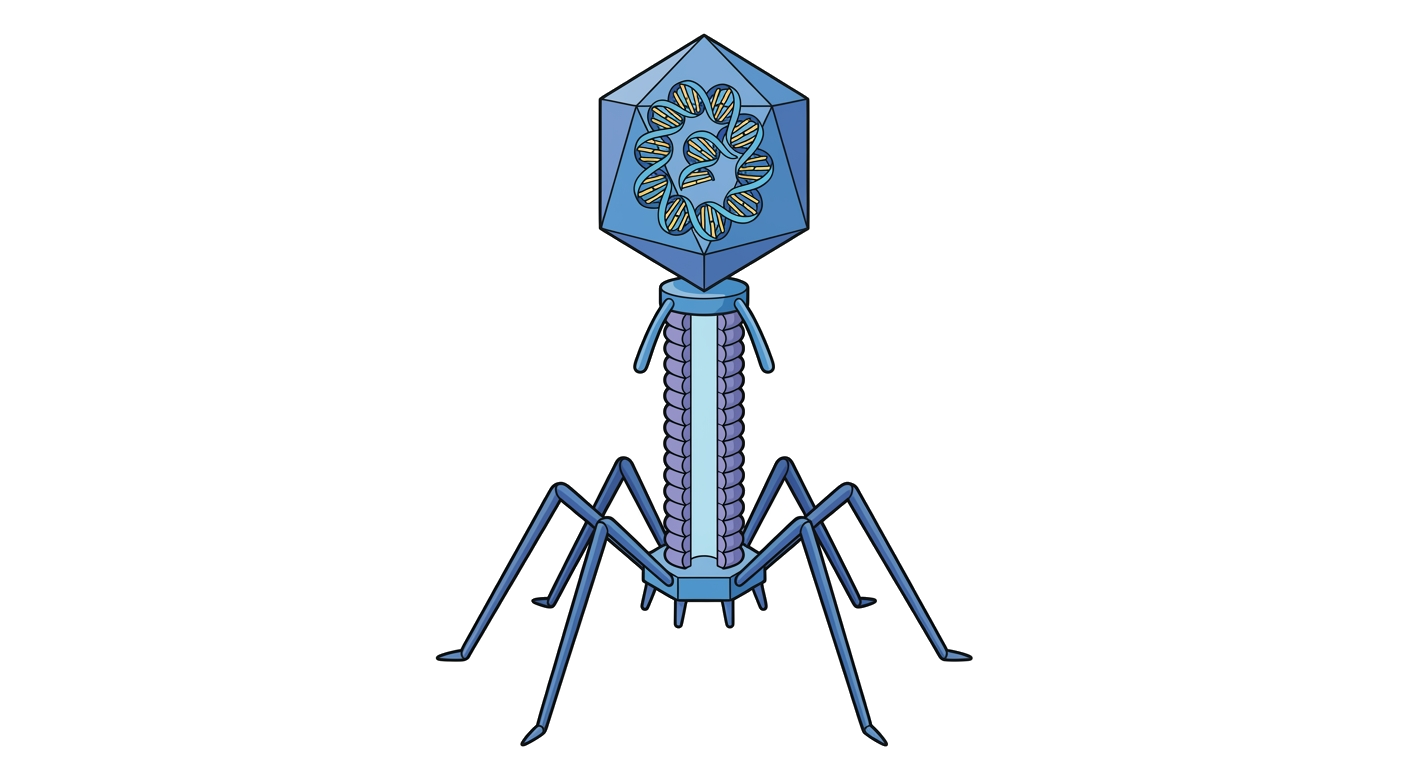
9. Explain two ways in which bacteria are beneficial to humans or the environment.
Match the term on the left with its correct definition on the right.
10. Plasmid
a. The process by which bacteria transfer genetic material through direct cell-to-cell contact.
11. Conjugation
b. A small, circular, double-stranded DNA molecule that is distinct from a bacterial cell's chromosomal DNA.
12. Endospore
c. A dormant, tough, and non-reproductive structure produced by some bacteria.
13. Compare and contrast the lytic and lysogenic cycles of viral replication. Include details on what happens to the host cell in each cycle.
Related Worksheets
The Cell Membrane: Structure and Function
An 11th-grade science worksheet focusing on the structure, components, and functions of the cell membrane, including transport mechanisms.
Human Skull Anatomy Worksheet
Explore the complex anatomy and functions of the human skull with this Grade 11 science worksheet.