Lenses in Geometric Optics
Explore the properties of convex and concave lenses, ray tracing, and image formation in this Grade 11 Physics worksheet.
Includes
Standards
Topics
Lenses in Geometric Optics
Name:
Date:
Score:
Read each question carefully and provide your answers in the space provided. For ray tracing diagrams, assume the principal axis is horizontal.
1. Which type of lens is thicker in the middle and thinner at the edges?
Concave lens
Convex lens
Plano-concave lens
Plano-convex lens
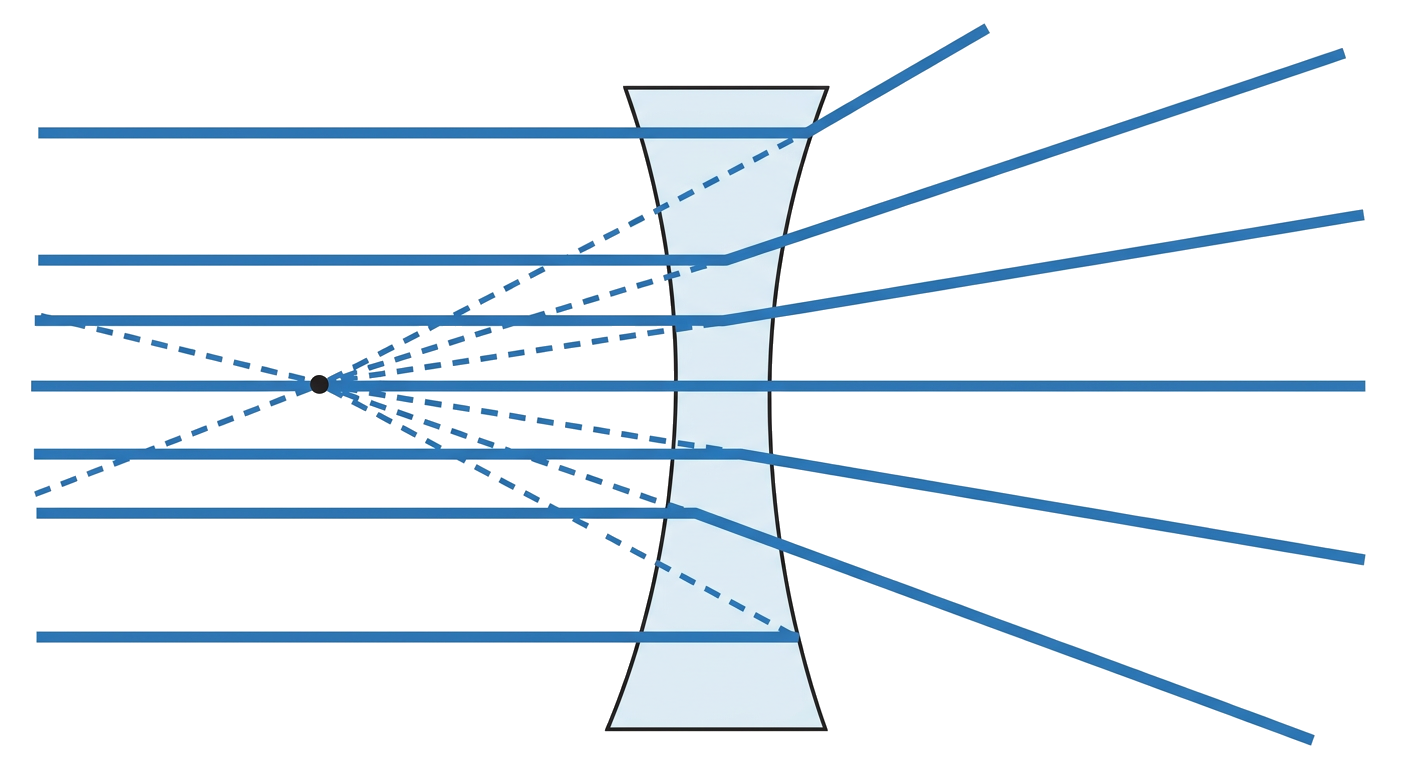
2. When parallel rays of light pass through a concave lens, they appear to diverge from a point called the:
Real focus
Virtual focus
Optical center
Principal axis
1. The distance between the optical center of a lens and its principal focus is called the .
2. A convex lens is also known as a lens because it converges parallel rays of light.
1. Draw a ray diagram for an object placed beyond 2F of a convex lens. Describe the characteristics of the image formed (real/virtual, inverted/erect, magnified/diminished).
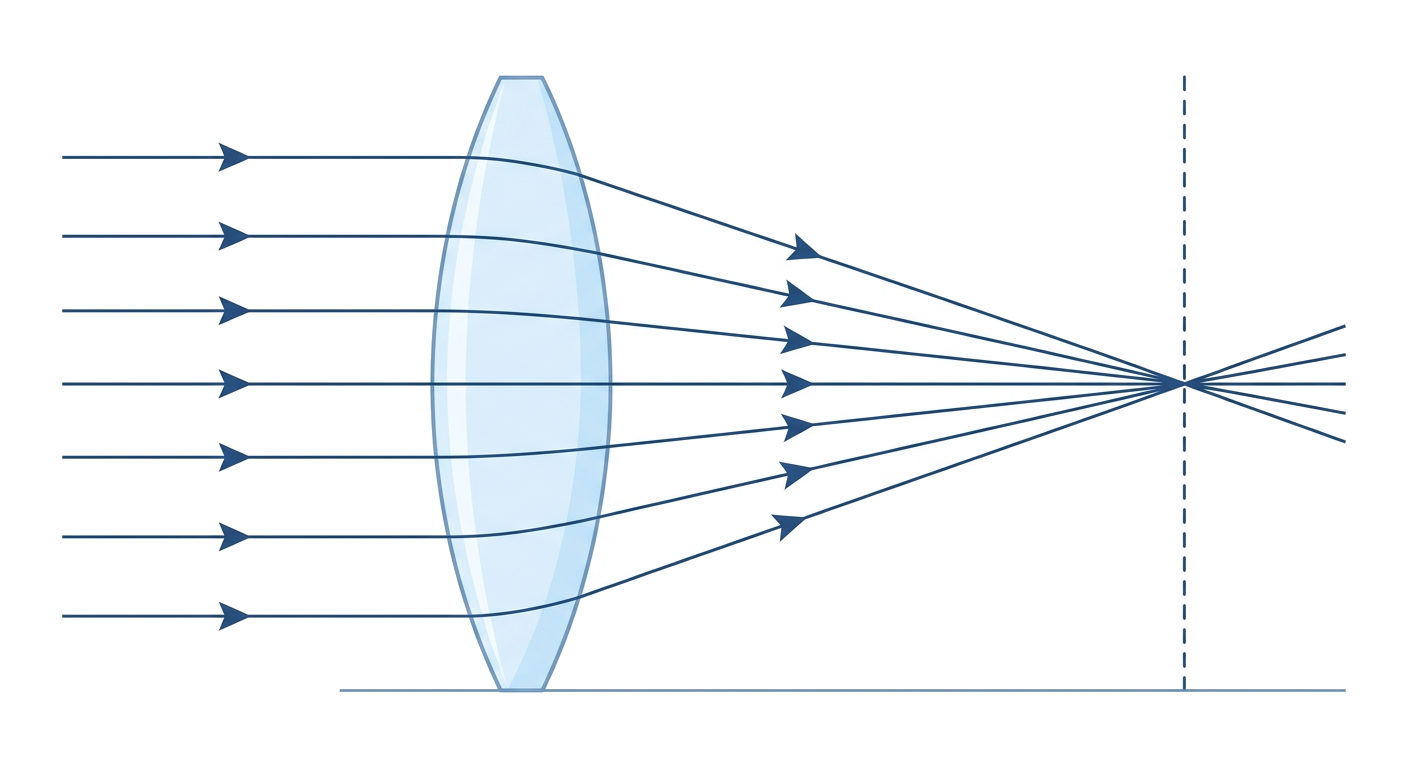
2. Draw a ray diagram for an object placed between the optical center and the focal point (F) of a concave lens. Describe the characteristics of the image formed.
1. A real image can be projected onto a screen.
True
False
2. The power of a lens is measured in diopters.
True
False
Match the term on the left with its definition on the right.
1. Focal length
a. The point where parallel rays converge or appear to diverge from
2. Optical center
b. The distance from the optical center to the principal focus
3. Principal focus
c. The central point of the lens through which light rays pass undeviated
1. Explain why a convex lens is used in magnifying glasses.
2. Describe one real-world application of a concave lens.
Related Worksheets
Conservation of Charge Worksheet
An 11th-grade physics worksheet focusing on the principle of conservation of electric charge, including conceptual questions and problem-solving.
Spring Potential Energy and Hooke's Law Worksheet
Explore Hooke's Law and calculate spring potential energy with this Grade 11 physics worksheet.
Static Electricity Worksheet
Grade 11 Science worksheet covering fundamental concepts of static electricity, charging methods, and applications.
Law of Conservation of Energy Worksheet
Understand and apply the Law of Conservation of Energy with this Grade 11 Physics worksheet, featuring various question types.
Electric Charge, Field, and Potential Worksheet
This worksheet covers fundamental concepts of electric charge, electric fields, and electric potential for Grade 11 Physics students.
Newton's First Law of Motion Worksheet
Explore Newton's First Law of Motion, also known as the Law of Inertia, through various questions and scenarios for Grade 11 science students.