Bacterial Transformation Worksheet
Explore the process of bacterial transformation, its mechanisms, and applications in molecular biology for Grade 12 science students.
Includes
Standards
Bacterial Transformation Worksheet
Name:
Date:
Score:
Read each question carefully and provide your best answer. Some questions may require critical thinking and application of concepts related to bacterial transformation.
1. Which of the following best describes bacterial transformation?
Transfer of genetic material via a bacteriophage.
Direct uptake of naked DNA from the environment by a bacterial cell.
Genetic exchange between bacteria through direct cell-to-cell contact.
Replication of DNA within a bacterial cell.
2. Competence in bacterial transformation refers to a bacterial cell's ability to:
Produce its own DNA.
Undergo binary fission.
Take up foreign DNA from its surroundings.
Resist antibiotic treatment.
1. All bacterial species are naturally competent.
True
False
2. Heat shock is a common method used to induce artificial competence in bacteria.
True
False
1. The process of bacterial transformation was first discovered by in 1928 while working with Streptococcus pneumoniae.
2. Plasmids are often used as in bacterial transformation experiments because they can carry foreign DNA into bacterial cells.
1. Briefly explain the role of calcium chloride in artificial bacterial transformation.
2. Describe one significant application of bacterial transformation in biotechnology.
Observe the diagram of a bacterial cell below and answer the question.
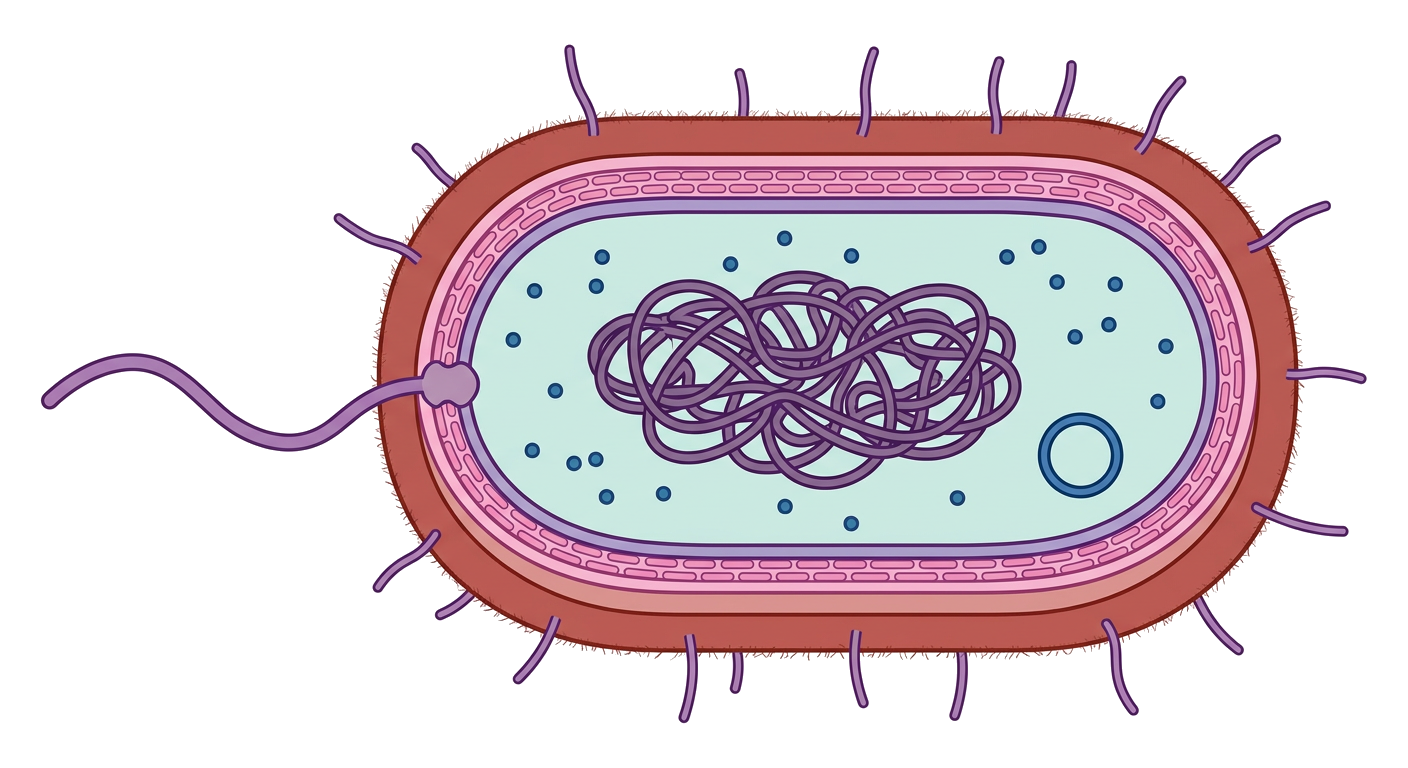
3. Identify two structures in the bacterial cell shown above that are crucial for its survival and briefly explain their functions.
Related Worksheets
Grade 12 Biology: Dissection Fundamentals
This worksheet covers essential concepts and practices in biological dissection, including safety, tool identification, and ethical considerations for Grade 12 Biology students.
Grade 12 Biology: The Integumentary System
This worksheet covers the structure, function, and common conditions of the human integumentary system for Grade 12 Biology students.
Grade 12 Biology: Heart Rate
This worksheet explores the physiological mechanisms regulating heart rate, factors influencing it, and methods of measurement for Grade 12 Biology students.
Grade 12 Non-Mendelian Inheritance Worksheet
Explore advanced concepts in genetics beyond simple Mendelian patterns, including incomplete dominance, codominance, multiple alleles, and polygenic inheritance.