Blood Groups: ABO and Rh Systems
Grade 12 Science worksheet covering the ABO and Rh blood group systems, inheritance patterns, and transfusion compatibility.
Includes
Standards
Topics
Blood Groups: ABO and Rh Systems
Name:
Date:
Score:
Read each question carefully and provide concise, accurate answers. For multiple-choice questions, circle the best option. For diagrams, label clearly.
1. Which of the following genotypes represents an individual with Type A blood?
I^A i
I^B I^B
ii
I^A I^B
2. An individual with Type O blood can receive blood from which donor type(s)?
Type A only
Type B only
Type O only
Type AB only
1. The presence of the Rh antigen on red blood cells indicates a person is Rh .
2. If a person has Type B blood, their plasma contains anti- antibodies.
3. The universal recipient blood type is .
1. Explain the concept of codominance using the ABO blood group system as an example.
2. Describe the potential dangers of an Rh incompatibility in pregnancy.
Refer to the blood type transfusion chart below to answer the following question.
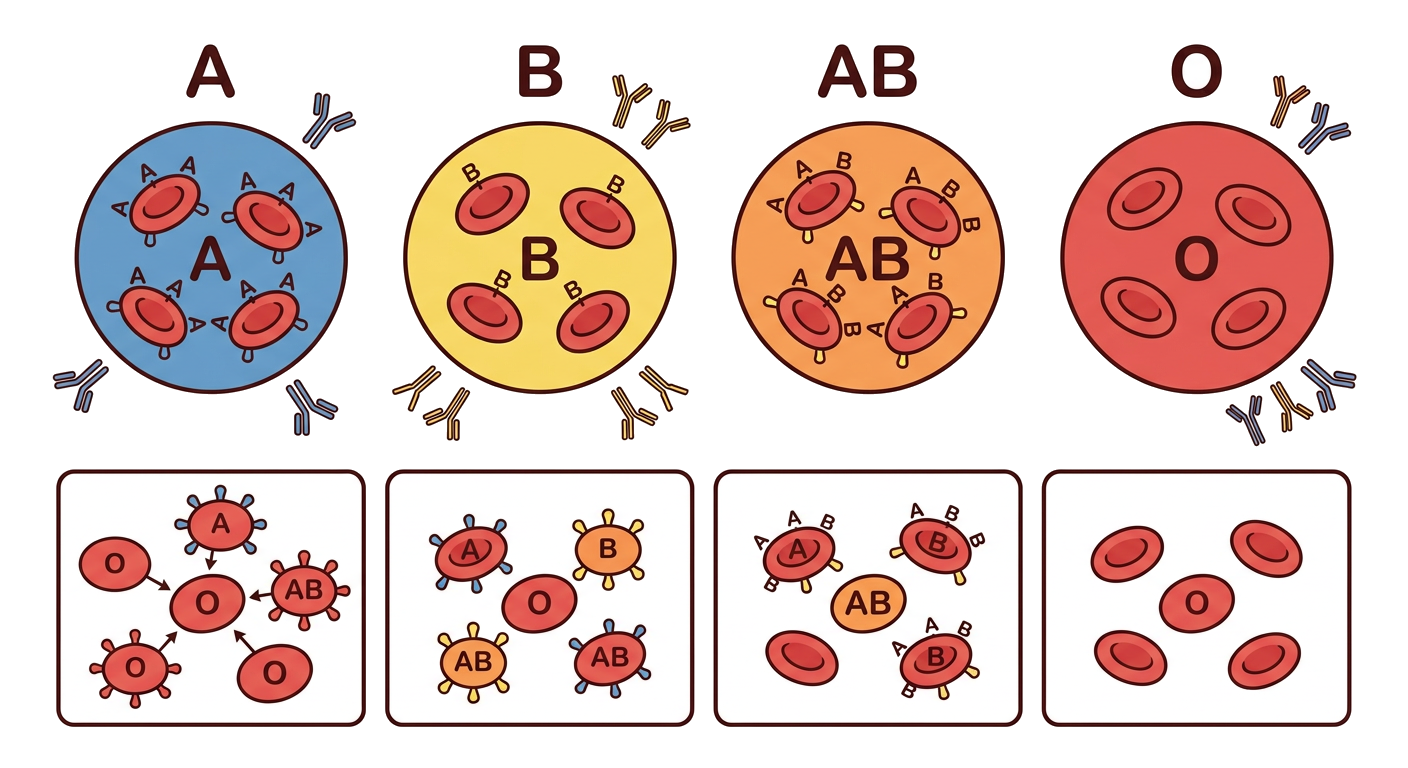
Based on the chart, if a patient has Type A- blood, which blood types can they safely receive?
1. An individual with Type AB blood has both A and B antigens on their red blood cells.
True
False
2. The Rh factor is determined by the presence or absence of the 'D' antigen.
True
False
Related Worksheets
Grade 12 Biology: Dissection Fundamentals
This worksheet covers essential concepts and practices in biological dissection, including safety, tool identification, and ethical considerations for Grade 12 Biology students.
Grade 12 Biology: The Integumentary System
This worksheet covers the structure, function, and common conditions of the human integumentary system for Grade 12 Biology students.
Grade 12 Biology: Heart Rate
This worksheet explores the physiological mechanisms regulating heart rate, factors influencing it, and methods of measurement for Grade 12 Biology students.
Grade 12 Non-Mendelian Inheritance Worksheet
Explore advanced concepts in genetics beyond simple Mendelian patterns, including incomplete dominance, codominance, multiple alleles, and polygenic inheritance.