DNA Fingerprinting Worksheet
Grade 12 Science worksheet covering the principles, techniques, and applications of DNA fingerprinting, including gel electrophoresis and RFLP analysis.
Includes
Standards
Topics
DNA Fingerprinting Worksheet
Name:
Date:
Score:
Read each question carefully and provide detailed answers based on your understanding of DNA fingerprinting. Use complete sentences and scientific terminology where appropriate.
1. Which of the following is the primary technique used in DNA fingerprinting to separate DNA fragments?
Polymerase Chain Reaction (PCR)
Gel Electrophoresis
DNA Sequencing
Restriction Fragment Length Polymorphism (RFLP)
2. What are the repeating sequences of non-coding DNA that are highly variable among individuals and are central to DNA fingerprinting?
Exons
Introns
Short Tandem Repeats (STRs)
Promoters
3. Restriction enzymes cut DNA at specific nucleotide sequences called sites.
4. The movement of DNA fragments through an agarose gel is primarily determined by their and .
5. In a typical gel electrophoresis setup, DNA fragments migrate towards the electrode because DNA is a charged molecule.
6. Briefly explain the principle behind DNA fingerprinting and why it is a powerful tool for individual identification.
7. Describe the role of PCR in DNA fingerprinting analysis for forensic samples.
8. DNA fingerprinting can definitively determine the exact age of an individual.
True
False
9. Identical twins have identical DNA fingerprints.
True
False
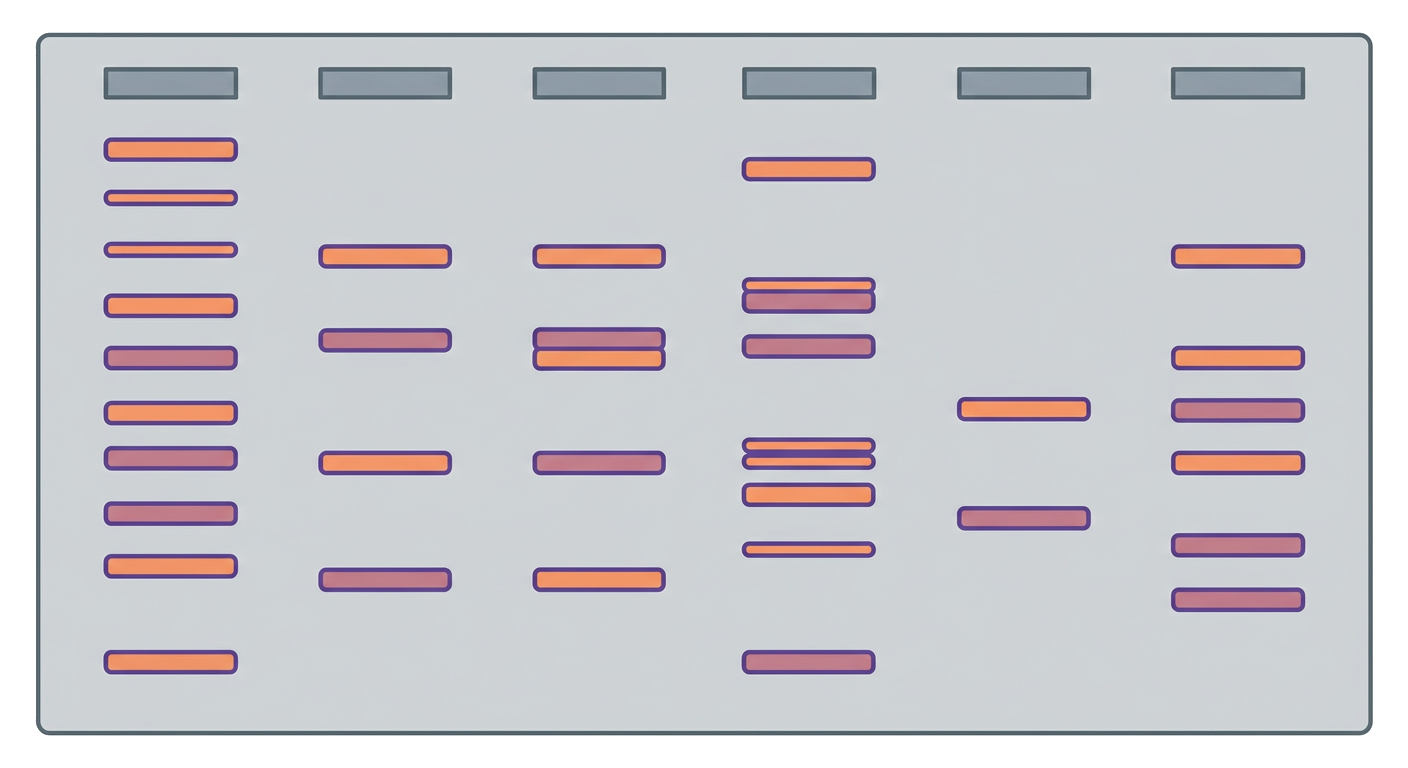
10. Analyze the provided gel electrophoresis image. If Lane 1 is a DNA ladder, Lane 2 is a suspect's DNA, and Lane 3 is DNA from a crime scene, determine if the suspect's DNA matches the crime scene DNA. Explain your reasoning.
Related Worksheets
Grade 12 Biology: Dissection Fundamentals
This worksheet covers essential concepts and practices in biological dissection, including safety, tool identification, and ethical considerations for Grade 12 Biology students.
Grade 12 Biology: The Integumentary System
This worksheet covers the structure, function, and common conditions of the human integumentary system for Grade 12 Biology students.
Grade 12 Biology: Heart Rate
This worksheet explores the physiological mechanisms regulating heart rate, factors influencing it, and methods of measurement for Grade 12 Biology students.
Grade 12 Non-Mendelian Inheritance Worksheet
Explore advanced concepts in genetics beyond simple Mendelian patterns, including incomplete dominance, codominance, multiple alleles, and polygenic inheritance.