Ecological Succession Worksheet
A Grade 12 science worksheet covering the concepts, types, and stages of ecological succession.
Includes
Standards
Topics
Ecological Succession
Name:
Date:
Score:
Read each question carefully and provide your best answer. Some questions may require critical thinking and application of concepts learned about ecological succession.
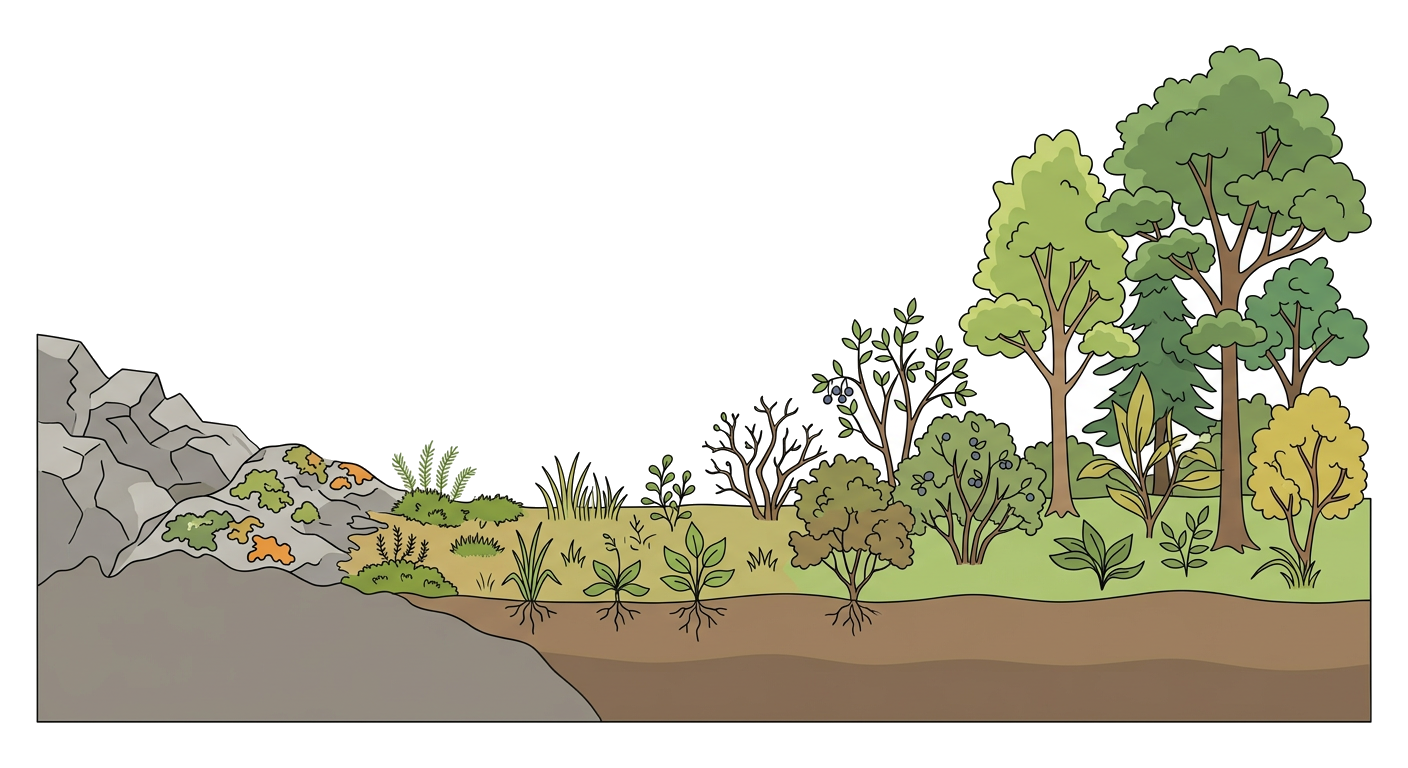
Ecological succession is the process of change in the species structure of an ecological community over time. The time scale can be decades (for example, after a wildfire), or even millions of years after a mass extinction. Below is an illustration showing different stages of succession.
1. Which of the following best defines primary succession?
Succession that occurs in an area where life has been removed but the soil remains.
Succession that occurs in an area where no soil exists, such as bare rock.
The process by which a climax community is maintained.
The gradual return of an ecosystem to its original state after a disturbance.
2. Pioneer species are crucial in primary succession because they:
Are typically large, slow-growing trees.
Quickly outcompete all other species.
Break down rock to form new soil.
Require rich, established soil to thrive.
3. The final, stable stage of ecological succession is known as a community.
4. Secondary succession is typically than primary succession because soil already exists.
5. A volcanic eruption creating new land is an example of secondary succession.
True
False
6. Human activities, such as clear-cutting forests, can initiate secondary succession.
True
False
7. Describe the key differences between primary and secondary succession, providing an example for each.
8. Explain the role of pioneer species in facilitating the establishment of subsequent species during primary succession.
Match each term with its correct definition.
9. Climax Community
a. The first species to colonize a barren environment.
10. Pioneer Species
b. A stable, mature ecological community that undergoes little further change.
11. Facilitation
c. The process by which one species makes an area suitable for species with different niche requirements.
Related Worksheets
Grade 12 Biology: Dissection Fundamentals
This worksheet covers essential concepts and practices in biological dissection, including safety, tool identification, and ethical considerations for Grade 12 Biology students.
Grade 12 Biology: The Integumentary System
This worksheet covers the structure, function, and common conditions of the human integumentary system for Grade 12 Biology students.
Grade 12 Biology: Heart Rate
This worksheet explores the physiological mechanisms regulating heart rate, factors influencing it, and methods of measurement for Grade 12 Biology students.
Grade 12 Non-Mendelian Inheritance Worksheet
Explore advanced concepts in genetics beyond simple Mendelian patterns, including incomplete dominance, codominance, multiple alleles, and polygenic inheritance.