Forensic Fingerprint Analysis
This worksheet covers advanced topics in forensic fingerprint analysis, including pattern types, classification systems, and methods of detection, suitable for Grade 12 Biology students.
Includes
Standards
Topics
Forensic Fingerprint Analysis
Name:
Date:
Score:
Read each question carefully and provide thorough answers. Use complete sentences and scientific terminology where appropriate.
1. Which of the following fingerprint patterns is characterized by one or more ridges entering from one side, recurring, and exiting from the same side?
Arch
Loop
Whorl
Accidental
2. The primary classification system for fingerprints, often referred to as the Henry Classification System, is based on the presence of which pattern type?
Arches
Loops
Whorls
All of the above
3. The study of fingerprints is known as .
4. Latent fingerprints are invisible to the naked eye and are typically developed using or chemical methods.
5. The unique minutiae points on a fingerprint, such as bifurcations and deltas, are crucial for individual .
6. Identical twins have identical fingerprints.
True
False
7. The dermal papillae are responsible for determining the ridge patterns of fingerprints.
True
False
8. Describe the three basic types of fingerprint patterns and provide a distinguishing characteristic for each.
9. Explain the principle of individuality as it applies to fingerprints.
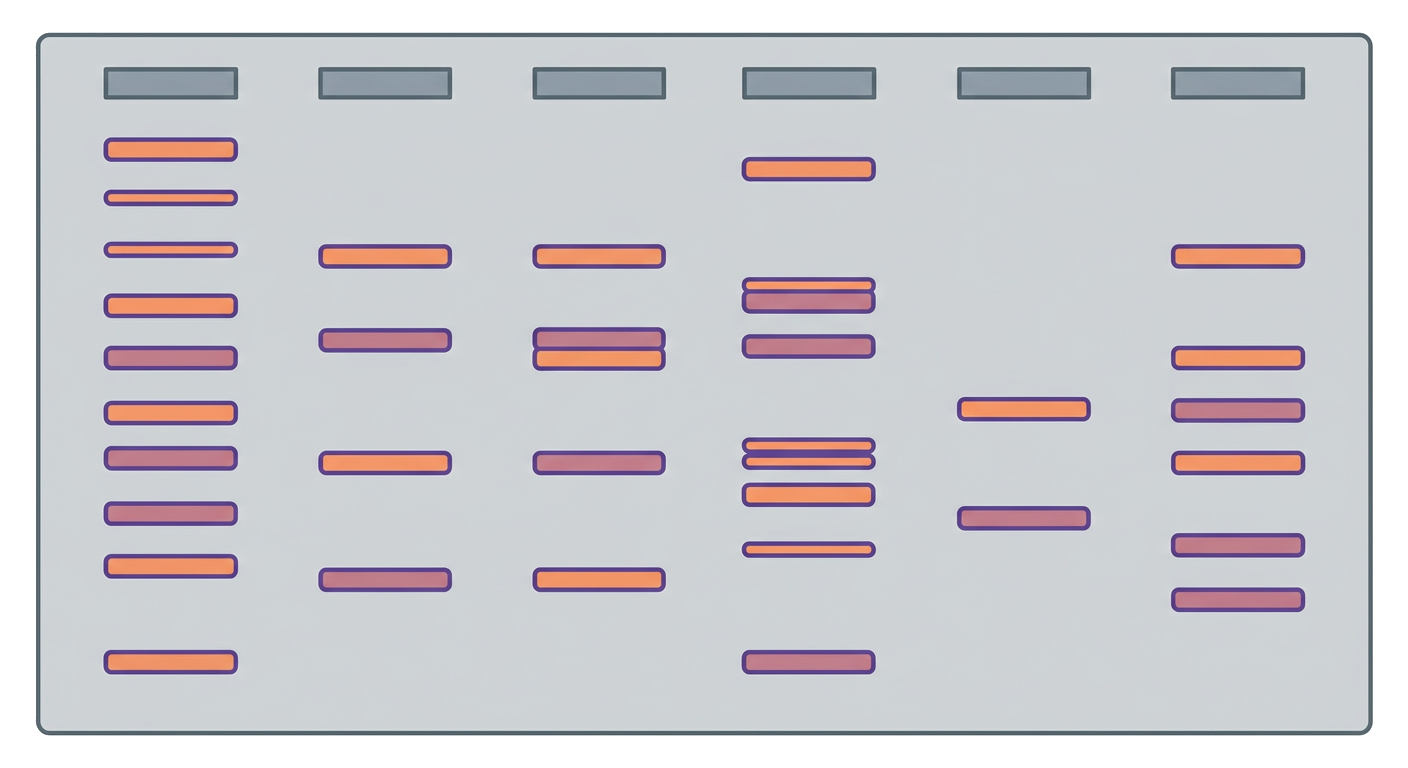
10. Analyze the provided DNA fingerprinting gel. Assuming Lane 1 is a crime scene sample and Lanes 2-4 are suspects, which suspect's DNA matches the crime scene?
Related Worksheets
Grade 12 Biology: Dissection Fundamentals
This worksheet covers essential concepts and practices in biological dissection, including safety, tool identification, and ethical considerations for Grade 12 Biology students.
Grade 12 Biology: The Integumentary System
This worksheet covers the structure, function, and common conditions of the human integumentary system for Grade 12 Biology students.
Grade 12 Biology: Heart Rate
This worksheet explores the physiological mechanisms regulating heart rate, factors influencing it, and methods of measurement for Grade 12 Biology students.
Grade 12 Non-Mendelian Inheritance Worksheet
Explore advanced concepts in genetics beyond simple Mendelian patterns, including incomplete dominance, codominance, multiple alleles, and polygenic inheritance.