Fossil Dating Worksheet
Explore the methods and principles of fossil dating, including relative and absolute dating techniques, for Grade 12 Biology students.
Includes
Standards
Topics
Fossil Dating: Understanding Earth's Past
Name:
Date:
Score:
Read each question carefully and answer to the best of your ability. This worksheet assesses your understanding of various fossil dating techniques and their applications.
1. Which dating method relies on the principle of superposition, where older layers of rock are found below younger layers?
Radiometric dating
Relative dating
Carbon-14 dating
Dendrochronology
2. What is the approximate half-life of Carbon-14?
5730 years
4.5 billion years
710 million years
1.3 billion years
3. The Law of states that in an undisturbed sequence of sedimentary rocks, the oldest layers are at the bottom and the youngest are at the top.
4. Absolute dating methods typically involve the use of isotopes.
5. Fossils used to define and identify geologic periods are known as fossils.
6. Radiometric dating can be used to date igneous rocks, but not sedimentary rocks directly.
True
False
7. The half-life of a radioactive isotope is affected by changes in temperature or pressure.
True
False
8. Explain the difference between relative dating and absolute dating methods.
9. Describe how the Law of Faunal Succession is used in relative dating.
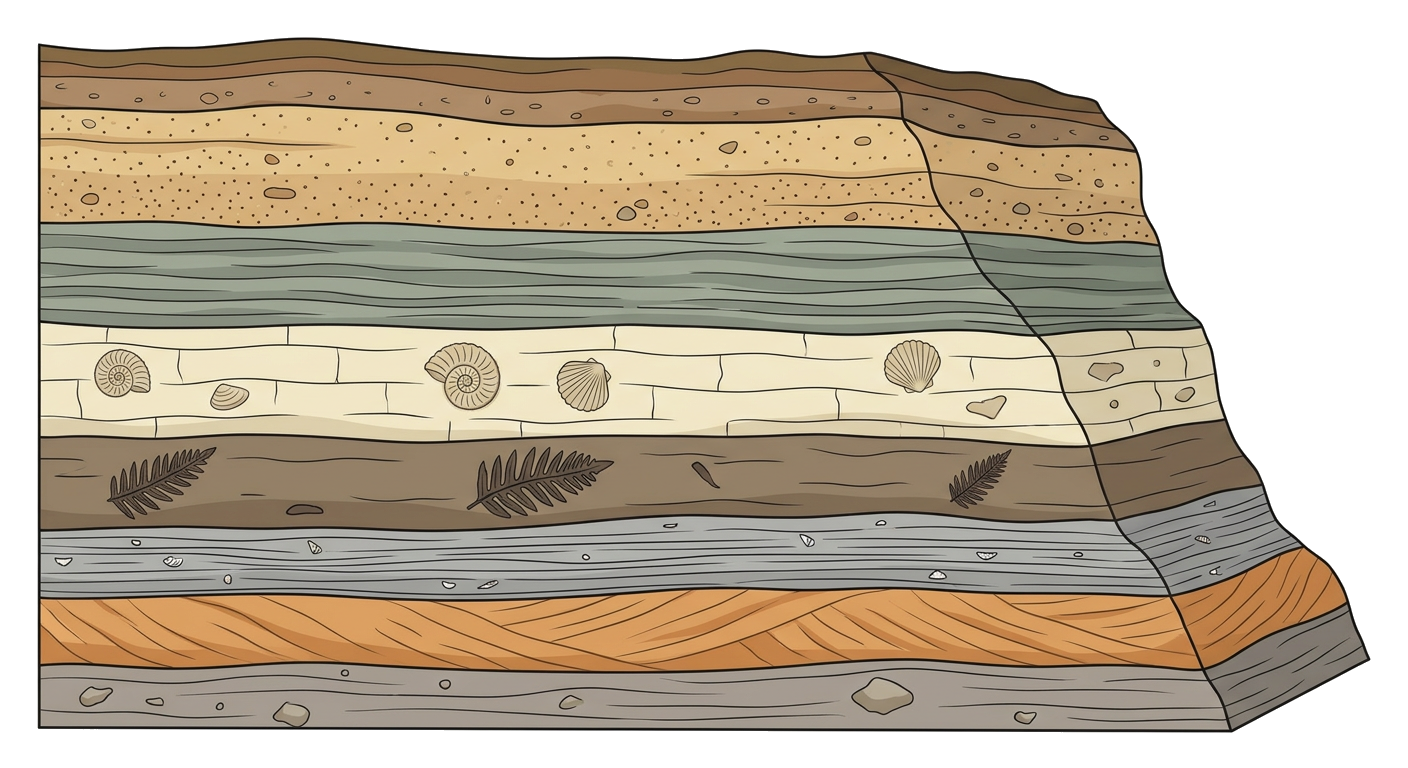
10. Observe the image of geological layers below. If Layer A is the oldest and Layer D is the youngest, arrange the fossils found in layers B, C, and D from oldest to youngest, and explain your reasoning.
Related Worksheets
Grade 12 Biology: Dissection Fundamentals
This worksheet covers essential concepts and practices in biological dissection, including safety, tool identification, and ethical considerations for Grade 12 Biology students.
Grade 12 Biology: The Integumentary System
This worksheet covers the structure, function, and common conditions of the human integumentary system for Grade 12 Biology students.
Grade 12 Biology: Heart Rate
This worksheet explores the physiological mechanisms regulating heart rate, factors influencing it, and methods of measurement for Grade 12 Biology students.
Grade 12 Non-Mendelian Inheritance Worksheet
Explore advanced concepts in genetics beyond simple Mendelian patterns, including incomplete dominance, codominance, multiple alleles, and polygenic inheritance.