Lung Volumes and Capacities Worksheet
A Grade 12 science worksheet covering lung volumes, capacities, and their physiological significance.
Includes
Standards
Topics
Lung Volumes and Capacities
Name:
Date:
Score:
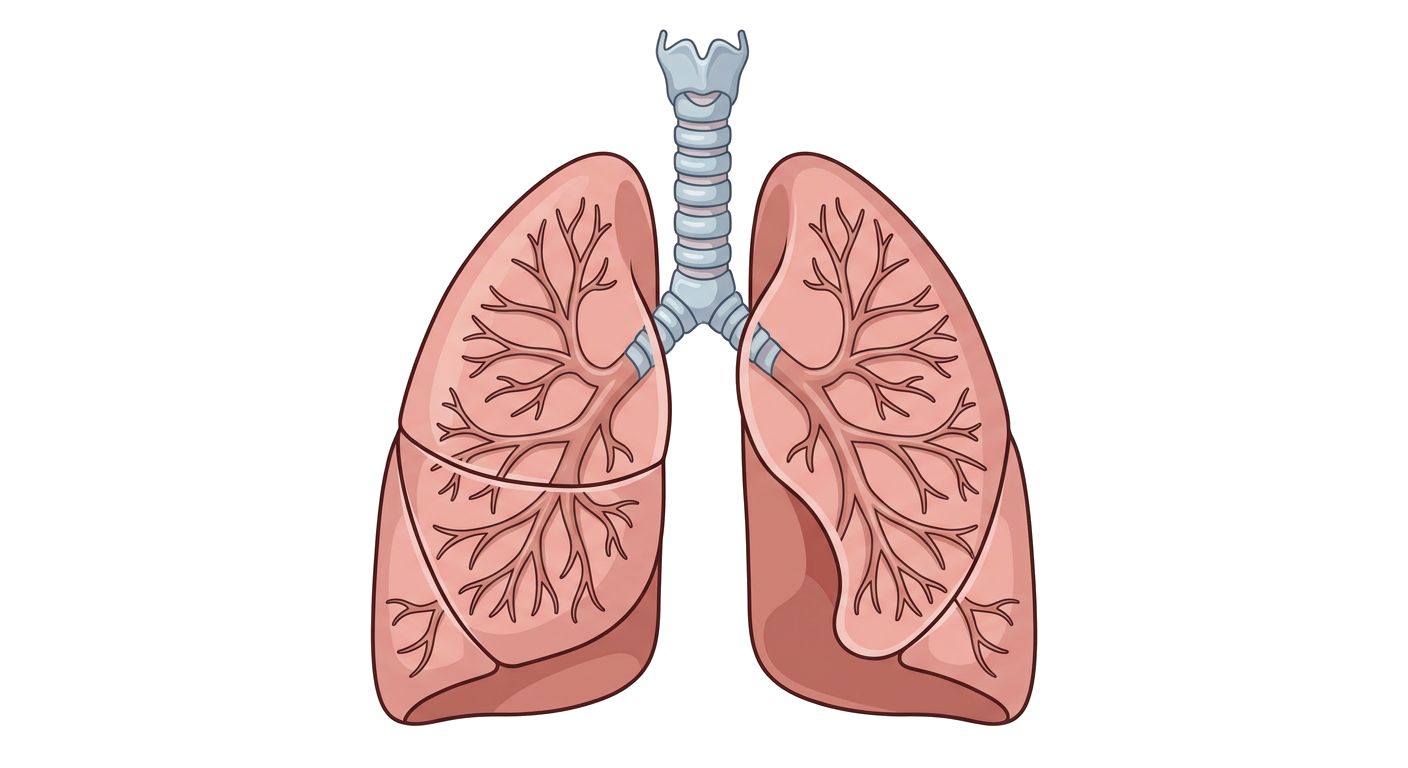
Read each question carefully and provide your best answer based on your knowledge of lung volumes and capacities. Refer to the diagram of the human lungs if needed.
Figure 1: Human Lungs
1. The volume of air inhaled or exhaled during a normal breathing cycle is called the .
2. After a maximal inhalation, the total amount of air that can be exhaled is known as the .
3. The air that remains in the lungs after a maximal exhalation is called the .
4. Which of the following lung capacities represents the sum of tidal volume, inspiratory reserve volume, and expiratory reserve volume?
Total Lung Capacity
Functional Residual Capacity
Vital Capacity
Inspiratory Capacity
5. A spirometer directly measures all of the following lung volumes EXCEPT:
Tidal Volume
Inspiratory Reserve Volume
Expiratory Reserve Volume
Residual Volume
6. Explain the difference between a lung volume and a lung capacity, providing an example of each.
7. Describe how an obstructive lung disease, such as asthma, might affect a person's Forced Expiratory Volume in 1 second (FEV1) and Forced Vital Capacity (FVC).
8. Functional Residual Capacity (FRC) is the amount of air remaining in the lungs after a normal expiration.
True
False
9. Inspiratory Reserve Volume (IRV) is typically larger than Expiratory Reserve Volume (ERV).
True
False
Match each lung volume/capacity with its correct description.
10. Tidal Volume (TV)
a. Maximum amount of air that can be inspired after a normal expiration.
11. Vital Capacity (VC)
b. Volume of air inspired or exhaled during a normal breath.
12. Inspiratory Capacity (IC)
c. Maximum amount of air that can be exhaled after a maximal inhalation.
Related Worksheets
Grade 12 Biology: Dissection Fundamentals
This worksheet covers essential concepts and practices in biological dissection, including safety, tool identification, and ethical considerations for Grade 12 Biology students.
Grade 12 Biology: The Integumentary System
This worksheet covers the structure, function, and common conditions of the human integumentary system for Grade 12 Biology students.
Grade 12 Biology: Heart Rate
This worksheet explores the physiological mechanisms regulating heart rate, factors influencing it, and methods of measurement for Grade 12 Biology students.
Grade 12 Non-Mendelian Inheritance Worksheet
Explore advanced concepts in genetics beyond simple Mendelian patterns, including incomplete dominance, codominance, multiple alleles, and polygenic inheritance.