Grade 12 Muscle Structure Worksheet
A comprehensive worksheet for Grade 12 Biology students covering the structure and function of muscle tissue, including sarcomeres, myofibrils, and the sliding filament theory.
Includes
Standards
Topics
Grade 12 Muscle Structure Worksheet
Name:
Date:
Score:
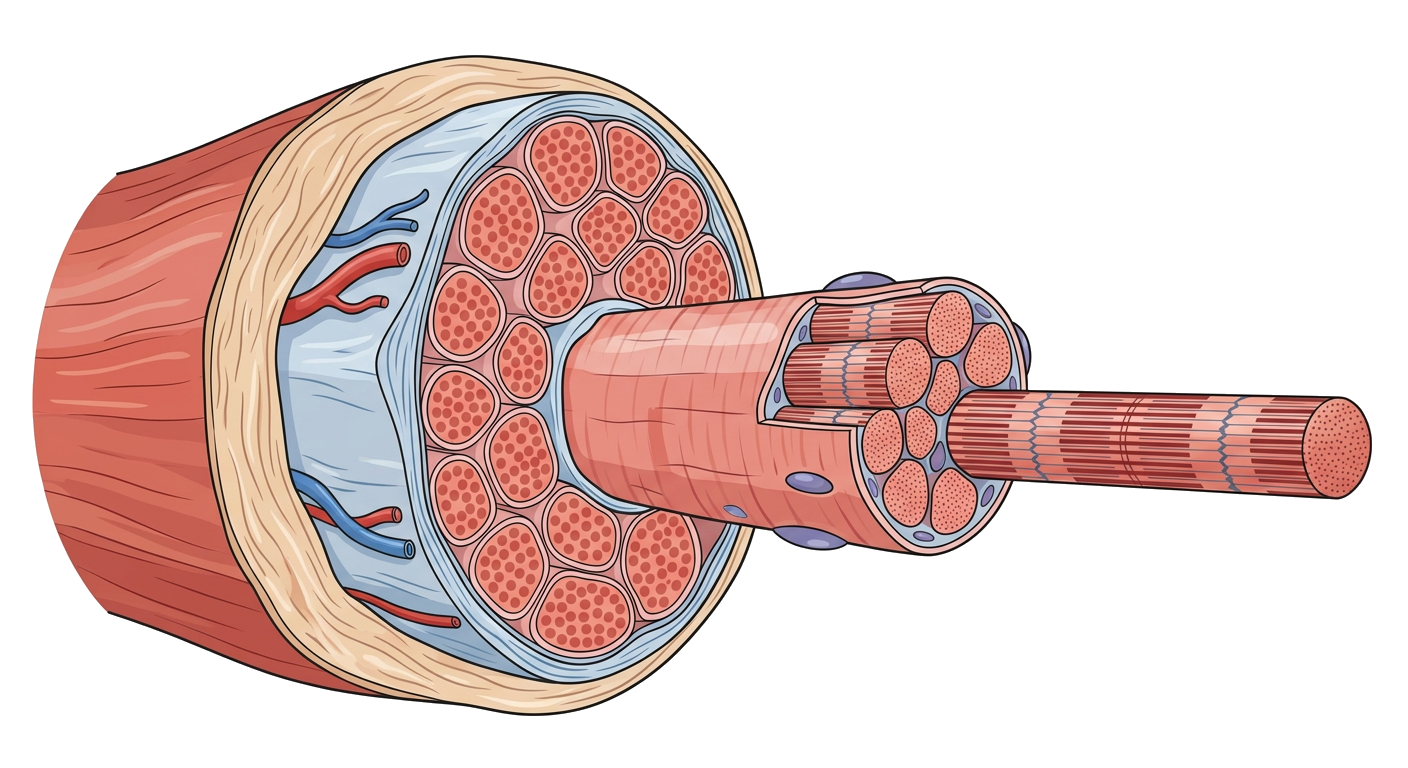
Read each question carefully and provide detailed answers based on your understanding of muscle structure and function. Refer to the provided illustration for Question 1.
1. Label the key components of the sarcomere shown below and describe the function of each labeled part in muscle contraction.
2. Which of the following is the primary protein component of thick filaments in a sarcomere?
Actin
Myosin
Troponin
Tropomyosin
3. The 'sliding filament theory' of muscle contraction involves:
Thick filaments shortening
Thin filaments shortening
Actin and myosin filaments sliding past each other
Z-discs moving further apart
4. The functional unit of a muscle fiber is the .
5. Calcium ions bind to , causing a conformational change that moves away from the actin binding sites.
6. The H-zone of a sarcomere contains only thin filaments.
True
False
7. ATP is required for both the contraction and relaxation phases of muscle activity.
True
False
8. Briefly explain the role of acetylcholine at the neuromuscular junction.
Related Worksheets
Grade 12 Biology: Dissection Fundamentals
This worksheet covers essential concepts and practices in biological dissection, including safety, tool identification, and ethical considerations for Grade 12 Biology students.
Grade 12 Biology: The Integumentary System
This worksheet covers the structure, function, and common conditions of the human integumentary system for Grade 12 Biology students.
Grade 12 Biology: Heart Rate
This worksheet explores the physiological mechanisms regulating heart rate, factors influencing it, and methods of measurement for Grade 12 Biology students.
Grade 12 Non-Mendelian Inheritance Worksheet
Explore advanced concepts in genetics beyond simple Mendelian patterns, including incomplete dominance, codominance, multiple alleles, and polygenic inheritance.